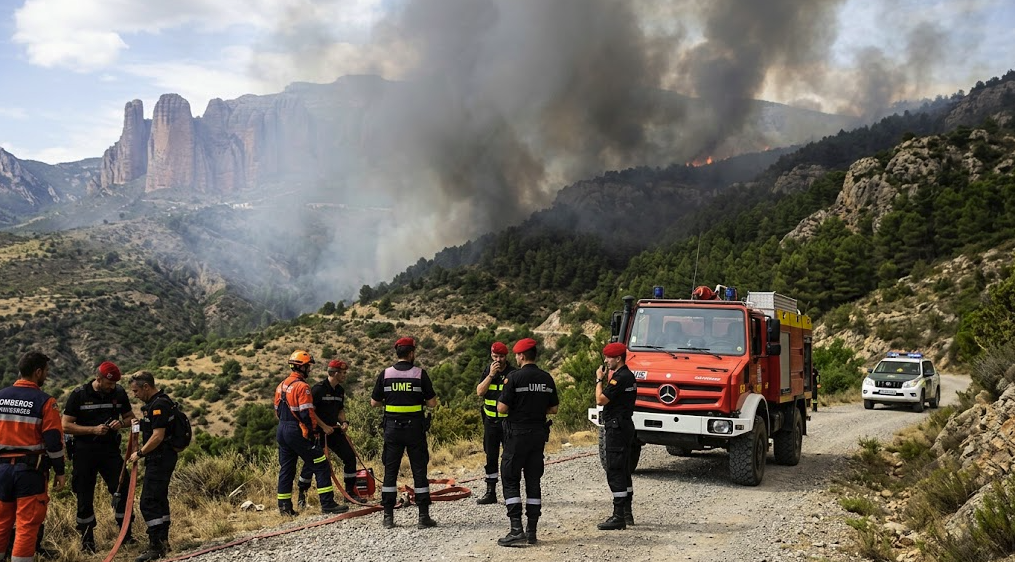

HUESCA – HIGRH NEWS: Las Peñas de Riglos wildfire has claimed the life of a member of Spain’s Military Emergencies Unit (UME) after the vehicle carrying four military personnel crashed while they were taking part in the firefighting operation in Huesca. Three other soldiers were injured, while around 1,000 emergency personnel and more than 40 aircraft continue to work against a blaze that has affected approximately 17,500 hectares. What is the latest situation on the ground?

Las Peñas de Riglos wildfire leaves UME soldier dead
A member of Spain’s Military Emergencies Unit died on Sunday during the operation to fight the Las Peñas de Riglos wildfire in Huesca, Aragón.
The accident happened in the Atarés ravine, close to Mount Oroel, an area known for its difficult and rugged terrain.

The vehicle carrying four UME personnel was involved in the accident while the soldiers were deployed as part of the firefighting operation.
One soldier died and the other three occupants suffered injuries.
The deceased soldier belonged to the UME’s Fourth Emergency Intervention Battalion, known as BIEM IV.
Two of the injured soldiers were taken to Jaca Hospital with minor injuries, while another was transferred to Miguel Servet University Hospital in Zaragoza.
Aragón government sources told Spain’s national broadcaster RTVE that the latter remained stable and out of danger.
The Ministry of Defence confirmed the soldier’s death while he was on duty and expressed its condolences to his family and colleagues.
The ministry also wished the injured personnel a speedy recovery.
The accident occurred as firefighters and emergency personnel were beginning to make some progress against the large wildfire.
Rain reached parts of the affected area and helped reduce the intensity of the fire in some sectors.
However, officials stressed that the improvement did not mean the emergency had ended.
The fire remains difficult to manage because of the size of the affected area, the rugged landscape and changing weather conditions.
The UME continues to work alongside civilian firefighters, regional emergency services and other authorities involved in the operation.
The fatal accident has added a tragic dimension to an already major emergency in Aragón.
The operation requires constant coordination between ground crews, aircraft and emergency command centres.
The death of the soldier has also prompted tributes from Spain’s political leaders and regional authorities.
Spanish Ministry of Defence — Military Emergencies Unit (UME)
Tributes to the soldier who died during the operation
The soldier’s death prompted messages of condolence from Spain’s political leadership.
Prime Minister Pedro Sánchez expressed his solidarity with the soldier’s family and colleagues.
He also paid tribute to members of the UME and emergency services working to contain the wildfire.
Opposition leader Alberto Núñez Feijóo also expressed his condolences to the family of the deceased soldier.
Feijóo wished the three injured personnel a speedy recovery.
Aragón regional president Jorge Azcón contacted the UME lieutenant general to convey his condolences.
Azcón expressed his support for the soldier’s family, colleagues and the wider UME community.
The Integrated Operational Coordination Centre, known as CECOPI, began its evening meeting with a minute’s silence for the deceased soldier.
Aragón institutions also announced a period of mourning.
The tributes came as emergency crews continued working across the wildfire perimeter.
The UME has been heavily involved in the response because of the scale of the emergency.
Its personnel are working alongside firefighters, police officers, civil protection teams and other emergency professionals.
The difficult terrain presents additional risks for personnel operating in affected areas.
The accident occurred during the firefighting operation itself, highlighting the demanding conditions faced by crews working in mountainous terrain.
Despite the tragedy, the emergency response continues.
Officials have repeatedly warned that improved weather conditions should not be interpreted as the end of the wildfire.
Crews must continue monitoring the perimeter and dealing with active sectors.
The priority remains protecting communities and consolidating the progress already achieved.
Las Peñas de Riglos wildfire affects approximately 17,500 hectares
The wildfire has affected approximately 17,500 hectares across the Huesca area.
The scale of the fire has prompted the deployment of around 1,000 personnel from different administrations.
More than 40 aircraft are also involved in the firefighting operation.
The Aragón regional government has described the deployment as the largest firefighting operation in the region’s history.
The size of the affected area has created major challenges for crews working on the ground.
Large wooded areas and rugged terrain make access to some sectors particularly difficult.
Weather conditions have also influenced the behaviour of the flames.
High temperatures and changing winds have complicated efforts to establish and maintain containment lines.
Rain has provided some relief in parts of the affected area.
Aragón’s regional interior minister Roberto Bermúdez de Castro said the fire was less intense than during the previous day.
However, he stressed that the situation remained difficult.
Fire crews are now concentrating on consolidating containment in the most challenging sectors.
They are also maintaining close surveillance around Mount Oroel.
Protecting nearby communities remains another key priority.
The authorities continue to monitor changing weather conditions because wind and temperature can quickly alter the behaviour of a wildfire.
The large size of the fire also means that crews cannot simply concentrate on one location.
Resources have to be distributed across several sectors according to the latest conditions.
Aircraft provide support in areas that are difficult for ground teams to reach.
Ground crews, meanwhile, continue strengthening containment lines and monitoring potential hotspots.
The operation therefore remains active despite the improvements recorded in some areas.
French firefighters reinforce the wildfire response
The firefighting operation has received international assistance from France.
Around 100 French firefighters arrived in Aragón on Sunday afternoon to reinforce the Spanish response.
They were due to begin working directly on the wildfire from Monday.
Their arrival adds further capacity to an operation that already includes approximately 1,000 personnel.
International assistance can provide additional resources when a major emergency places significant demands on regional firefighting teams.
The French firefighters are joining Spanish crews operating in different sectors of the affected area.
The response is coordinated through the Integrated Operational Coordination Centre.
The centre assesses the latest developments and determines operational priorities.
Protecting populated areas remains one of the main objectives.
Emergency authorities are also monitoring infrastructure and cultural heritage sites located close to the wildfire.
The arrival of additional personnel gives commanders more resources to maintain operations across the large fire perimeter.
However, officials continue to stress the complexity of the emergency.
The terrain remains difficult and the weather can change quickly.
Rain has helped some sectors, but emergency teams must continue monitoring the fire for signs of renewed activity.
The operation therefore remains focused on containment rather than declaring the emergency over.
Evacuations affect more than 1,000 people
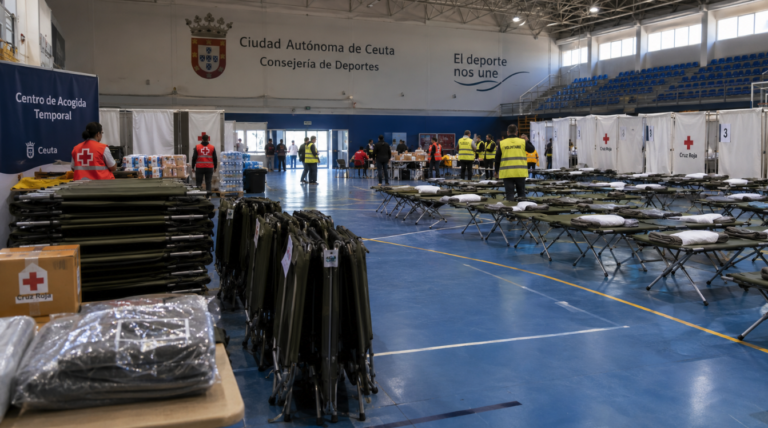
The wildfire has forced authorities to evacuate 19 communities and three camps.
A total of 1,046 people have been forced to leave their homes or accommodation because of the fire.
Authorities have also closed roads and reported disruption to parts of the regional railway network.
The restrictions have affected residents as well as people travelling through the area.
The return of evacuated residents will depend on the evolution of the fire and the safety conditions in each location.
Authorities must establish that roads are safe and that communities no longer face an immediate threat before allowing people to return.
The improvement in some areas has allowed officials to assess whether certain restrictions can eventually be lifted.
However, evacuation decisions remain linked to local conditions.
Emergency crews continue to monitor sectors where the fire could potentially regain strength.
The large perimeter means that authorities need to maintain surveillance even in areas where flames have become less intense.
The safety of evacuated residents remains a central priority.
Officials have continued to urge caution while firefighting operations remain active.
The fire has also created challenges for the protection of important cultural sites.
Among the locations receiving particular attention is the historic San Juan de la Peña monastery complex.
San Juan de la Peña heritage site remains under protection
The wildfire has threatened the surroundings of the historic monasteries of San Juan de la Peña.
The site is one of Aragón’s most important historical and religious landmarks.
The older monastery dates back to the medieval period and is closely linked to the history of the former Kingdom of Aragón.
The site is also associated with the tradition of the Holy Grail.
As the wildfire approached, authorities took preventive measures to protect important historical material.
The remains of some of the early kings of the medieval Kingdom of Aragón were removed from the site as a precaution.
The operation has therefore involved protecting both communities and cultural heritage.
UME personnel have taken part in emergency measures in the wider area.
The surroundings of Mount Oroel and San Juan de la Peña remain under close observation.
Although rainfall has improved conditions in certain areas, authorities have not ended the emergency response.
Weather remains an important factor.
Changes in wind direction, temperature and humidity can influence the behaviour of the fire.
For this reason, emergency teams continue to assess the situation sector by sector.
Protecting the historic site remains part of the wider effort to limit the consequences of the wildfire.
Investigation into the origin of the wildfire
The Guardia Civil is investigating the circumstances surrounding the start of the wildfire.
Authorities have arrested a person suspected of starting the fire.
The investigation will examine the circumstances surrounding the outbreak and establish any responsibilities supported by the evidence.
The investigation is continuing alongside the firefighting operation.
While emergency crews focus on containing the fire, investigators are examining how it began.
The scale of the wildfire makes determining its origin an important part of the wider response.
However, the arrest does not by itself establish final criminal responsibility.
The judicial process must determine the facts and any responsibilities arising from them.
Investigators will continue gathering evidence while firefighters remain deployed.
The emergency response and the investigation are therefore taking place simultaneously.
For now, authorities remain focused on protecting people, property and the environment while working to contain the fire.
Las Peñas de Riglos wildfire enters a critical phase
Emergency crews are now concentrating on consolidating the containment achieved in the most difficult sectors.
They are also maintaining surveillance around Mount Oroel and protecting nearby communities.
Rain has helped reduce fire activity in some areas, but officials have stressed that the emergency is not over.
The rugged terrain remains one of the biggest challenges facing ground crews.
Extensive wooded areas make it difficult to establish and maintain containment lines across the entire affected area.
Changing weather conditions add another element of uncertainty.
The deployment of around 1,000 personnel allows crews to work across multiple sectors.
More than 40 aircraft are supporting the operation from the air.
The arrival of French firefighters has provided an additional international reinforcement.
Coordination between the different emergency services remains essential.
The immediate objective is to prevent the fire from advancing into new areas.
Authorities must also continue assessing conditions before allowing evacuated residents to return.
The death of the UME soldier has cast a shadow over the operation.
He died while carrying out his duties as part of the response to the wildfire.
Three colleagues were injured in the same accident.
The emergency services continue working in difficult conditions while mourning the loss of a colleague.
The firefighting operation remains active as authorities assess the evolution of the fire across its extensive perimeter.
Frequently Asked Questions
Where did the accident happen?
The accident happened in the Atarés ravine, near Mount Oroel in Huesca.
How many military personnel were affected?
One UME soldier died and three others were injured in the accident.
How large is the wildfire?
The fire has affected approximately 17,500 hectares.
How many people have been evacuated?
Authorities have evacuated 1,046 people from 19 communities and three camps…….MORE