
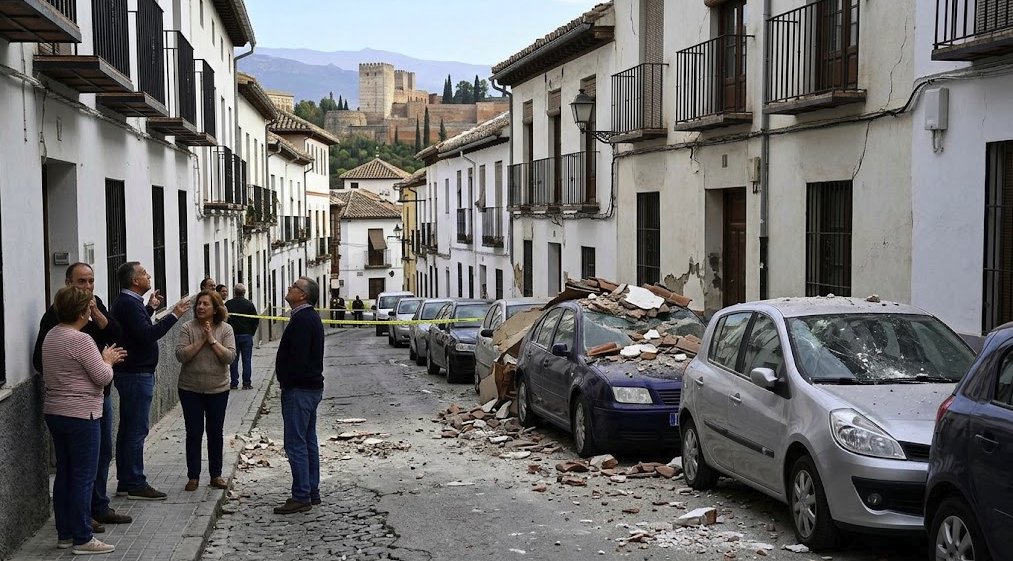

GRANADA – HIGRH NEWS: earthquake in Granada caused three minor injuries and material damage after a strong tremor struck southern Spain on Tuesday morning. Falling debris damaged several vehicles, while some facilities temporarily suspended their activities and numerous residents left their homes as a precaution. What happened during the earthquake, and what were its main consequences?

The earthquake originated near Alhendín
Spain’s National Geographic Institute (IGN) recorded the earthquake at 10:37 local time and placed its epicentre approximately 10 kilometres south of Granada, near the town of Alhendín.
The earthquake measured magnitude 4.8, with its focus at a depth of less than 10 kilometres. The movement was felt across parts of the area and prompted an immediate reaction among local residents.

Many people left their homes and remained outside because they feared further shaking. Concern was also linked to the seismic activity recorded in the area during the previous days.
The IGN said the event formed part of a sequence of very shallow earthquakes that had begun on Friday. Residents had widely felt those earlier tremors.
The available information confirmed three people with minor injuries. The earthquake also caused material damage to buildings, while several vehicles suffered damage after debris fell during the shaking.
The initial assessment did not provide a final number of affected buildings or an estimate of the financial cost of the damage. Those figures therefore cannot be established from the available information.
The earthquake also affected the operation of several public facilities. Some museums, administrative buildings and sports centres had to close following the tremor.
The measures focused on the safety of workers, visitors and users while the condition of the affected locations was assessed.
For official information about earthquakes recorded in Spain, readers can consult the National Geographic Institute.
Residents react as the shaking causes alarm
The earthquake caught people by surprise during the morning and caused scenes of concern across Granada.
Numerous residents left their homes shortly after the shaking began. Fear of possible aftershocks led many people to remain outside their buildings.
Alfonso Malpica, a Granada resident, told El País about his experience inside his ground-floor flat.
He said the movement felt stronger than other occasional earthquakes that residents in the area have experienced.
His account reflects the impression left on some residents, who distinguished this tremor from other seismic movements they had previously experienced.
Cristina Ruiz López experienced the earthquake while she was inside a supermarket in Granada. The laboratory worker told AFP that the situation was terrifying and that several objects fell during the shaking.
The accounts from residents accompanied the initial official figures: three people suffered minor injuries and material damage was reported.
Falling debris also damaged several cars. The information available does not provide an exact number of affected vehicles.
Several facilities suspend their activities
The earthquake also disrupted activity at several locations across the city.
Museums, administrative buildings and sports centres closed their doors following the tremor. The available information does not specify how many facilities were affected or exactly how long they remained closed.
The decisions allowed access to remain restricted while the situation was assessed after the earthquake.
In a city with major cultural and tourist activity, the disruption was particularly significant.
The most prominent case involved the Alhambra, one of Granada’s best-known historic landmarks.
The Alhambra suspends visits during the afternoon
Administrators of the Alhambra announced that the historic complex would remain closed during the afternoon following the earthquake.
The UNESCO World Heritage site is one of Granada’s main tourist attractions and receives millions of visitors from around the world every year.
The Alhambra is also one of the most recognised examples of medieval Islamic architecture and represents a central part of Granada’s historic heritage.
The decision affected visitors who had planned to enter the complex that day and came after the strong morning tremor.
However, the temporary closure should not be presented as confirmation of specific damage to the monument. The information available states that administrators decided to keep the site closed during the afternoon, but it does not provide a specific assessment of damage inside the Alhambra.
It is therefore not possible to confirm particular damage to the complex based on the information provided.
The closure formed part of the precautions taken at different locations in Granada following the earthquake.
The suspension of visits came alongside closures at museums, administrative buildings and sports centres.
The earthquake therefore affected both everyday life for residents and the operation of some of the city’s most important cultural sites.
Granada’s urban transport changes its operation after the tremor
The earthquake also affected Granada’s metropolitan transport network.
Granada Metro announced that trains would operate at a maximum speed of 30 kilometres per hour for safety reasons.
The reduction could cause delays for passengers. The network warned users about the possibility of disruptions while trains operated under the temporary restrictions.
The measure was introduced alongside other precautions across the city.
While some residents remained outside their homes and several facilities stayed closed, public transport continued operating under the reduced speed limit.
The available information does not establish how long the restriction would remain in place.
What is confirmed is that the Metro introduced the measure after the earthquake and warned passengers that delays could occur.
The tremor therefore had consequences beyond buildings and homes directly affected by the shaking.
A series of tremors preceded the stronger event
The earthquake recorded on Tuesday morning occurred after several tremors had been detected in the area since Friday.
The National Geographic Institute described the earlier movements as very shallow and said they had been widely felt.
The preceding seismic activity contributed to residents’ concern when the stronger tremor occurred.
The epicentre of the magnitude 4.8 earthquake was located near Alhendín, with a depth of less than 10 kilometres, according to the IGN.
The official data established the approximate location and magnitude of the earthquake, while residents’ accounts illustrated how strongly the movement was experienced in different parts of Granada.
The sequence of tremors also prompted residents to remain alert to the possibility of further movement.
However, the available information does not establish how the seismic activity would develop afterwards, nor does it allow predictions about future earthquakes. For that reason, the report remains limited to confirmed facts.
At the time covered by the available information, the earthquake had left three people lightly injured and caused material damage.
It had also led to temporary measures at public facilities, cultural sites and the metropolitan transport network.
Buildings and vehicles suffer material damage
Among the confirmed consequences of the earthquake were damage to several vehicles.
Falling debris from buildings caused damage to cars, although the available information does not state the exact number of affected vehicles.
Several buildings also suffered damage, but the initial assessment did not provide a complete list of affected properties.
That lack of information makes it impossible to quantify the total extent of the material damage.
Public facilities responded by introducing safety measures. Museums, administrative buildings and sports centres temporarily suspended their activities, while the Alhambra announced its afternoon closure.
Granada Metro introduced a speed restriction and warned passengers about possible delays.
The measures reflected the immediate response of a city that had experienced a clearly noticeable earthquake.
Residents reacted by leaving their homes and seeking to remain outdoors because of concerns about further shaking.
Accounts collected by news organisations described a frightening experience, including objects falling inside commercial premises.
With a magnitude of 4.8, the earthquake became the most significant event within the sequence of tremors recorded in the area during the preceding days.
Granada remains attentive to seismic activity
The earthquake left three people lightly injured, caused material damage and resulted in temporary changes to several services.
The epicentre was located near Alhendín, around 10 kilometres from Granada, while the focus was less than 10 kilometres below the surface.
The National Geographic Institute placed the event within a sequence of earthquakes that had started on Friday.
On the streets, numerous residents responded to the shaking by leaving their homes. Several accounts described the movement as particularly intense.
The damage affected buildings and vehicles, while various facilities interrupted their activities.
The Alhambra remained closed during the afternoon and Granada Metro reduced the operating speed of its trains to 30 kilometres per hour.
The available information does not provide a complete assessment of all damage or an estimate of the financial losses.
Any further assessment would therefore require additional inspections or official information establishing the full extent of the damage.
The facts currently available confirm the human and material impact of the earthquake, as well as the measures adopted at several locations in Granada.
Frequently asked questions about the Granada earthquake
How strong was the earthquake?
The earthquake reached magnitude 4.8, according to the National Geographic Institute.
Where was the epicentre?
The epicentre was approximately 10 kilometres south of Granada, near Alhendín.
How many people were injured?
Three people suffered minor injuries, according to the available information.
What happened after the earthquake?
Some public facilities closed, the Alhambra remained closed during the afternoon and Granada Metro temporarily reduced the speed of its trains…….MORE