
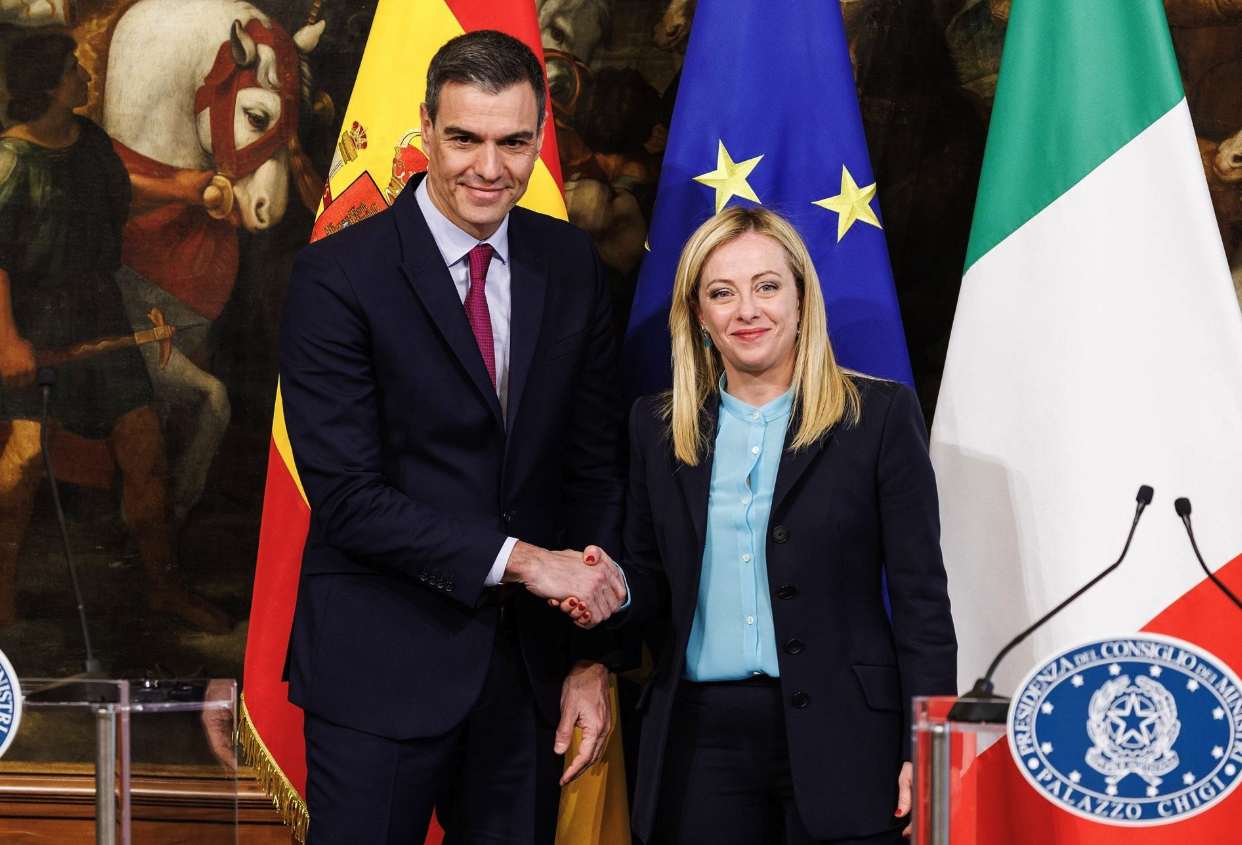

Italy and Spain Move to Ease Border Dispute After Meloni–Sánchez Talks
Italy Extends Border Checks for Seven Days
The latest extension marks a change from Italy’s previous decisions to renew the controls for 15 days at a time.

Rome initially introduced the temporary checks on August 1 following the arrival of almost 90,000 irregular migrants in the Spanish North African enclave of Ceuta, according to the information reported during the dispute.
The Italian government subsequently renewed the restrictions on three occasions, effectively reintroducing checks on travel connections with Spain despite the general principle of free movement within the Schengen area.

Spain responded with reciprocal measures, arguing that Italy’s decision was unjustified. The latest Spanish extension was due to expire on October 22.
By aligning the deadlines, the two governments have created an opportunity to coordinate their next steps and prevent the dispute from escalating further.
The seven-day extension does not, however, mean that all border checks have already been lifted.
Interior Ministers to Explore Alternatives
Diplomatic sources cited in the original report indicated that the interior ministers of both countries were expected to discuss alternative arrangements the following week.
The immediate challenge is to find a solution that addresses Italy’s stated security concerns without prolonging a disagreement that has strained relations between two EU member states.
The checks take place at airports and ports because Italy and Spain do not share a land border. Travellers may therefore face additional document checks while the temporary measures remain in force.
The outcome of the ministerial discussions will be important in determining whether the countries can move towards ending the restrictions or whether further extensions will be considered.
Nearly 500,000 People Checked in the First Month
Figures cited by Italy’s interior minister indicate that authorities checked almost 500,000 people during the first month of the controls.
Of those checked, 31 people were refused entry, including eight Moroccan nationals.
The available figures do not establish how many of those refused entry had arrived in Ceuta during the migration surge that prompted the restrictions.
Spain’s government, meanwhile, maintained that no irregular migrants had moved from Ceuta to mainland Spain.
These figures offer an indication of the scale of the checks, but they do not demonstrate that the measures reduced irregular migration. The number of people checked is not the same as the number of irregular migrants identified, and the published figures do not establish a direct link between the controls and the arrivals in Ceuta.
Why the Dispute Matters for the Schengen Area
The disagreement touches on one of the European Union’s central principles: the free movement of people across internal borders.
The Schengen framework generally allows people to travel between participating countries without routine internal border checks. However, EU rules permit temporary controls to be reintroduced in specific circumstances, subject to applicable legal requirements.
Italy has defended its measures on security grounds, citing concerns related to the situation in Ceuta and the protection of European borders.
Spain has challenged the need for the restrictions, arguing that the situation did not justify imposing additional checks on arrivals from its territory.
The dispute highlights the tension between national governments seeking greater control over migration and the EU’s commitment to maintaining free movement among its members.
It also raises practical questions about how governments should coordinate temporary border measures when their assessments of a security or migration situation differ.
Migration Returns to the Centre of the EU Debate
The dispute comes as European leaders discuss migration at the European Council summit in Brussels on October 15 and 16. The Council’s published agenda confirms that migration is among the strategic issues scheduled for discussion.
Meloni, who leads a right-wing government, and Sánchez, who heads a centre-left administration, have repeatedly taken different positions on migration policy.
Spain’s proposed regularisation of approximately 600,000 undocumented migrants is another issue expected to feature in the wider European debate, according to the information provided in the original report.
Some governments have expressed concern that such a measure could encourage further irregular arrivals or create pressure on other EU countries. These concerns remain political arguments about potential consequences and should not be treated as proof that a so-called pull factor will necessarily occur.
The discussions in Brussels provide an opportunity for leaders to address these differences, but they do not automatically produce a common migration policy or resolve individual disputes between member states.
What the Latest Developments Mean for Travellers
For people travelling between Italy and Spain, the short extension means that additional checks may continue while the temporary arrangements remain active.
Travellers should:
Carry a valid passport or national identity document, as applicable to their nationality and circumstances.
Check official travel advice and updates from the relevant authorities before departure.
Allow additional time for document checks where necessary.
Avoid assuming that the restrictions have ended until their formal withdrawal is confirmed.
The practical impact will depend on the measures in force at the time of travel and how authorities implement them at airports and ports.
HIGRH NEWS Editorial Analysis
The decision to extend the controls for only seven days is a constructive sign, but it should be viewed as a diplomatic opening rather than a final settlement.
Italy and Spain have a shared interest in managing migration effectively while maintaining cooperation within the European Union. Prolonged reciprocal restrictions risk creating unnecessary uncertainty for travellers and turning disagreements over migration into wider diplomatic problems.
The next step should be a transparent agreement that clarifies the conditions under which temporary controls can be introduced, the evidence required to justify them and the process for coordinating decisions between governments.
Ultimately, a durable solution will depend on more than aligning expiry dates. It will require both countries to establish a workable approach to border security and migration that respects EU rules and avoids unnecessary disruption to cross-border travel.
For now, the latest move offers grounds for cautious optimism, but the final outcome remains uncertain.
Official Sources
European Council — European Council meeting, October 15–16, 2026: Official meeting page.
Italian Ministry of the Interior — Spain: Border checks extended for 15 days, September 30, 2026: Official statement.
Italian Ministry of the Interior — Ceuta: Border checks extended for 15 days, September 15, 2026: Official statement.
Spanish Ministry of the Interior — Schengen Agreement and temporary internal border controls: Official information.