
Spain to Release Another 4.4 Million Barrels of Oil from Strategic Reserves in October
Spain will release an additional 4.4 million barrels of oil from its strategic reserves in October as part of a coordinated response by the International Energy Agency (IEA) to supply disruptions linked to the crisis in the Middle East. The move aims to increase the availability of petroleum products, ease pressure on international markets and help limit further fuel price increases.

The release forms part of Spain’s commitment to the emergency plan agreed in March, when IEA member countries decided to make 400 million barrels available to the market over 90 days. However, the additional supply does not guarantee an immediate reduction in petrol or diesel prices, which also depend on crude oil quotations, refining costs, distribution expenses and taxes.
Spain accelerates the release of its strategic oil reserves
Spain’s Ministry for the Ecological Transition and the Demographic Challenge has indicated that IEA member countries decided to accelerate the release of the remaining reserves in response to conditions in international energy markets.

The latest phase adds 4.4 million barrels to the volumes already made available under Spain’s original commitment. The government initially authorised the release of up to 11.5 million barrels of petroleum products, with deliveries scheduled in stages rather than through a single operation.
According to the information provided for this announcement, slightly more than three million barrels of Spain’s initial commitment would remain pending after the latest releases. The final amount and timing could depend on further assessments of international supply conditions.
The distinction between the original commitment and the quantities actually released is important: the 11.5 million barrels represented the maximum authorised volume, while the staged schedule allowed the authorities to adapt the operation to changing market conditions.
How much oil will Spain release?
The October release is part of a broader international effort to address disruptions to oil supplies. The main figures associated with Spain’s commitment are summarised below.
| Measure | Volume |
|---|---|
| Spain’s initial authorised commitment | Up to 11.5 million barrels |
| Volume released in the first phase | 3.75 million barrels |
| Additional release planned for October | 4.4 million barrels |
| Remaining volume indicated in the supplied information | Slightly more than 3 million barrels |
These figures refer to different stages of the plan and should not be treated as a definitive accounting of completed deliveries without an updated official breakdown.
Spain’s original plan also covered several categories of petroleum products, rather than crude oil alone. The announced allocation included approximately 2.2 million barrels of gasoline, nine million barrels of middle distillates, including automotive diesel and aviation kerosene, and around 297,000 barrels of fuel oil.
This composition matters because the impact of an emergency release depends not only on the total volume but also on which products reach the market and where supply shortages are most severe.
Why the IEA is releasing emergency oil stocks
The coordinated release is intended to cushion the impact of disruptions to global oil supplies caused by the Middle East conflict, particularly restrictions affecting shipping through the Strait of Hormuz.
On 11 March, the 32 members of the IEA agreed to make 400 million barrels available to the market. The organisation described the decision as the largest coordinated oil-stock release in its history. The disruption has affected both crude oil and refined petroleum products, with diesel supplies facing particular pressure.
In its statement on 15 October, the IEA said approximately 330 million barrels had been released and agreed to accelerate the remaining deliveries. It also highlighted plans to release more than 20 million barrels of diesel as soon as possible.
The strategy is designed to provide temporary relief while normal supply routes recover. Emergency stocks can help bridge a supply gap, but they cannot independently resolve the geopolitical causes of the disruption.
Will petrol and diesel prices fall in Spain?
The additional supply could help moderate price pressures, but motorists should not assume that petrol and diesel prices will automatically fall.
Several factors influence the price drivers pay at Spanish filling stations:
International oil prices: Changes in global crude benchmarks affect the cost of purchasing oil.
Refining capacity: Crude oil must be processed into usable fuels, and shortages of refined products can persist even when crude supplies improve.
Transport and distribution costs: Shipping disruptions and higher freight costs can offset some benefits of additional supply.
Taxes and retail margins: These also contribute to the final price paid by consumers.
Diesel deserves particular attention because the IEA has identified tighter diesel markets as a continuing concern. The organisation’s October Oil Market Report also highlighted the economic impact of restricted product availability and elevated fuel prices.
For households, businesses and transport operators, the main potential benefit is improved supply security and reduced pressure on fuel costs. The actual impact will depend on how markets respond over the coming weeks.
Who manages Spain’s oil reserves?
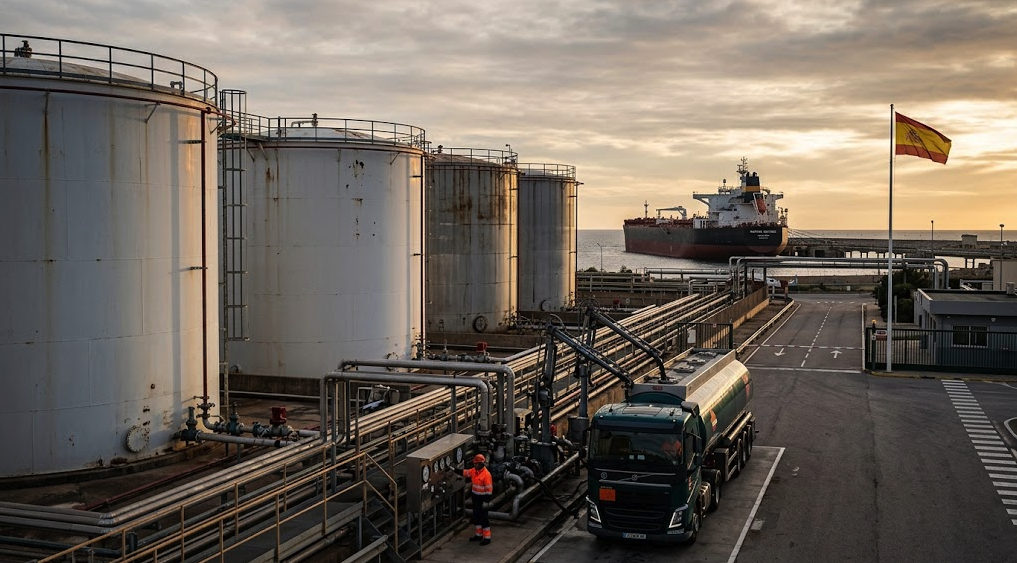
Spain’s emergency oil-stock system includes stocks held by the Spanish Corporation of Strategic Reserves of Petroleum Products (CORES), alongside compulsory stocks maintained by industry, distributors and petroleum operators.
When the Council of Ministers authorised the March release, the government said the products would come from stocks already held by these market participants. CORES was tasked with supervising the procedure to help ensure the products reached the market efficiently.
The release should not be confused with Spain exhausting its emergency reserves. The country maintains compulsory oil stocks for energy-security purposes, and the March measure was designed as a staged response to an exceptional supply disruption.
What remains unconfirmed about the October release?
The IEA’s 15 October statement confirms that member countries have agreed to accelerate the remaining releases under the March collective action. However, the statement does not provide a country-by-country breakdown confirming Spain’s specific additional allocation of 4.4 million barrels.
The figure of 4.4 million barrels and the estimate of slightly more than three million barrels still pending are therefore presented here as figures reported in the supplied announcement, rather than as independently verified figures in the IEA’s latest statement.
An updated Spanish government or CORES announcement detailing the October allocation would be needed to confirm the precise volume, product mix and delivery schedule.
Editorial analysis
Spain’s participation in the coordinated release is a practical short-term response to an exceptional energy-supply problem. Its effectiveness will depend on whether additional petroleum products reach the parts of the market experiencing the greatest shortages.
For consumers, the key distinction is between stabilising supply and reducing prices. The first is the direct purpose of the release; the second remains a possible outcome rather than a guarantee.
The longer-term priority should be to strengthen energy resilience, diversify supply routes and reduce exposure to sudden international disruptions. Emergency reserves are an important safeguard, but their value is greatest when they complement a broader energy-security strategy.
Frequently asked questions
How much oil will Spain release in October?
The supplied announcement reports an additional release of 4.4 million barrels. The IEA has confirmed the acceleration of outstanding releases internationally, but its 15 October statement does not independently specify Spain’s October allocation.
Why is Spain releasing oil reserves?
Spain is participating in the IEA’s coordinated response to supply disruptions linked to the Middle East conflict and restrictions affecting oil shipments through the Strait of Hormuz.
Will petrol become cheaper after the release?
Not necessarily. Additional supply may ease pressure on prices, but the cost of petrol and diesel also depends on crude oil prices, refining, transport, distribution and taxes.
Which fuels are covered by Spain’s reserve-release plan?
The original Spanish commitment included gasoline, diesel and other middle distillates, aviation kerosene and fuel oil. The exact product breakdown for the additional October release has not been established by the cited IEA statement.
Does releasing reserves mean Spain is running out of oil?
No. The measure is part of an emergency response using existing stocks. It does not, by itself, indicate that Spain has exhausted its reserves or cannot meet its normal energy-security obligations.
Official sources
International Energy Agency (IEA) — IEA Governing Board statement on energy markets and security, 15 October 2026: Read the official statement
International Energy Agency (IEA) — Statement by IEA Executive Director on meeting of IEA Member governments on 7 October 2026: Read the official statement
International Energy Agency (IEA) — IEA Member countries to carry out largest ever oil stock release amid market disruptions from Middle East conflict, 11 March 2026: Read the official announcement
Government of Spain, La Moncloa — The Government of Spain authorises the release of oil reserves to mitigate the impact of the war in Iran, 17 March 2026: Read the official announcement
International Energy Agency (IEA) — Oil Market Report, October 2026: Read the official report