
Spain Grinds to a Halt in First General Strike in 14 Years as Thousands Protest Over Housing and Wages
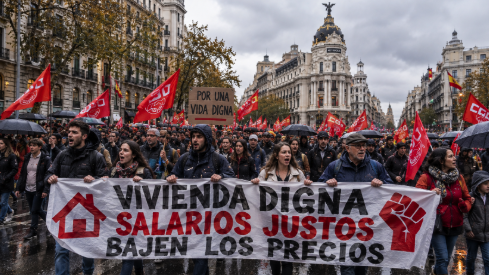
Spain experienced a nationwide day of demonstrations on Wednesday, as the country saw its first general strike backed by the main trade unions in 14 years. Workers and protesters gathered in cities across the country to demand more affordable rents, better wages and measures to curb the rising cost of living.

The 24-hour strike, held under the slogan “Wages, Housing and Prices”, was supported by the Workers’ Commissions (CCOO), the General Workers’ Union (UGT), the General Confederation of Labour (CGT), the National Confederation of Labour (CNT) and other trade union and social organisations.
The 11 November strike marks the first major mobilisation by Spain’s two largest trade unions since 2012, when the country was governed by Mariano Rajoy. It also represents one of the most significant expressions of public discontent in recent years over access to housing and the loss of purchasing power.

Madrid and Barcelona See the Largest Demonstrations
Demonstrations took place in cities across Spain, despite heavy rainfall in several parts of the country.
In Madrid, protesters marched through the streets carrying banners, chanting slogans and raising keys as a symbol of the difficulties people face when trying to find a home. The poor weather did not prevent thousands from joining the demonstrations.
Attendance figures revealed significant differences between organisers and authorities:
- Madrid: The Tenants’ Union estimated that more than 500,000 people took part, while the Government Delegation counted approximately 120,000.
- Barcelona: Organisers estimated that 400,000 protesters attended, compared with the 55,000 recorded by the Urban Guard.
- Bilbao: The Municipal Police put attendance at around 50,000 people.
These differences highlight the difficulty of establishing a definitive turnout figure. Trade union estimates and official figures were based on different counting methods and should therefore be understood as figures attributed to each source, rather than as a single confirmed total.
The Housing Crisis: The Main Trigger Behind the Strike
Access to decent housing became the central issue behind the strike. Trade unions and tenants’ organisations argue that rising rents are pushing a significant proportion of the population out of the housing market, particularly young people and workers on lower incomes.
The problem is not limited to property prices. It is also linked to wage developments, as many households have not seen their incomes rise at the same pace as housing, food, energy and other essential costs.
The demonstrations aimed to bring these demands to every level of public administration, from the central government to Spain’s regional authorities and local councils.
Valeria Racu, spokesperson for the Tenants’ Union, criticised the actions of different levels of government and questioned the housing policies implemented so far.
The union representative argued that the protest should not be directed exclusively at landlords or businesses, but also at the institutions responsible for developing policies that guarantee access to affordable housing.
The main demands put forward by the organisers include:
- Increasing the availability of rental housing at prices households can afford.
- Strengthening workers’ incomes in response to rising everyday expenses.
- Introducing mechanisms to limit speculative practices in the property market.
- Strengthening public services and social protection.
- Ensuring that housing costs do not absorb a disproportionate share of household income.
The situation particularly affects people trying to enter the housing market for the first time, as well as employees on lower wages.
Clashes with Police and Arrests During the Demonstrations
The day was also marked by incidents in several parts of the country.
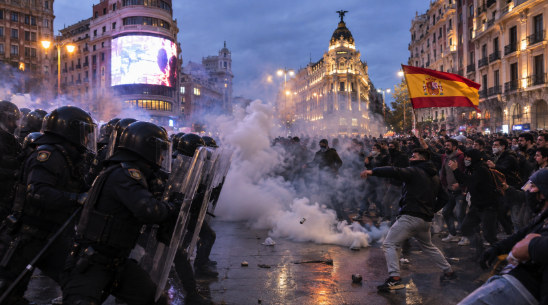
The most tense moments took place in Madrid and Barcelona, where riot police intervened against groups of hooded protesters who had thrown firecrackers, flares and other objects towards officers.
In Madrid, clashes had already been reported during the early hours of the strike near bus depots. Trade unions accused police of charging at an information picket and reported that several people had been injured.
UGT leader Pepe Álvarez criticised the police intervention at Mercamadrid, one of Spain’s main food distribution centres. According to his allegations, the officers’ actions hindered the work of the union picket informing people about the strike.
UGT and CCOO criticised the use of police force and announced that their legal teams would examine footage of the interventions, particularly incidents in which pepper spray was allegedly used.
Police operations were also linked to disturbances involving groups of protesters who took part in confrontations.
Reports published during and after the demonstrations gave different figures for the number of arrests. For this reason, it would be premature to present a definitive nationwide total without consolidated confirmation from the relevant authorities.
Trade Unions and Employers Disagree Over Strike Participation
One of the most controversial aspects of the strike was the assessment of its impact on economic activity.
While CCOO and UGT argued that participation had been significant, business organisations maintained that the number of workers who joined the stoppage was low.
Figures released by both sides reflect two very different interpretations of the day.
CCOO and UGT’s Assessment
In its initial assessment, UGT reported that strike participation ranged from 41% in regions such as Castilla-La Mancha and Extremadura to more than 80% in Catalonia and Andalusia.
The unions highlighted participation in industrial sectors and activities with a strong trade union presence.
The sectors identified included:
- Energy-intensive industry and automotive manufacturing.
- Petrochemical industry.
- Transport and logistics.
- Meat processing.
- Waste collection.
- Port activities.
The unions also claimed that minimum service requirements imposed by regional administrations could restrict the effective exercise of the right to strike.
The Response from CEOE and CEPYME
The Spanish Confederation of Business Organisations (CEOE) and the Spanish Confederation of Small and Medium-sized Enterprises (CEPYME) offered a very different interpretation.
In their assessment statement on 11 November, both organisations described the mobilisation as a failure and put average participation below 5% in the territories and sectors analysed.
The business associations argued that most companies operated normally and that the impact was greater in large businesses and sectors with a strong trade union presence.
They also referred to electricity demand data. According to their statement, at 5 p.m. electricity demand was 4.7% below Red Eléctrica’s forecast and 2.5% lower than on the previous day.
Comparison of the Main Assessments
| Aspect | Trade unions | Business associations |
|---|---|---|
| Overall assessment | Significant strike participation | Strike described as a failure |
| Worker participation | Between 41% and more than 80%, depending on the region, according to initial figures | Less than 5% on average |
| Sectors most affected | Industry, automotive, transport and logistics | Large companies and sectors with strong union representation |
| Electricity demand | Drop of more than 10%, according to their initial assessment | 2.5% decrease compared with the previous day at 5 p.m. |
The figures are not directly comparable because they are based on different methodologies, samples and measurement periods. Neither statement provides a single official statistic that establishes the exact national percentage of workers who took part in the strike.
Political Reaction: People’s Party Warning and Pressure on the Government
The strike also had political repercussions.
Alberto Núñez Feijóo, president of the People’s Party (PP) and the main opposition leader, warned that the unions may have made a “historic mistake” by calling the stoppage.
UGT leader Pepe Álvarez defended the mobilisation, arguing that every government must listen to the public’s demands, regardless of its political orientation.
The strike was directed at administrations controlled by different political parties. Organisers argue that the housing crisis requires coordinated action and cannot be attributed solely to the policies of a single government.
The debate has once again placed issues such as rent regulation, increasing the supply of affordable housing and improving wage conditions at the centre of political discussion.
What Spanish Law Says About the Right to Housing
The demonstrations have also brought attention to the legal tools available to address problems in the housing market.
Spain’s Law 12/2023 of 24 May, on the right to housing, establishes mechanisms to promote access to decent housing and includes specific measures for areas designated as stressed residential market zones.
Among its provisions is the possibility of declaring certain geographical areas to be stressed zones when they meet legal requirements relating to household housing costs and the development of residential prices.
The law also provides for mechanisms to regulate rents in these areas, subject to the conditions established by legislation.
However, the existence of this law does not mean that all the problems raised during the strike have been resolved. Its implementation depends on the powers of the relevant administrations, the necessary official designations and the effective application of the measures provided for.
The main demand from the organisers is for public authorities to introduce measures that have a real impact on housing costs and workers’ living conditions.
HIGRH NEWS Opinion: Housing Has Become a Labour and Social Issue
The 11 November general strike raises an issue that goes beyond the confrontation between trade unions, employers and political parties: the difficulty of maintaining decent living standards when household incomes are not enough to comfortably cover essential expenses.
The difference between trade union and business figures makes it difficult to describe worker participation as either an unquestionable success or an outright failure. However, the demonstrations in major cities show that access to housing and the cost of living are matters of considerable public concern.
In HIGRH NEWS’s view, one of the most significant aspects of the strike is that it has brought together two debates that have traditionally been addressed separately: working conditions and the property market.
A salary may increase on paper and still prove insufficient if rent, food and utility bills absorb an ever-larger share of household income.
The response should not be limited to political statements or disputes between business and trade union organisations. What is needed are measurable actions, effective housing policies and measures that improve the balance between wages and essential living costs.
The strike may be over, but the problem that prompted it remains unresolved.
Official Sources
- Official State Gazette (BOE) — Order TED/1180/2026 of 5 November, concerning minimum services during the 11 November general strike.
View the official publication in the BOE. - General Workers’ Union (UGT) — Report on significant participation in the general strike and the involvement of information pickets.
View the UGT statement. - Spanish Confederation of Business Organisations (CEOE) and CEPYME — Statement assessing participation in the general strike.
View the CEOE and CEPYME statement. - Official State Gazette (BOE) — Law 12/2023 of 24 May, on the right to housing.
View the consolidated text of the Housing Law.