
Madrid Protests Turn Violent During Spain’s November 11 General Strike as Police Use Rubber Bullets and Tear Gas
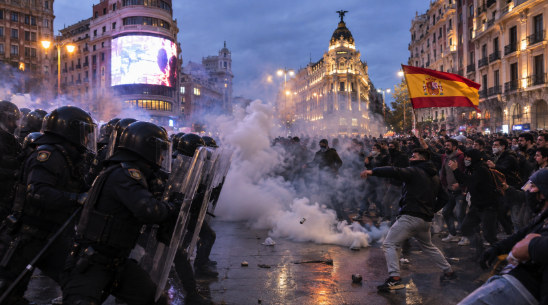
Violent clashes broke out in central Madrid during Spain’s November 11 general strike, forcing riot police to intervene with rubber bullets and tear gas near Gran Vía and Callao. The confrontation marked a significant escalation in tensions during a nationwide day of demonstrations, with more than 50 arrests reported across Spain by the Ministry of the Interior.

The most serious disturbances were reported around Plaza de Callao, where police officers attempted to disperse groups of protesters as tensions increased throughout the evening.
The incidents also disrupted commercial activity and movement through central Madrid, with some businesses reportedly closing their doors amid concerns over public safety.

Police Deploy Rubber Bullets and Tear Gas in Central Madrid
The situation escalated around Gran Vía and Plaza de Callao, two of the busiest areas in the Spanish capital.
According to reports published during the evening, clashes developed between riot police and groups of demonstrators. Officers subsequently deployed crowd-control measures, including rubber bullets and tear gas, to disperse violent protesters.
Several loud detonations were also heard during the police operation. Initial reports suggested that these sounds could have been associated with the use of riot-control equipment.
Police officers established cordons to restrict demonstrators’ movements and contain the situation. Tensions remained high as officers attempted to regain control of the affected streets.
The disturbances continued into the evening, with reports of further confrontations around Callao.
More Than 50 Arrests Reported Across Spain
Spain’s Ministry of the Interior reported more than 50 arrests in connection with incidents during the general strike.
The arrests were recorded across several parts of the country, although the national figure should not be confused with the number of people detained specifically during the clashes in central Madrid.
In the capital, police operations were also reported in connection with disturbances involving demonstrators and pickets.
The available information does not establish a definitive number of arrests directly linked to the confrontations around Gran Vía and Callao.
Businesses Close as Pickets Disrupt Madrid’s Gran Vía
The disturbances were not limited to confrontations between demonstrators and police.
Pickets also disrupted commercial activity in Madrid, with some businesses reportedly closing as a precaution amid concerns about possible incidents.
Gran Vía was particularly affected by demonstrations and road disruptions, creating difficulties for pedestrians, employees, customers and businesses operating in the area.
The combination of street protests, police operations and temporary business closures added to the disruption experienced in central Madrid throughout the day.
Why Are Workers Protesting Across Spain?
The general strike was called over growing concerns about housing affordability, wages and the cost of living.
Workers and housing campaigners have demanded stronger measures to address Spain’s housing crisis, alongside improvements in salaries and purchasing power.
The mobilisation has placed pressure on the government to respond to concerns about the affordability of renting and the financial difficulties facing many households.
The strike has also drawn attention to the relationship between housing costs and workers’ living standards, making the issue a central part of the national political debate.
Reuters described the mobilisation as Spain’s first nationwide general strike in 14 years, with housing affordability among its main drivers.
Political Leaders React to the General Strike
The demonstrations have also triggered strong political reactions.
Vox leader Santiago Abascal criticised the strike, describing it as a failure for Prime Minister Pedro Sánchez. He also promised to take action against pickets accused of intimidating workers, self-employed people and business owners.
Miguel Tellado, secretary-general of the People’s Party (PP), also dismissed the mobilisation as a failure and accused the unions of providing political support to Sánchez.
Their comments came shortly before the start of the campaign for Spain’s November 29 general election, adding another political dimension to an already tense day.
The criticism reflects the divisions between political parties over the purpose, organisation and impact of the strike.
What Happens Next in Madrid?
The immediate priority remains the restoration of normal activity in the affected areas.
Police operations around central Madrid have sought to contain the disturbances and prevent further confrontations. Businesses and residents have also faced uncertainty as demonstrations and traffic restrictions affected the city centre.
At the time of the latest reports included in this article, a definitive breakdown of injuries and arrests specifically linked to the evening clashes in Callao had not been established.
Further official information will be needed to determine the full consequences of the police operation.
HIGRH NEWS Editorial Analysis: Protest Rights Must Be Protected, but Violence Cannot Be Justified
The events in Madrid highlight the difficult balance between protecting the right to protest and maintaining public safety.
Workers have legitimate reasons to demand better wages, affordable housing and improved living conditions. These are major social and economic issues that deserve serious political attention.
However, violence, intimidation and attacks on people or businesses cannot be justified as part of a labour protest.
At the same time, police operations must respect fundamental rights and follow the principles of necessity and proportionality.
For HIGRH NEWS, the key distinction is between peaceful demonstrators exercising their democratic rights and individuals involved in violent incidents. Both the right to protest and the safety of the public must be protected.
Frequently Asked Questions
1. Why did protests turn violent in Madrid?
Tensions escalated during the November 11 general strike, particularly around Gran Vía and Plaza de Callao, where police confronted groups of demonstrators.
2. Did Spanish police use rubber bullets and tear gas?
Yes. Reports published during the evening described the use of rubber bullets and tear gas by riot police to disperse violent demonstrators near Callao.
3. How many people were arrested during the general strike?
At least 52 people had been arrested across Spain by 5 p.m., according to figures compiled by the Ministry of the Interior. The national figure included arrests made by different police forces.
4. What were the main demands of the general strike?
The main demands included better wages, improved purchasing power, more affordable housing and stronger protection for workers and public services.
5. Which areas of Madrid were affected?
Gran Vía and Plaza de Callao were among the main locations affected by demonstrations, police interventions and traffic disruption.
Sources and Further Reading
The following sources were used to support and contextualise this report.
1. Reuters — Millions of Spaniards stage first general strike in 14 years as anger rages over housing. November 11, 2026.