
GRANADA – HIGRH NEWS: A powerful earthquake struck the Granada area early Saturday morning, startling residents across southern Spain and prompting an emergency response after buildings and vehicles were damaged. The tremor was felt well beyond the immediate epicentre, while a series of smaller earthquakes kept residents on edge through the morning. What happened during the night, and how serious is the situation now?

Granada earthquake jolts the city before dawn
The main earthquake struck at about 1:04 a.m. local time, with its epicentre in the Alhendín area, southwest of Granada. Spain’s National Geographic Institute initially placed the magnitude at 4.8 before later data put the tremor at magnitude 5.0.
The earthquake lasted only several seconds, but its shallow location and strength made the movement particularly noticeable in Granada and surrounding municipalities.

Residents across the metropolitan area reported feeling the ground shake strongly. The tremor also reached other parts of Andalusia, with emergency calls coming from provinces including Málaga, Córdoba, Jaén, Almería and Seville. Reports indicated that the movement was felt even farther away in parts of Spain.
The sudden shaking caused alarm in homes, hotels and apartment buildings. Some residents left their properties and gathered outdoors, taking chairs, blankets and other belongings with them as they waited for the situation to become clearer.
More than 200 calls reached the Andalusian emergency service in connection with the earthquake. Most reports concerned Granada and nearby municipalities, with callers describing cracks, falling materials and other damage.
Despite the scale of the disturbance, authorities reported no deaths or injuries in the initial assessments.
The main concern shifted quickly towards damaged buildings, falling debris and the possibility of further tremors.
Granada earthquake causes damage to buildings and cars
The force of the Granada earthquake caused visible damage in several locations around the metropolitan area.
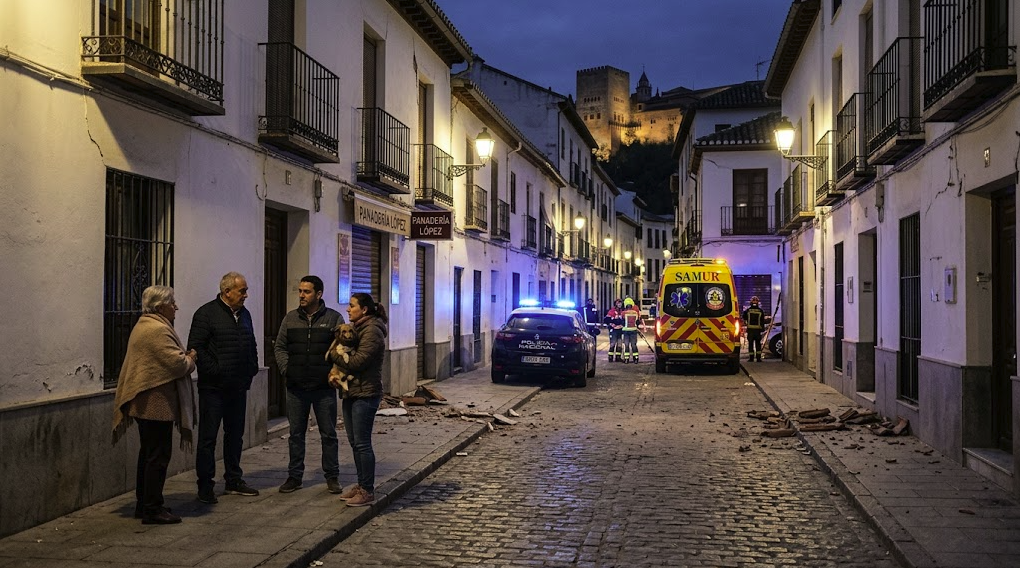
Emergency crews dealt with reports involving cracks, fallen cornices, damaged façades and other pieces of construction material. Some falling debris also damaged parked vehicles, adding to the disruption caused by the overnight tremor.
Authorities restricted access to areas where damaged façades or other structures could pose a danger to pedestrians. Firefighters and police officers worked alongside technical specialists to assess buildings and secure affected locations.
Most of the damage reported so far has been described as limited and concentrated mainly on non-structural elements. However, inspections remain important because visible cracks or falling decorative features can create additional risks after an earthquake.
In some locations, residents were prevented from returning immediately while officials examined the condition of buildings.
The earthquake also affected people inside buildings during the initial shock. Emergency teams attended incidents involving residents who needed assistance in properties affected by the tremor.
The situation was particularly unsettling because the earthquake occurred while most people were asleep. The sudden movement gave residents little time to understand what was happening before the shaking stopped.
For many people, the uncertainty continued after the main earthquake because smaller tremors followed during the early hours.
Residents remain outside as aftershocks continue
The Granada earthquake was followed by a sequence of smaller movements in and around the metropolitan area.
Early reports identified aftershocks in municipalities including Alhendín, Armilla, Ogíjares, Gójar and Otura. Later counts placed the number of recorded aftershocks at several dozen, with some strong enough for residents to notice them.
One of the more noticeable later tremors reached magnitude 3.3, according to reports citing seismic monitoring data.
The continuing activity encouraged some residents to remain outdoors rather than immediately return to their homes.
Streets and open spaces became temporary gathering points during the night as people tried to decide whether it was safe to go back inside.
The authorities urged residents to avoid damaged buildings and stay away from façades, balconies, cornices, walls and other elements that could fall.
Antonio Sanz Cabello, vice-president of the Andalusian government, called for calm and advised people whose homes had not suffered damage to avoid unnecessary movement in and out of buildings.
Emergency officials also reminded residents that seismic activity can continue after a major tremor and that people should follow instructions from police, firefighters and other emergency personnel.
The focus remained on monitoring the sequence and identifying any additional damage.
Andalusia activates its seismic emergency response
The Andalusian government activated the emergency phase of its seismic-risk plan after the earthquake and raised the operational response to level 1.
The measure strengthened coordination between regional authorities, municipalities, emergency services, firefighters, police and technical teams.
More than 200 calls to the 112 emergency service provided an early picture of the impact. Reports included cracks in buildings, falling cornices, debris and other material damage.
Technical inspections became a priority as authorities worked to determine whether reported damage affected only exterior or decorative elements or required additional safety measures.
Volunteer architects and other specialists were also involved in building assessments in affected areas. Their work helps authorities decide whether properties require restrictions or further technical checks.
Emergency crews also established safety perimeters around locations where damaged elements could fall.
Officials have continued to coordinate with scientific institutions monitoring the seismic sequence.
For residents, the immediate message has remained consistent: stay calm, keep away from damaged structures and follow official instructions.
How far was the Granada earthquake felt?
The earthquake’s effects extended well beyond Alhendín.
Reports indicated that people felt the tremor across much of Granada province and in several other parts of Andalusia. Emergency calls came from Málaga, Córdoba, Jaén, Almería and Seville, among other locations.
The movement was also reported in areas farther from Granada, demonstrating the broad reach of the overnight shock.
Its impact was particularly noticeable because the earthquake occurred shortly after 1 a.m., when residents were inside homes and hotels.
The combination of the timing, the strength of the shaking and the subsequent aftershocks created widespread concern.
Granada is also a major tourist destination, meaning the earthquake affected not only permanent residents but also visitors staying in hotels and other accommodation.
Some hotels took precautionary measures as guests reacted to the tremor and the subsequent activity.
Authorities focused on reassurance while emergency teams checked properties and dealt with reports of damage.
No widespread structural collapse was reported in the initial assessments, and officials continued to distinguish between isolated material damage and serious structural problems.
Why earthquakes are common in the Granada area
Granada lies in one of Spain’s more active seismic regions.
Earthquakes occur regularly in southern Spain because of the geological forces affecting the area around the boundary between the African and Eurasian tectonic plates.
The Granada basin has experienced numerous earthquakes over time, including periods when repeated tremors have caused concern among residents.
The current earthquake stands out because of its magnitude and the number of people who felt it.
The event also comes after other seismic activity in the Granada area, although individual earthquakes should not automatically be treated as directly connected without scientific evidence.
The role of seismic monitoring is therefore crucial. Instruments operated by Spain’s National Geographic Institute record the location, depth and magnitude of earthquakes and help specialists track changes in seismic activity.
Official monitoring also allows authorities to update information as preliminary measurements are reviewed.
What residents should do after an earthquake
Authorities have urged people to remain calm and avoid unnecessary movement around buildings that may have suffered damage.
Anyone outside should keep away from façades, balconies, cornices, walls and other structures that could become unstable.
Residents should also respect police and emergency-service cordons. Entering restricted areas can expose people to falling debris or other hazards.
If a building shows visible damage, residents should wait for appropriate instructions rather than assuming it is safe simply because the main shaking has stopped.
Emergency guidance also advises against using lifts during seismic emergencies.
People should keep their phones available for genuine emergencies and rely on official channels for updates rather than spreading unverified information.
Official earthquake information and monitoring can be checked through Spain’s National Geographic Institute.
The authorities continue to assess reported damage while specialists monitor the aftershock sequence.
Granada faces a tense morning after the quake
The overnight earthquake left thousands of people shaken and prompted an extensive emergency response across the Granada metropolitan area.
The strongest movement caused damage to buildings, façades and vehicles, while subsequent tremors kept many residents outside their homes.
More than 200 emergency calls demonstrated the scale of public concern, although authorities reported no deaths or injuries in the initial assessments.
The response has centred on inspections, safety measures and monitoring rather than widespread evacuation.
Firefighters, police officers, technical specialists and emergency officials continue to work in affected locations while seismic monitoring remains active.
For residents, the immediate priority is safety. Damaged structures should be avoided, official instructions should be followed and any new emergency should be reported through the appropriate channels.
The coming hours will provide a clearer picture of the full extent of the material damage and the behaviour of the aftershock sequence.
Frequently Asked Questions
Where did the earthquake strike?
The epicentre was in the Alhendín area, southwest of Granada.
How strong was the earthquake?
The earthquake was reported at magnitude 5.0 after initial measurements placed it at 4.8.
Were there any casualties?
Authorities reported no deaths or injuries in the initial assessments.
Were there aftershocks?
Yes. Dozens of smaller earthquakes were recorded following the main tremor…….MORE