
BARCELONA – HIGRH NEWS: Torrential rains in Barcelona caused flooding, road closures, disruptions to public transport and the death of a man in Olivella, while the rainfall also hit several areas of the Valencia region with intensity. How did the storm develop and what consequences did it leave in the worst-affected areas?

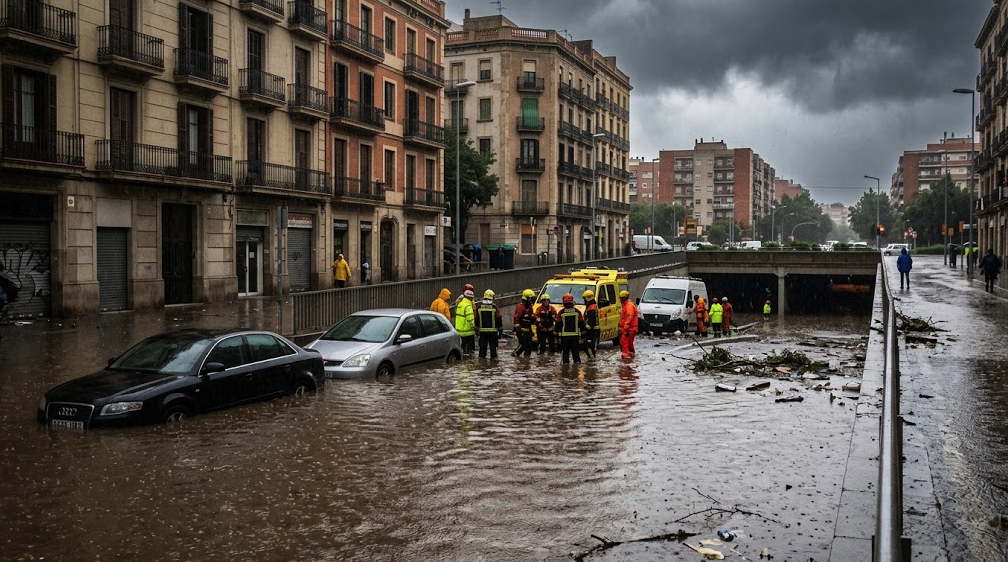
Heavy rain fell for hours across Spain’s Mediterranean coast, causing numerous incidents in both Catalonia and Valencia. In Barcelona and nearby areas, water flooded streets, affected infrastructure and made travel more difficult.
The most serious situation occurred in Olivella, in the Garraf area of Barcelona province. Emergency services recovered the body of a man whose vehicle had been swept away by a stream.

Rescue teams first located the vehicle and later found the driver’s body several hundred metres from where the car had been left. The operation involved 11 units from the Catalan Fire and Rescue Service, specialist underwater rescue personnel and drones.
One Person Dies After Vehicle Is Swept Away in Olivella
The most serious incident recorded in Catalonia occurred in Olivella, where a current of water swept away a vehicle during the storm. An emergency call alerted authorities that a car had been moved by the force of the water.
Firefighters launched a search operation in the area. The response involved ground teams, specialist water-rescue personnel and drones to search the surrounding area.
The teams eventually located the vehicle and found the man dead after his car had been swept away by a current of water.
The Catalan Fire and Rescue Service said on Thursday that it had recovered the lifeless body of a man in Olivella. Initial information had identified the missing person as a woman, but emergency services later corrected that information.
Civil Protection activated an ES-Alert message for several areas around Barcelona because of forecasts for heavy rain and adverse weather conditions. The areas included Barcelonès, Maresme, Baix Llobregat, Garraf, Alt and Baix Penedès and Vallès Occidental.
Spain’s national weather agency AEMET had issued a red warning for Barcelona’s coastline because of the risk of torrential rainfall. Forecasts anticipated accumulations of more than 90 litres per square metre in less than an hour in some areas.
AEMET weather warnings for Catalonia
Water Causes Incidents in Barcelona and Disrupts Travel
The rainfall also affected mobility in Barcelona and other parts of Catalonia.
Some metro stations were closed and several bus routes had to change their services. Regional rail services were also disrupted.
Barcelona-El Prat Airport experienced flight delays and cancellations during the period of heavy rainfall.
Catalan emergency services received more than 850 calls related to the rainfall and recorded more than 500 incidents.
Authorities advised people to avoid unnecessary travel because of the weather conditions and the problems caused by the flooding.
Videos shared on social media showed partially submerged vehicles and rescue teams working to reach cars trapped in flooded underpasses.
The situation affected different parts of Catalonia and forced emergency services to maintain monitoring and assistance operations while the rainfall continued.
The Storm Also Disrupted Transport
The problems were not limited to roads. Metro interruptions, bus diversions and railway disruptions made travel more difficult for thousands of people.
Weather conditions also affected operations at Barcelona-El Prat Airport, where delays and cancellations were reported.
Authorities continued to urge caution and advised residents to follow instructions from emergency services.
Heavy Rain Also Hits the Valencia Region
The weather system also affected the Valencia region, where rainfall caused flooding and numerous traffic problems.
According to AVAMET, several municipalities recorded more than 70 millimetres of rain in just half an hour.
The meteorological association described the rainfall totals recorded over a 30-minute period as unusual.
Emergency services recorded 478 incidents in Valencia province. Most involved property damage, leaks and traffic problems.
In the regional capital, all metro lines were suspended during the worst of the rainfall and the airport was closed for several hours, leading to diverted flights.
The storm also affected sport. The match between Levante and Athletic Bilbao was postponed after the pitch became waterlogged and water entered the players’ tunnel.
Weather Warnings Trigger Emergency Protocols
AEMET issued warnings for heavy rainfall in several areas of eastern Spain. A red warning was established along Barcelona’s coastline because of the risk of torrential rain.
In the Valencia region, authorities also activated specific measures to deal with the risk of flooding. The Emergency Coordination Centre issued warnings to residents and recommended limiting travel.
Emergency messages advised people to stay away from rivers and ravines, respect road closures and move to higher ground if water levels began to rise.
In Catalonia, Civil Protection also used the ES-Alert system to send direct warnings to mobile phones in areas facing the greatest risk.
Prime Minister Pedro Sánchez urged citizens to follow the recommendations of emergency services and consult official sources during the storm.
Emergency services continued their response as rainfall caused incidents in different parts of Spain’s Mediterranean coast.
A Situation Marked by Intense Rainfall
The rain reached particularly high intensities over very short periods. This complicated the response in some areas, as rapidly accumulating water can quickly increase the flow of streams, ravines and waterways.
In Olivella, the force of the current swept away a vehicle and caused the death of its driver.
The situation required a search operation involving numerous emergency workers and technical resources. Drones were used to expand surveillance of an area affected by flooding.
In Valencia, rainfall records also showed the intensity of the episode. Several municipalities recorded more than 70 millimetres of rain in just half an hour, according to AVAMET.
Emergency services continued to advise against unnecessary travel while adverse conditions remained.
Weather authorities and Civil Protection monitored the development of the rainfall and water levels as officials assessed when restrictions could be lifted and normal conditions gradually restored.
The Mediterranean Faces Another Episode of Extreme Rainfall
The episode came after a period marked by high temperatures and unusually warm Mediterranean waters.
Meteorological experts have explained that warm Mediterranean waters can provide additional moisture to storms when they coincide with certain atmospheric conditions. This moisture can contribute to very intense rainfall in specific areas.
The relationship between climate warming and the intensity of certain extreme rainfall events forms part of scientific analysis of the evolution of Mediterranean weather phenomena.
In this particular case, the rainfall had different effects depending on the location. While Olivella recorded the fatal incident, Barcelona experienced transport disruptions and flooding, and Valencia recorded significant rainfall totals and hundreds of incidents.
The available data show the geographical extent of the storm, although a complete assessment of the damage takes time and depends on the development of weather conditions.
Emergency services focused on rescuing people affected by the flooding, monitoring inundated areas and restoring disrupted communications.
Emergency Services Continue Assessing the Damage
After the heaviest rainfall, emergency teams began inspecting roads, buildings and infrastructure.
In Catalonia, the death of a man in Olivella marked the most serious incident. Authorities continued gathering information about what happened.
In Valencia, operations focused mainly on property damage, flooding and the consequences for transport.
The scale of the incidents also required checks on transport networks. Roads, railways, metro systems and airports had to adapt their operations to conditions caused by the water.
As the rainfall eased, teams began clearing obstacles and checking the condition of infrastructure.
Authorities continued to urge caution, particularly in areas where water remained accumulated or where waterways could still have elevated flows.
The storm left a toll marked by one fatality, hundreds of incidents and significant disruption to daily life across Catalonia and the Valencia region.
Frequently Asked Questions
Where did the storm victim die?
The man died in Olivella after the current swept away the vehicle in which he was travelling.
What happened in Barcelona?
The rainfall caused flooding, closures at some metro stations, bus diversions, railway disruptions and problems at the airport.
Which areas of Valencia recorded intense rainfall?
Several municipalities in the province recorded more than 70 millimetres of rain in just half an hour, according to AVAMET.
What did authorities recommend?
They advised people to avoid unnecessary travel and follow instructions from emergency services…….MORE