
CEUTA – HIGRH NEWS: police operation to relocate migrants from Ceuta beaches has begun, with Spanish security forces moving hundreds of people from beach areas to a new temporary tented site in the port of the Spanish territory in North Africa. The operation started early Friday as authorities attempted to bring thousands of migrants into designated facilities, but what happened during the first hours of the transfer?

Police operation to relocate migrants from Ceuta beaches begins
The operation began at around 07:00 local time, or 05:00 GMT, on Friday, according to the information provided by Spain’s government-owned news agency EFE.
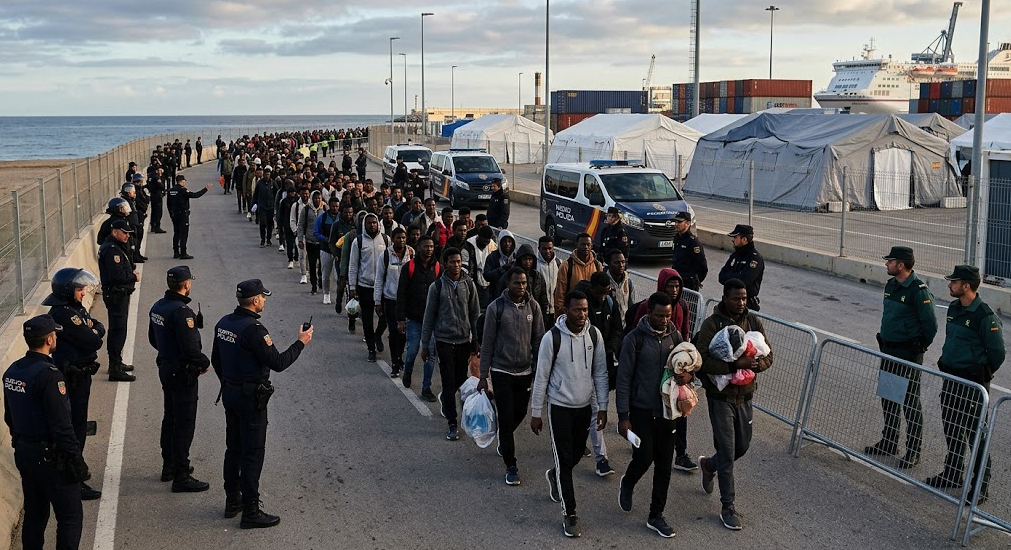
More than 3,000 migrants were being transferred as part of the operation, Spanish media reported. The authorities directed people from areas where they had spent weeks living on the beaches towards a temporary camp established in the port area.

The camp has a capacity of 1,700 people. Authorities intend to use the facility to concentrate migrants in one location while officials identify them, provide assistance and determine their individual administrative status.
The transfer followed weeks of pressure on Ceuta, a Spanish territory covering about 18.5 sq km on the North African coast.
During the operation, police faced difficulties maintaining the designated route. Some migrants broke through the security cordon along the approximately 2km route leading towards the port.
Video footage showed groups of young men running through the darkness as officers attempted to maintain control of the movement.
More than 170 police officers were deployed, according to EFE, including personnel responsible for operating drones. The agency later reported that officers brought the situation under control quickly, allowing the transfer to continue.
The operation involves moving people from informal beach settlements into an organised facility where authorities can carry out identification and provide care.
For the migrants involved, the transfer marks a significant change from spending weeks in exposed coastal areas to being placed in a designated temporary site.
For Ceuta’s authorities, meanwhile, the operation represents an attempt to manage a migration situation that has placed considerable pressure on the small territory.
Hundreds reach the temporary port camp
Several hundred migrants had reached the new camp as the operation continued.
The facility can accommodate up to 1,700 people, meaning the authorities must manage the transfers in stages as they move people from the beaches and other locations.
The purpose of the camp goes beyond simply providing shelter. The government says it wants migrants concentrated in facilities where officials can identify them, assess their needs and determine their administrative situation individually.
The approach also gives authorities a controlled location from which to organise assistance.
The scenes during the first part of the operation, however, demonstrated the difficulties involved in moving such a large number of people at the same time.
Migrants crowded along the narrow route while riot police formed lines to keep the movement organised. At certain points, groups pushed against the police cordon, creating chaotic scenes.
Reports also said shots could be heard and that police fired into the air. The material available for this report does not establish further details about those reports.
The authorities subsequently said the situation was brought under control quickly.
The presence of drone technicians formed part of the security deployment, allowing officers to monitor the operation from above while ground units managed the movement of people.
The operation therefore combined crowd-control measures with logistical work to move thousands of people over a relatively short distance.
Why the port site matters
The port facility gives authorities a single location where migrants can receive assistance and undergo identification procedures.
Officials also need to establish the circumstances of individuals who arrived in Ceuta, including their administrative status.
The process is particularly significant because the people involved do not necessarily have identical circumstances. Their individual situations must be examined before authorities determine what procedures apply.
The temporary camp consequently forms part of a wider administrative response to the influx rather than representing an immediate final decision about the future of those being transferred.
More than 13,000 migrants believed to remain
The scale of the operation reflects the size of the influx that preceded it.
According to the information supplied, around 72,000 migrants crossed from Morocco into Ceuta during the mass border breach in July. Most subsequently returned, but more than 13,000 were believed to remain in the Spanish enclave.
The number has placed significant pressure on a territory with a land area of only 18.5 sq km.
Authorities have had to deal not only with accommodation but also with identification, healthcare, social assistance and the individual administrative procedures associated with the migrants.
The beaches became one of the most visible locations where people remained after the mass arrival.
The operation now seeks to move those groups away from the coastal areas and into designated facilities.
The transfer also comes against a backdrop of concern among some Ceuta residents. Since the influx, residents have raised concerns about safety and the impact of the large number of migrants on everyday life.
Some residents have destroyed shelters and blocked aid being delivered to migrants, according to the information provided.
These incidents have added another layer of tension to an already complex situation involving migrants, local residents, Spanish authorities and neighbouring Morocco.
The city has a limited geographical area, while the number of people involved in the migration crisis has been exceptionally large.
The challenge for authorities is therefore both immediate and administrative: maintain order during transfers while creating enough capacity to process and accommodate those who remain.
Political pressure grows over the migration crisis
The operation is also taking place amid political criticism of Spanish Prime Minister Pedro Sánchez and his government’s handling of the migration influx.
Opposition parties have questioned whether the government had sufficient warning before the mass crossing occurred.
Sánchez has maintained that the influx could not have been predicted.
However, government documents cited in the supplied material indicate that intelligence services had received warnings about social media calls for a mass crossing into Ceuta one day before the events.
The existence of those warnings has become part of the political dispute surrounding the government’s response.
Ester Muñoz of the conservative People’s Party accused the government of being directly responsible for the situation and for deaths linked to the crossing.
That statement represents the position of the opposition and should be distinguished from the government’s account of events.
Sánchez has denied knowing about the migrant rush in advance.
The political dispute is therefore focused partly on what Spanish authorities knew before the border breach and how they responded once the influx began.
The situation has also generated concern at the local level.
Ceuta Mayor Juan Jesús Vivas described the effect of the influx in strong terms when addressing lawmakers at the European Parliament. He said migrants had turned the city into a “pressure cooker” and argued that the lives of Ceuta residents had been deeply disrupted.
His comments reflect the concerns expressed by local authorities about the impact of the influx on the territory.
Spain faces diplomatic complications
The migration crisis has also created difficulties for Spain’s foreign relations.
The Spanish government is seeking to maintain its bilateral relationship with Morocco while managing the consequences of the mass crossing from Moroccan territory into Ceuta.
At the same time, Spain and Italy have been involved in a dispute over migration and border controls. The two countries extended temporary border controls imposed on each other earlier in the week, according to the information supplied.
The developments place the Ceuta operation within a broader European debate over migration management and border security.
Ceuta’s geographical position makes the issue particularly sensitive. The territory sits on the North African coast and shares a land border with Morocco while remaining part of Spain.
Any large movement of people across the border consequently involves both domestic Spanish authorities and wider diplomatic considerations.
The immediate operation, however, remains focused on the migrants already inside Ceuta.
Authorities are seeking to move people from beaches and other informal locations into controlled facilities where they can be identified and assisted.
Court ruling preceded the mass influx
The events that led to the current operation followed a legal development involving migrants attempting to reach Ceuta by sea.
Spain’s Supreme Court ruled that migrants stopped at sea while attempting to reach Ceuta could not simply be returned to Morocco without following the applicable procedures.
Following the ruling, social media accounts circulated misinformation and offered assistance to people seeking to cross into Spanish territory in exchange for hundreds of pounds.
Thousands of people subsequently crossed the border fence or entered the territory by swimming around ocean barriers.
The crossing resulted in a major humanitarian emergency.
At least 100 people died during the crossing, according to local authorities.
The deaths added a tragic dimension to an already significant border crisis and intensified the debate surrounding the management of migration into Ceuta.
The combination of the court ruling, misinformation online and organised calls for people to attempt the crossing contributed to a rapid increase in the number of people entering the territory.
Authorities then faced the challenge of providing accommodation and assistance to a population that had increased dramatically within a short period.
The current relocation operation is one response to the continuing presence of thousands of migrants in the enclave.
What happens after the relocation?
Moving migrants from the beaches does not by itself resolve their administrative situation.
The government intends to use the temporary facilities to identify migrants and assess their individual circumstances.
That process will determine what procedures apply to each person.
The capacity of the new camp is another important factor. With space for 1,700 people and more than 13,000 migrants believed to remain in Ceuta, the facility cannot accommodate everyone who entered the territory during the influx.
Authorities therefore face the continuing task of managing additional accommodation and assistance.
The operation also needs to maintain order along the transfer route. The early scenes showed how quickly large crowds can become difficult to control when thousands of people move through a confined area.
Police and Civil Guard officers have been deployed to maintain the cordon and prevent people from leaving the designated route.
Drone operators form part of the deployment, providing additional monitoring capabilities.
The authorities’ immediate objective is to complete the relocation while preventing further disorder.
The longer-term question concerns what happens to the migrants once officials complete the identification and individual assessment process.
Their administrative status will have to be determined separately, with the relevant procedures applied to each case.
For Ceuta, the operation also raises the question of how the territory will manage the people who remain outside the new camp.
The mass influx has already tested the city’s limited space and resources, while the political debate over the government’s preparedness and response continues.
For now, the police operation represents the latest effort to move migrants away from the beaches and into organised facilities.
The first hours brought tense scenes, large crowds and breaches of the security cordon, but authorities reported that they regained control and continued the operation.
With thousands of people involved and the temporary camp offering 1,700 places, the relocation is a substantial logistical undertaking.
Its completion will mark another stage in the response to the migration crisis, but identification, assistance and the determination of individual administrative situations will continue after the physical transfer ends.
the offical link https: tralado puerto migrantes playas ceuta
Frequently Asked Questions
How many migrants are being transferred?
Spanish media reported that more than 3,000 migrants were being transferred during the operation.
Where are the migrants being taken?
They are being moved from beach areas in Ceuta to a temporary tented camp in the port area.
How many people can the new camp accommodate?
The temporary camp has a capacity of 1,700 people.
How many migrants are believed to remain in Ceuta?
More than 13,000 migrants were believed to remain in the enclave after most of those who crossed the border in July returned to Morocco…….MORE