
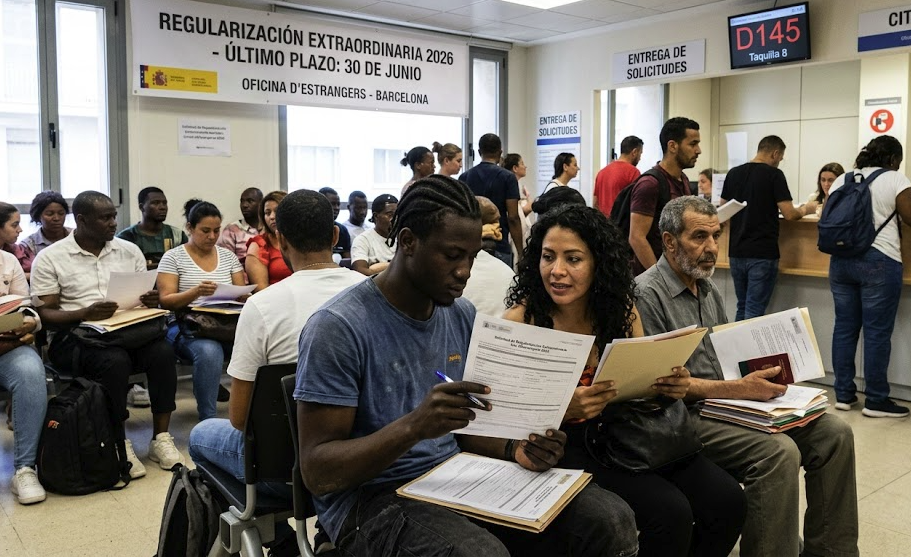

Madrid – HIGRH NEWS: The regularization of immigrants in Spain is approaching its decisive days ahead of the looming deadline set for June 30. Thousands of families are awaiting an administrative response that could transform their employment and residential status, while Foreign National Offices (Oficinas de Extranjería) prepare to manage one of the largest bureaucratic challenges in recent years. This initiative, coordinated by the Ministry of Inclusion, Social Security and Migrations, has been described by various national and international media outlets as one of the largest extraordinary regularization processes driven in democratic Spain. What will happen after the closure, and how will it affect those still waiting for a resolution?

What Does This Extraordinary Process Mean and What Are Its Objectives?
The measure was originally articulated through a royal decree approved with the explicit purpose of bringing underground employment to light and facilitating the sectoral integration of those who are already part of the national productive fabric. The Executive clearly defended the proposal on the official portal of Moncloa, stating: “The objective is not to incentivize irregular immigration, but to incorporate into the formal economy people who already live and work in Spain.”
Requirements to Submit the Application
To access this exceptional processing channel, the legal text established that interested parties had to strictly comply with a series of technical parameters before expiration:

Justify entry and stay in Spanish territory before the cutoff date fixed at the end of the previous year.
Prove a minimum continuous residence of five months prior to the publication of the decree.
Present valid official certificates showing an absolute absence of a criminal record.
Be in an irregular administrative situation or have applied for international protection before the date established by the regulations.
Affected Economic Sectors
Government sources indicated during the campaign that the plan focused on sectors with a high demand for labor and elevated rates of informal employment. The main activities linked to this process include agriculture, hospitality, construction, and domestic or care work.
Admitted Documentation
Unlike standard channels, this process required specific and fully verifiable evidence. Applicants had to provide clear institutional documents such as registration in the municipal census (empadronamiento), medical reports from the public health system, lease contracts validated by official bodies, or prior administrative documentation. The rigidity of the document review forced support networks and law firms to meticulously check every file to avoid immediate archiving due to formal defects.
Balance of Applications for the Regularization of Immigrants in Spain
Provisional data published until mid-June reflect an unprecedented social impact. According to estimates published in various international media outlets, authorities have begun issuing temporary work authorizations in certain cases while continuing to study the files. This urgent measure seeks to allow a segment of the applicants to engage in a regulated professional activity during the waiting period, avoiding situations of vulnerability.
However, preliminary estimates of the global volume of files submitted to public registries place the figure close to 900,000 applications, a data point that practically doubles the initial forecast of 500,000 calculated by state technicians. Some migrant support organizations estimate that, following the final consolidation of digital and in-person registries concluding at the end of June, the final number of active files could approach the one-million mark.
How the Mercurio Platform and Digital Management Work
The massive influx of applications forced government delegations to direct most of their resources toward digital tools. Through the IT support provided by the Mercurio platform, the collection of uploaded files was centralized to facilitate data cross-referencing with the National Police and the General Treasury of the Social Security.
Despite rumors circulating about the complete closure of in-person offices, physical desks and telephone hotlines maintained their activity. These traditional channels served to provide support to individuals affected by the digital divide or those experiencing complex technical issues with their archives.
Why This Change Matters and What Will Happen After the Deadline Closes
The closure of the deadline now poses a major challenge for the Foreign National Offices. Experts and sector associations predict that the Administration will prioritize the processing of these files due to their social relevance, though realistic waiting times could double the standard three-month period stipulated in standard regulations due to the structural staff shortages plaguing the system.
Why Is Spain Betting on These Regularizations?
From a macroeconomic perspective, the decision to push this management policy responds to the need to guarantee the sustainability of the pension system in the face of demographic aging and low birth rates. The transition of workers from the informal sector to the formal economy generates direct revenue through social security contributions and the payment of income tax (IRPF).
On the political front, the measure has divided Parliament, with opposition parties asserting that these extraordinary actions weaken common European border controls and strain local public services. HIGRH NEWS consulted official documents and analyses published by specialized organizations, which unanimously agree that the shortage of labor in key sectors has been the primary driver behind executing this decree.
How This Process Compares to the 2005 Regularization
This program inevitably recalls the extraordinary regularization of immigrants in Spain carried out in the year 2005, which became the main historical benchmark on the matter.
Number of beneficiaries: In 2005, around 700,000 applications were submitted, a figure notably lower than the high volume of current requests, which preliminary estimates place close to one million.
Economic context: The 2005 process took place during a major economic boom and expansion of the construction sector, whereas the current one responds to needs derived from demographic aging and labor shortages in specific sectors.
Main differences: The current program has relied almost exclusively on digital management and remote processing through the Mercurio electronic platform to ensure faster screening.
Legal Scenario for Those Who Did Not Submit the Application
For those foreign citizens who are excluded because they did not apply in time, the legal landscape will return to the standard rules of the general Immigration Law. This means they will not be able to benefit from the flexibilities offered by this extraordinary path and must resort to traditional roots-based channels (arraigo: social, labor, or family).
These standard channels require much longer proven periods of residence (ranging between two and three years), alongside employment contracts subject to highly strict viability requirements for the hiring companies.
Comparison of Administrative Situations After Expiration
Technical Guidelines for Files Still Under Processing
Applicants whose files are currently in the review stage must perform periodic checks via the Ministry’s official digital portals. Notifications regarding the correction of errors or requests for document clarification typically grant a short response window of just ten business days.
Failing to reply within the legally stipulated timeframe is considered an implicit withdrawal of the application, thereby canceling the benefits acquired from the extraordinary decree and forcing the affected individual to start procedures from scratch via standard legal avenues.
Frequently Asked Questions
Will an extraordinary period be opened to submit documents past the deadline?
Guidelines published by the Ministry clearly state that the deadline concludes definitively on June 30, and no automatic extensions are contemplated for this program.
What legal validity does the application receipt hold against a labor inspection?
The receipt only proves that the file has been delivered to the Administration and is under processing; the specific effects regarding work authorization depend on the final resolution and measures adopted by the Administration.
Does a rejection of the extraordinary application imply an automatic deportation order?
A negative resolution does not immediately trigger an exit order from the country, but rather returns the foreign citizen to their prior administrative situation, remaining subject to standard laws in force.
Can they demand the submission of original physical documents if the process was done digitally?
Yes, officials responsible for analyzing the files reserve the right to request an in-person appointment to verify the authenticity of foreign certificates that were scanned into the system.
The true impact of this regularization of immigrants in Spain will not fully emerge on June 30, but in the subsequent months, as the Administration demonstrates its capacity to respond to hundreds of thousands of files, and applicants finally learn their legal and professional future.……MORE