
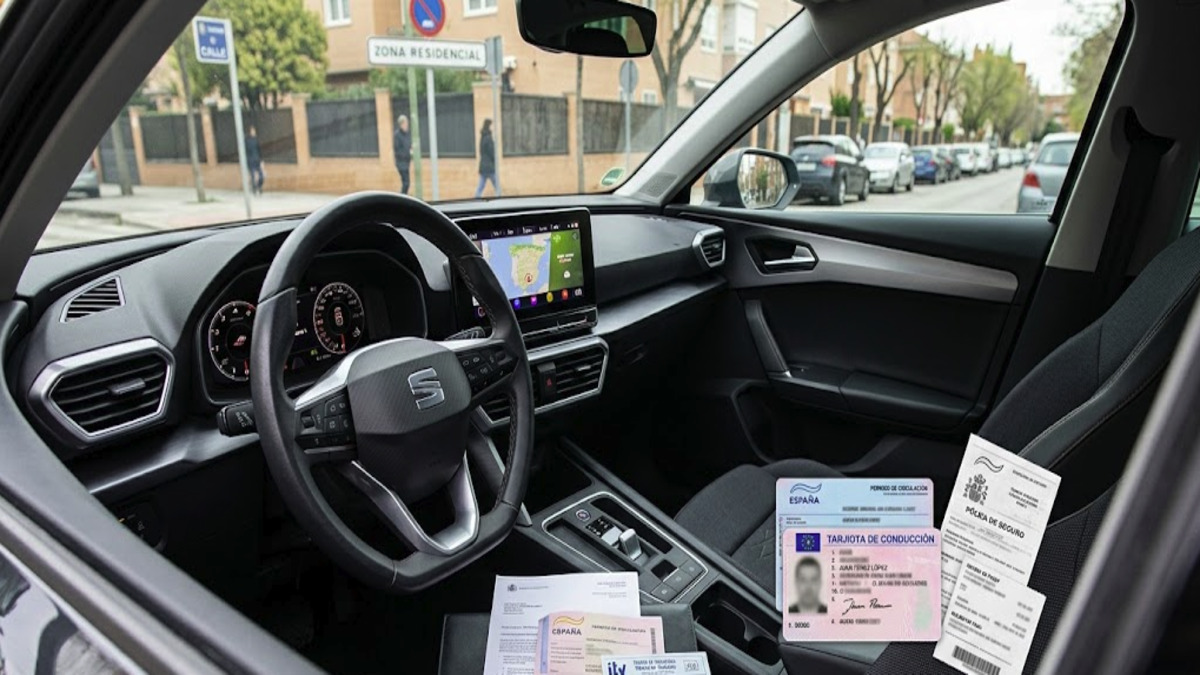

SPAIN – HIGRH NEWS: What Documents Must You Always Carry in Your Car in Spain and Which Are No Longer Required? Drivers in Spain do not need to fill their glove compartment with every document associated with their vehicle. The rules distinguish between documents that must be available when driving and paperwork that no longer has to be carried physically. So, what does a driver actually need to have with them on the road?

Documents required to carry in a car in Spain
The Directorate-General for Traffic (DGT) identifies three documents that drivers must have when they drive in Spain: a valid driving licence, the vehicle registration document and the vehicle’s ITV inspection card.
The three documents must be valid. The DGT states that drivers should carry the original documents or properly certified copies and present them to traffic officers if requested.

The requirement applies regardless of whether the journey is long or short. A quick trip through town does not change the documentation rules. Once a person drives a vehicle, the relevant documents must be available.
The three documents cover different aspects of driving and vehicle ownership.
The driving licence relates to the person behind the wheel. It confirms that the driver holds the appropriate authorisation to drive.
The registration document relates to the vehicle. It identifies the vehicle and provides the administrative information associated with its registration.
The ITV inspection card, also known as the technical inspection card or ficha técnica, provides information about the vehicle’s technical characteristics and its inspection status.
Together, these documents form the core paperwork that drivers need when using a vehicle on Spanish roads.
The Spanish traffic law also establishes that drivers must possess and carry their valid driving authorisation, the vehicle registration document and the technical inspection card, and must show them to traffic authorities when requested.
The driving licence
The first document concerns the driver rather than the vehicle.
A person driving a motor vehicle or moped must have the appropriate valid driving licence or permit. Traffic officers can request it during a roadside check or following a traffic incident.
The important point is validity. Having obtained a licence in the past is not enough if it is no longer valid.
Drivers in Spain also have a digital option for certain documents. The DGT’s miDGT application provides access to the driving licence and vehicle registration document, and the agency states that these digital versions have the same legal validity as the physical documents for driving within Spain.
That means drivers who use miDGT have an official digital way to demonstrate these two documents while driving in Spain.
The digital system does not, however, mean that every piece of vehicle paperwork can simply be discarded.
The technical inspection card remains part of the vehicle’s required documentation, so drivers should pay particular attention to keeping it available.
The vehicle registration document and ITV card
The second document is the vehicle registration document, known in Spain as the permiso de circulación.
This document belongs to the vehicle rather than to the individual driver. It identifies the registered vehicle and forms part of the documentation required for legal circulation.
The DGT explains that the registration document and technical inspection card constitute the documentation necessary for a vehicle to circulate legally on public roads in Spain.
The third document is the ITV card, or ficha técnica.
The ITV card contains the technical information associated with the vehicle and provides evidence connected with its technical inspection. The DGT describes it as documentation that confirms the vehicle’s technical characteristics and its suitability for circulation.
The inspection itself is not simply a paperwork requirement. Spanish regulations require vehicles subject to the ITV system to undergo the relevant technical inspections according to the applicable rules and schedules.
For drivers, the practical distinction is straightforward: the registration document and ITV card relate to the vehicle, while the driving licence relates to the person driving it.
A driver should therefore check that the vehicle documentation corresponds to the car being used and that the required documents remain valid.
What about digital documents?
Digital documentation has made the process more convenient for Spanish drivers.
The DGT states that miDGT contains both the driving licence and the vehicle registration document. According to the agency, these digital versions have the same legal validity as the physical versions when driving within Spain.
This is particularly useful for drivers who prefer to keep official documentation on their smartphone.
However, drivers should not assume that the existence of a digital version for some documents automatically eliminates the need for every physical document.
The DGT’s specific guidance continues to identify the ITV card among the three documents drivers must carry.
For that reason, motorists should distinguish between the documents available through miDGT and the documentation that still needs to accompany the vehicle.
Which documents are no longer mandatory to carry?
One of the biggest sources of confusion concerns insurance paperwork.
The DGT states that drivers do not have to carry the vehicle insurance policy or the receipt for the latest insurance payment in the car. The agency says this requirement was removed in 2008.
That does not mean that vehicle insurance is optional.
There is an important difference between having insurance and carrying proof of the insurance physically in the vehicle.
A vehicle must have the required insurance coverage. The DGT states that vehicles must have, at a minimum, insurance covering compulsory civil liability.
The vehicle must have valid insurance, but the driver is not required to carry the policy or the latest payment receipt in the car as part of the documentation required for driving.
This distinction is worth remembering because many drivers continue to keep old insurance receipts in the glove compartment.
Those documents may be useful for personal records or when dealing with an insurer, but the DGT does not list the policy or latest payment receipt among the documents that must be carried while driving.
The insurance receipt is not required either
The same rule applies to the receipt showing the most recent insurance payment.
A driver does not have to keep that receipt in the vehicle for a traffic officer to establish whether the vehicle has the required insurance.
The fact that the receipt does not have to be carried does not remove the underlying insurance obligation.
In other words, removing the insurance paperwork from the glove compartment does not remove the need for the vehicle to have valid compulsory coverage.
This is one of the most important distinctions for drivers to understand.
The documentation requirement concerns what the driver must carry and produce when required. The insurance requirement concerns the legal obligation for the vehicle to have the appropriate coverage.
The two issues should not be confused.
Documents required to carry in a car in Spain when using a rental vehicle
The same basic documentation rules also apply to rental vehicles.
The DGT specifically states that the three required documents are also applicable to rental vehicles. Before starting a journey in a rented car, the driver should check that the vehicle has the required documentation.
This matters because the driver may not be the registered owner of the vehicle.
The rental company normally handles the vehicle’s administrative documentation, but the person renting the car is still the person driving it. The driver should therefore make sure that the required vehicle documentation is available before leaving the rental location.
A simple check before starting the journey can prevent problems later.
The driving licence remains the responsibility of the driver. The vehicle registration document and ITV documentation relate to the rented vehicle.
The insurance arrangements can differ depending on the rental agreement, but the vehicle must have the legally required insurance coverage.
What happens if a document is lost?
Losing vehicle paperwork does not make the document unnecessary.
The DGT provides procedures for replacing documentation that has been lost or damaged. Its guidance states that drivers who no longer have the vehicle registration document or technical inspection card should request a duplicate.
The situation is particularly important when documents have been stolen.
Drivers should deal with the loss rather than simply continuing to drive without the relevant paperwork.
The DGT provides information on obtaining replacement documentation, allowing the owner or authorised person to restore the vehicle’s official paperwork.
A damaged document can create similar problems. If the information is no longer readable or the document has deteriorated, obtaining a duplicate can prevent difficulties when the documentation needs to be presented.
The safest approach is therefore to keep the required documentation in good condition and deal promptly with any loss or damage.
Special cases involving trailers
The basic three-document list does not cover every possible vehicle configuration.
Spanish vehicle regulations include specific documentation requirements for certain combinations involving cars, trailers and semi-trailers.
For example, the General Vehicle Regulations establish specific requirements for combinations in which a car tows a trailer or semi-trailer with a maximum authorised mass of up to 750 kilograms. In such cases, the relevant technical inspection documentation for the trailer or semi-trailer also comes into play.
This means drivers should not automatically assume that the standard list covers every possible combination.
A driver using a trailer should check the documentation requirements that apply to that particular vehicle combination.
The same principle applies to other special vehicle categories and circumstances. The documentation required can depend on the type and configuration of the vehicle.
What should drivers check before setting off?
The simplest way to avoid confusion is to make a short documentation check before driving.
First, the driver should make sure the driving licence is valid.
Second, the vehicle should have its registration document available.
Third, the ITV technical inspection card should be available and correspond to the vehicle.
The vehicle must also have the required insurance coverage, even though the policy and latest payment receipt do not have to be carried physically.
Drivers who use miDGT can also check their digital driving licence and vehicle registration document through the official application.
This can reduce the need to carry those two physical documents, provided the driver is using the official digital documentation available through the DGT system.
For the ITV card, drivers should continue to treat the document as part of the vehicle’s required paperwork.
A simple checklist
Before driving, the essential checklist is:
- Driving licence: must be valid.
- Vehicle registration document: must correspond to the vehicle.
- ITV inspection card: must accompany the vehicle as required.
- Insurance: the vehicle must have the legally required coverage.
- Insurance policy: no longer mandatory to carry physically.
- Latest insurance payment receipt: no longer mandatory to carry physically.
This distinction makes the rules much easier to understand.
The driver needs to focus on the documents that the DGT identifies as mandatory while remembering that the absence of an insurance policy in the glove compartment does not mean the vehicle can legally operate without insurance.
The bottom line for drivers in Spain
The rules are simpler than the amount of paperwork traditionally associated with driving might suggest.
The DGT identifies three documents that drivers must have when driving: the valid driving licence, the vehicle registration document and the ITV inspection card.
At the same time, drivers no longer need to carry the vehicle’s insurance policy or the receipt for the latest insurance payment.
The insurance itself remains essential.
Digital documentation also provides an alternative for the driving licence and vehicle registration document through miDGT, with the DGT confirming the same legal validity within Spain as the physical versions.
For most motorists, the practical rule is therefore clear: keep the required vehicle documentation in order, make sure the driving licence is valid, ensure the vehicle has the necessary insurance and do not worry about carrying an old insurance receipt in the glove compartment.
Official source: Directorate-General for Traffic (DGT) — Documents you must carry in your vehicle
Frequently Asked Questions
What documents must I carry when driving in Spain?
You must have a valid driving licence, the vehicle registration document and the ITV inspection card.
Do I have to carry my car insurance policy?
No. The DGT says the insurance policy does not have to be physically carried in the vehicle.
Do I need the latest insurance payment receipt?
No. The latest insurance payment receipt is also not mandatory to carry in the car.
Can I use digital documents?
Yes. The DGT states that the driving licence and vehicle registration document available through miDGT have the same legal validity as the physical versions for driving within Spain…….MORE