
MADRID – HIGRH NEWS: The Ceuta migration crisis has triggered a new political dispute between Spain and several European governments after around 60,000 migrants arrived from Morocco and at least 67 people were reported dead. Italy has suspended cooperation under the Schengen arrangement with Spain for a month, while Prime Minister Pedro Sánchez is calling for an urgent meeting of EU interior ministers, but how did a border emergency in Ceuta become a wider European dispute?

The situation in the Spanish enclave began to ease after the events of 30 July.
Spanish authorities said that almost all of the people who had reached Ceuta had subsequently left the city. Interior Minister Fernando Grande-Marlaska also said the number of deaths had risen to at least 67.

The immediate emergency began to subside, but the political reaction moved in another direction.
As Spanish authorities strengthened the border and worked with Morocco on returns, several European capitals expressed concern about the images coming from the enclave.
The strongest response came from Rome.
Italian Prime Minister Giorgia Meloni described the scenes as shocking and announced a one-month suspension of Schengen cooperation with Spain.
Madrid rejected the move.
Pedro Sánchez wrote to European Commission President Ursula von der Leyen, expressing serious concern about the reaction from some European governments.
The Spanish prime minister defended his government’s handling of the situation and said Spain had restored control of its border in less than 48 hours.
He also said authorities had prevented any unauthorised movement towards mainland Europe.
Sánchez was particularly critical of governments that, in his view, had moved away from the support offered by other European partners.
In his letter, he wrote:
“The European Union cannot afford this kind of selfish, polarising and unlawful reaction.”
Ceuta migration crisis: Sánchez calls for a common European response
Madrid wants the issue to be handled as a European matter rather than as a problem facing Spain alone.
Sánchez has called for an urgent meeting of EU interior ministers to examine what happened and discuss how the bloc should respond when one of its external borders faces an exceptional surge.
The Spanish government says many of its European partners offered support and solidarity during the emergency.
Its criticism is aimed at governments that publicly challenged Madrid’s handling of the situation.
Sánchez attributed some of those reactions to “prejudice, fake news, ignorance or political interest”.
The Spanish request received significant backing.
Twenty-two of the European Union’s 27 member states signed a letter expressing serious concern about developments in Ceuta.
The governments also welcomed cooperation between Spain and Morocco to speed up the return of migrants who had entered the enclave.
The proposal includes a video conference involving European interior ministers.
The meeting could examine which EU mechanisms can be used to support Spain and strengthen efforts to prevent further unauthorised crossings.
The dispute touches on one of the EU’s most sensitive political questions: who should take responsibility when pressure increases at an external European border.
Ceuta has an unusual geographical position.
The city is Spanish territory but lies on the northern coast of Africa and shares a land border with Morocco.
Together with Melilla, it forms one of the two Spanish enclaves in North Africa with land borders with the neighbouring country.
That location gives movements of migrants towards Ceuta a significance that extends well beyond the city itself.
Italy escalates the dispute over Schengen cooperation
Rome’s decision pushed the disagreement into a new phase.
Giorgia Meloni said uncontrolled immigration represented a threat to national security.
She then announced that Italy would suspend Schengen cooperation with Spain for one month.
Madrid reacted immediately.
Spain summoned the Italian ambassador for an explanation, while the Spanish foreign minister called for “European solidarity and not partisan demagoguery”.
The Schengen Area brings together 29 European countries that have removed systematic checks at their common borders.
Ceuta has a special position.
The Spanish enclave is not part of the Schengen Area, a point Sánchez highlighted in his response to criticism from other governments.
Italy’s decision was followed by support from several other capitals.
Finland backed Rome’s position. Interior Minister Mari Rantanen said preparations had begun to restore internal border checks if circumstances required them.
She also urged other European countries to support Italy.
Denmark joined the discussion.
Prime Minister Mette Frederiksen called on the European Union to consider all available options, including a suspension of Schengen cooperation.
From the Czech Republic, Prime Minister Andrej Babiš also called for a temporary suspension of Spain’s participation in Schengen.
France announced tighter checks along its border with Spain and prepared to increase the police presence.
Portugal said it was considering stronger border checks as well.
The European Commission also responded.
Ursula von der Leyen described the images from Ceuta as unacceptable and stressed the importance of following European rules.
“We cannot allow anyone to come to our Union without abiding by our rules.”
The debate was therefore no longer limited to Spain and Morocco.
It had become a disagreement among European governments over how to respond to a major migration emergency.
Spain strengthens security around Ceuta and Melilla
Madrid responded on the ground with a major security deployment.
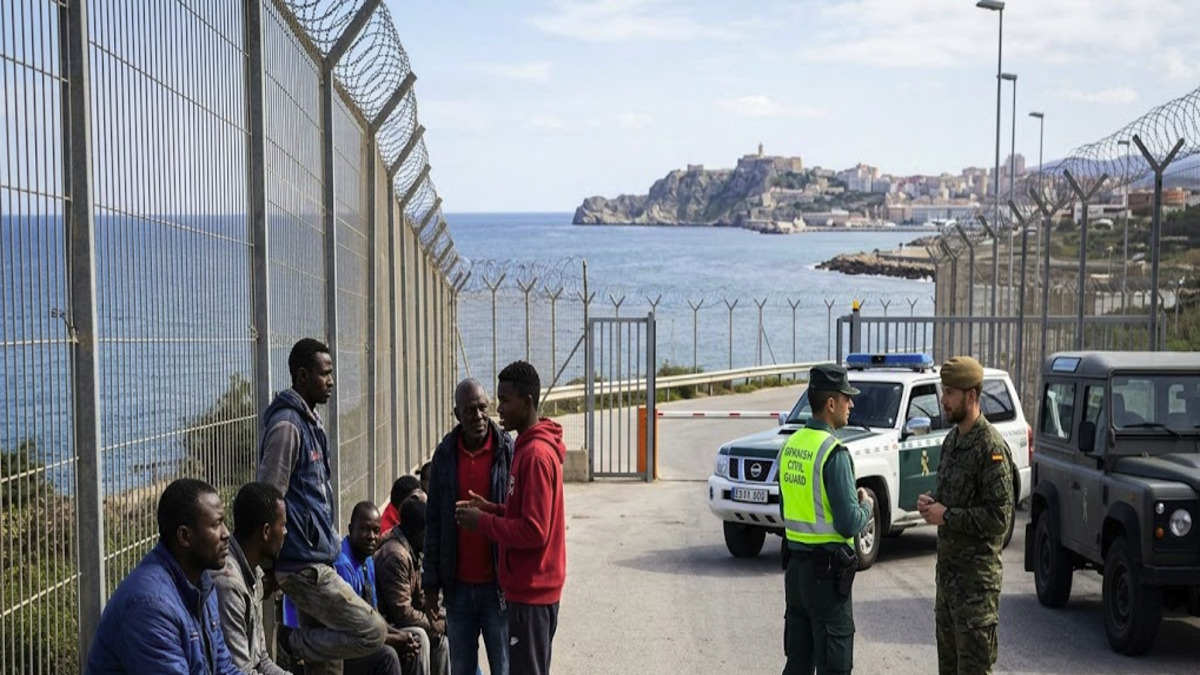
Spain sent soldiers, police officers, drones, divers and boats to reinforce surveillance around Ceuta.
The armed forces were also used to strengthen security in Melilla after hundreds of attempted crossings were reported there.
The aim was to prevent a repeat of the events in Ceuta.
Grande-Marlaska said on Saturday that the city was returning to normal.
Businesses had reopened and, according to the interior minister, the situation had almost completely been reversed.
The improvement did not mean the security operation was over.
Spain began installing an inflatable maritime barrier designed to make further irregular entries more difficult.
Pedro Sánchez visited Ceuta after the mass arrival and raised the possibility of reinforcing the border with Morocco.
The Spanish prime minister blamed trafficking organisations for driving the movement.
According to Sánchez, those networks had used an interpretation of a Spanish Supreme Court ruling and spread that interpretation rapidly.
He described the events as a “violation of Spain’s territorial integrity”.
Cooperation with Morocco has become another central part of the Spanish response.
Sánchez said Moroccan authorities were working with Spain to facilitate the return of people who had reached Ceuta.
Supreme Court ruling becomes part of the migration debate
The Ceuta border crisis is also linked to a court ruling issued in June.
Spain’s Supreme Court ruled that migrants intercepted at sea while attempting to reach Ceuta or Melilla cannot simply be returned to Morocco without following the required legal procedure.
The ruling subsequently became part of the political debate surrounding the mass arrival.
Sánchez argued that trafficking networks had promoted a self-serving interpretation of the judgment.
According to the prime minister, that interpretation spread rapidly among people attempting to reach the enclave.
The ruling concerns legal safeguards that must be followed in certain maritime interception cases.
It therefore became an important element of the political discussion following the emergency.
Ceuta has long been a route used by people attempting to reach Europe.
Summer months often see attempts to enter the enclave.
Some movements are organised through social media.
There is also a recent precedent.
In 2021, around 8,000 people entered Ceuta over a period of several days.
That episode caused a major deterioration in diplomatic relations between Spain and Morocco.
The city’s geography provides several possible routes for people attempting to enter.
Some migrants try to reach Ceuta from Morocco by swimming several kilometres.
The land border is protected by security infrastructure that Spain has strengthened following previous incidents.
Morocco becomes central to Spain’s response
Relations with Rabat are crucial to managing the situation.
The Spanish government says Moroccan authorities are cooperating to facilitate returns.
The 22 European countries that called for emergency talks also welcomed the cooperation between Spain and Morocco.
For Madrid, coordination with Morocco is necessary both to manage departures and to reduce the possibility of further crossings.
Spain has combined that cooperation with additional security resources along the border.
Sánchez also wants the European Union to become directly involved.
That is why he continues to press for a meeting of EU interior ministers.
The Spain-Morocco migration crisis comes at a time when Spain’s wider immigration policy is already being debated.
In April, the Spanish government approved plans to grant legal status to around 500,000 undocumented migrants.
The measure would allow them to formally enter the workforce.
Giorgia Meloni had already criticised that policy.
The Italian prime minister argued that Spanish decisions could have consequences for neighbouring countries.
The mass arrival in Ceuta has brought those differences back into the spotlight.
Germany backs Madrid as European governments consider tighter controls
The European response has not been uniform.
German Chancellor Friedrich Merz backed Spain’s intention to prevent irregular migrants from reaching the European continent.
He also called on Morocco to immediately take back people who had entered irregularly.
France strengthened checks along its border with Spain.
Portugal considered similar measures.
Italy, Finland, Denmark and the Czech Republic proposed different approaches involving border controls and Schengen cooperation.
Germany, meanwhile, publicly supported Madrid’s handling of the situation.
The different positions reveal a clear division within Europe.
Spain is calling for solidarity and coordination.
Other governments are more concerned that intense pressure on one border could eventually lead to further movements towards their own territories.
The European Commission maintains that arrivals must comply with EU rules.
Spain adds that protecting the bloc’s external borders is a shared responsibility.
That disagreement is one of the main reasons Sánchez wants an extraordinary meeting of European interior ministers.
Europe is tightening its migration framework
The events in Ceuta come as the European Union is already changing its migration rules.
In June, the European Parliament approved tougher measures giving authorities greater powers to return people who arrive irregularly.
The changes came amid a broader European debate over border controls and returns.
Spain is part of that process while continuing its own integration policies.
Sánchez’s government argues that stronger border controls can coexist with measures designed to help migrants enter the formal labour market.
The plan to regularise around 500,000 undocumented migrants had already attracted criticism before the Ceuta emergency.
The border crisis has now brought Spain’s migration policy back into the focus of other European governments.
Two separate issues are being discussed.
One concerns border security.
The other concerns policies affecting people already living in Spain.
International criticism has brought both issues into the same political debate.
Madrid insists that the situation should be handled through the European Union’s existing cooperation mechanisms.
Washington also reacts to the Ceuta emergency
The developments attracted attention beyond Europe.
The US State Department attributed the episode directly to Spain’s migration policies.
Donald Trump called the situation a “catastrophe” and said the images appeared to show an invasion of a country by hundreds of thousands of people.
The American comments added another international dimension to an already tense dispute.
In Brussels, EU Commissioner Magnus Brunner said none of the people who had arrived had crossed into mainland Europe.
That point is significant in the discussion surrounding Schengen.
Spain maintains that it prevented unauthorised movement towards the continent and restored control of its border.
Meanwhile, security deployments remain strengthened in Ceuta and Melilla.
Cooperation with Morocco continues to form part of the Spanish strategy.
The Ceuta migration crisis moves from the border to European capitals
The situation on the streets of Ceuta has eased since the mass arrival.
Businesses reopened and the Spanish government said almost all of the people who had reached the city had subsequently left.
The political dispute, however, remains unresolved.
Italy has taken temporary measures related to Schengen.
Finland and Denmark have discussed possible internal border controls.
France has increased checks along its border with Spain, while Portugal is considering stronger measures.
Germany has supported Madrid.
At the same time, 22 EU governments have called for emergency discussions.
Pedro Sánchez wants European interior ministers to examine the situation and agree on a coordinated response.
The Spanish government argues that responsibility for protecting an external EU border cannot rest solely with the country on the front line.
In Ceuta, security measures remain strengthened.
Spain has also begun installing an inflatable maritime barrier intended to make further irregular crossings more difficult.
Cooperation with Morocco continues as Madrid seeks greater support from its European partners.
The Ceuta migration crisis has therefore become more than a border emergency. The dispute has moved into European capitals, where governments now face a wider question over how the bloc should respond to similar migration pressures in the future.
Frequently Asked Questions about the Ceuta Migration Crisis
How many migrants arrived in Ceuta?
Authorities put the number at around 60,000 people arriving from Morocco.
When did the mass arrival take place?
The main episode occurred on 30 July.
How many people died?
Spanish Interior Minister Fernando Grande-Marlaska reported at least 67 deaths.
What is Pedro Sánchez asking from the European Union?
The Spanish prime minister is calling for an urgent meeting of EU interior ministers to coordinate the European response to the border situation…….MORE