
CIUDAD – ECO NOTICIA: Migration crisis in Ceuta has entered a more tense phase after protests, clashes and disruptions to humanitarian assistance raised concerns over public order in the Spanish North African city. The situation has brought residents, migrants, police, humanitarian organisations and the central government into an increasingly difficult confrontation. What is happening in Ceuta, and why has finding a solution become so complicated?

Migration crisis in Ceuta: tension rises on the streets
Ceuta is facing a growing social and humanitarian challenge after thousands of migrants remained in the city following a large-scale arrival from Morocco.
The situation has become increasingly visible in public spaces, particularly around coastal areas where some migrants have been sleeping outdoors while authorities work to identify them and determine their individual legal circumstances.

The latest escalation has involved demonstrations by residents, police interventions and confrontations between protesters and migrants.
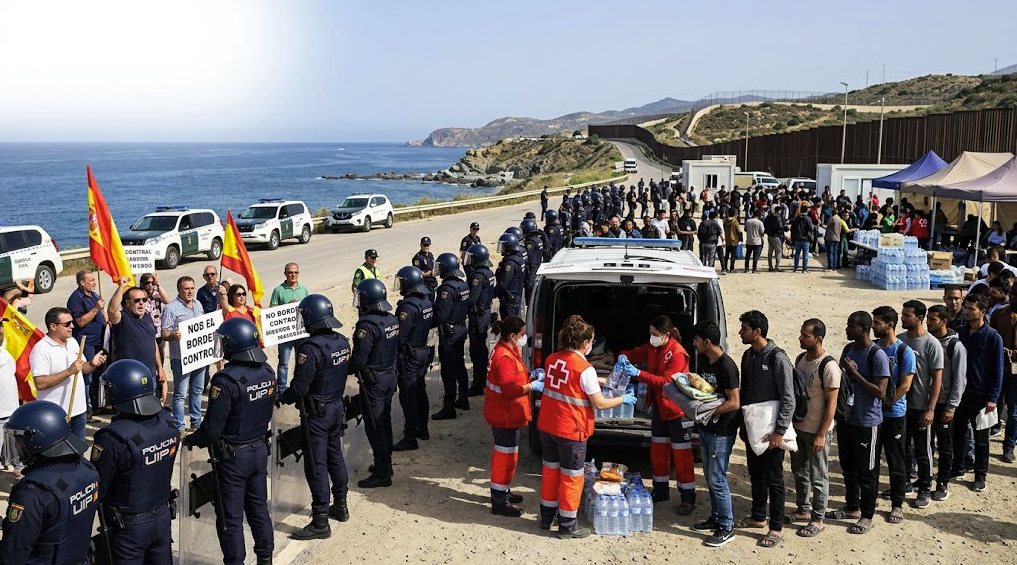
One of the most sensitive incidents involved the distribution of food by the Red Cross.
Humanitarian workers were temporarily prevented from reaching an area where migrants were staying, prompting concern among authorities that humanitarian assistance could become another source of confrontation.
The developments have added a new dimension to an already complex situation involving migration management, accommodation, public security and relations between Spain and Morocco.
The Spanish government has called for calm and condemned attacks or intimidation against migrants, humanitarian workers, journalists and residents.
How the situation in Ceuta developed
The current crisis follows the mass arrival of migrants from Morocco at the end of July.
Spanish authorities have revised their estimates as information has been collected and verified. The Interior Ministry subsequently placed the number of people who entered Ceuta during the episode at around 72,000.
The government has also said that more than 70,000 people subsequently left the city, largely through returns to Morocco.
The remaining population has created significant pressure on Ceuta’s limited infrastructure.
Authorities have had to deal with people sleeping outdoors while simultaneously carrying out identification procedures and assessing individual legal circumstances.
The situation is particularly sensitive when unaccompanied minors are involved because they receive additional legal protection.
The Spanish government has rejected the idea of indiscriminate mass expulsions and maintains that individual circumstances must be examined before decisions are taken.
This process requires personnel, facilities and time, all of which have become increasingly important as the number of people requiring assistance remains high.
Humanitarian aid becomes part of the confrontation
Food distribution had been one of the activities continuing despite the wider crisis.
Red Cross workers have provided meals and other basic assistance to migrants staying in different parts of Ceuta.
That work came under pressure when protesters blocked access to vehicles carrying food to migrants near El Trampolín beach.
The incident raised concern because humanitarian organisations need to be able to operate without intimidation or obstruction.
Spanish authorities subsequently called for humanitarian workers to be protected and for political disagreements not to interfere with basic assistance.
The confrontation later extended beyond the initial protest, with disturbances reported in areas occupied by migrants.
Police officers intervened to prevent the situation from escalating further.
The incidents have increased concerns among humanitarian workers about their personal safety.
The government has stressed that volunteers providing food and assistance should not become targets because of the political dispute surrounding migration.
The government strengthens identification procedures
One of the central challenges facing the authorities is identifying the people who remain in Ceuta.
The Interior Ministry has strengthened the identification and triage operation in the city and has increased resources dedicated to processing migrants.
Specialist personnel linked to international protection procedures have also been incorporated into the response.
The purpose is to establish who the people are, determine their individual circumstances and identify which legal procedure applies in each case.
This process is especially important for people who may have grounds to request international protection.
It is also essential for distinguishing between adults and minors, as unaccompanied children fall under a different protection framework.
The government argues that accelerating these procedures is necessary to reduce the time migrants spend in public spaces.
But the authorities face a practical problem: identification requires suitable facilities, while the city has limited available space.
Accommodation remains one of the biggest obstacles
Finding suitable accommodation has become one of the most difficult aspects of the crisis.
The government and local authorities have examined different locations where temporary facilities could be established.
One of the areas considered is close to El Tarajal, near the border with Morocco.
However, some of the proposed locations lack the infrastructure required to accommodate large numbers of people.
Electricity, water and sanitation are among the basic requirements before a site can operate safely.
This has created a difficult situation.
Residents want migrants moved away from beaches and public spaces, but proposals for new temporary accommodation can themselves face opposition when residents believe the facilities would be too close to residential areas.
The authorities therefore have to balance several competing demands at the same time.
They need to provide humanitarian assistance, maintain public order, respect legal obligations and reduce the impact of the crisis on residents.
The security situation becomes more difficult
The deterioration in relations between some residents and migrants has increased pressure on police forces.
Officers have intervened to separate groups and prevent confrontations.
Another incident involved Spanish military personnel.
According to reports cited by Spanish media, a military vehicle was surrounded by a group of migrants during the early hours of Thursday and was struck by stones and other objects.
The incident resulted in a police response and the detention of Moroccan nationals.
One soldier reportedly suffered minor injuries.
Authorities are investigating the circumstances surrounding the incident.
The episode added to concerns about public order at a time when demonstrations and confrontations were already increasing.
Government officials have repeatedly called for restraint and have insisted that criminal incidents must be investigated individually.
Residents demand greater security
Many residents have expressed frustration with the length of the crisis.
Their concerns include security, sanitation, the use of public spaces and the continued presence of migrants sleeping outdoors.
Ceuta’s geographical characteristics make the issue particularly sensitive.
The city covers only around 18 square kilometres, leaving limited space for temporary accommodation and humanitarian infrastructure.
The concentration of migrants in beaches and other public areas has therefore become one of the most visible aspects of the crisis.
Local authorities have argued that Ceuta cannot indefinitely carry the burden alone.
They have called for greater support from the central government and for measures that allow public spaces to return to normal use.
At the same time, local officials have appealed to residents to demonstrate peacefully and avoid actions that could increase tensions.
Political pressure grows around the crisis
The situation has also become a major political dispute.
The People’s Party (PP) and Vox have strongly criticised the central government’s management of the crisis.
The opposition argues that the government reacted too slowly to the mass arrival and has failed to restore normality quickly enough.
The government rejects that assessment.
Ministers point to the large number of migrants who subsequently returned to Morocco and argue that cooperation with Rabat has been essential in managing the situation.
The government has also defended its decision to process individual cases rather than carry out indiscriminate expulsions.
This disagreement reflects a broader political debate about migration policy in Spain.
Ceuta has become one of the most visible points of that debate because its geographical position makes it particularly exposed to migration movements from neighbouring Morocco.
Ángel Víctor Torres calls for calm
Minister for Territorial Policy Ángel Víctor Torres has played a central role in coordinating the government’s response.
Torres has called on political parties and residents to reject violence regardless of who commits it.
He has specifically condemned attacks or intimidation directed at migrants, Muslim residents of Ceuta, journalists and humanitarian workers.
The minister has also highlighted the position of Red Cross volunteers who are involved in food distribution.
His message has been that humanitarian assistance must continue and that volunteers should not feel threatened while carrying out their work.
Ceuta’s regional president, Juan Jesús Vivas, has also called for calm.
The two sides of the political debate nevertheless remain far apart over how the crisis should be handled.
Concern grows over racist and xenophobic messages
Authorities are also increasingly concerned about the atmosphere on social media.
Government officials have warned about xenophobic and racist messages directed at migrants and Muslim residents.
The concern is not limited to offensive comments.
Officials are particularly worried about messages encouraging direct confrontation with migrants or portraying entire communities as responsible for the problems facing the city.
Such messages can intensify tensions at street level.
The government has therefore urged political leaders and citizens to avoid rhetoric that could encourage violence.
The issue is particularly sensitive in Ceuta, a city with a diverse population and longstanding links between Spanish and Moroccan communities.
Morocco remains central to the response
Spain’s relationship with Morocco remains an important part of the government’s strategy.
Madrid argues that cooperation with Rabat has helped facilitate the return of most people who entered Ceuta during the mass arrival.
The Interior Ministry has repeatedly stressed that cooperation with Moroccan authorities is essential for managing irregular migration and preventing new large-scale arrivals.
However, not every person can be treated in the same way.
Spanish authorities must determine each individual’s circumstances before deciding which legal procedure applies.
Some people may seek international protection, while unaccompanied minors receive specific safeguards.
This explains why the government has rejected claims that everyone remaining in Ceuta can simply be returned immediately.
The legal process is more complex and requires individual assessment.
The humanitarian dimension of the crisis
The situation is not solely a migration-control problem.
It has also become a humanitarian issue.
People who remain without adequate accommodation require food, water, medical assistance and basic protection.
Humanitarian organisations have therefore become an important part of the response.
The interruption of food deliveries highlighted how quickly humanitarian work can become affected by the wider political conflict.
Authorities face the challenge of maintaining assistance while simultaneously responding to protests and public-order concerns.
The situation also raises questions about how Spain distributes responsibility for migration management between the central government and Ceuta’s local administration.
Local officials argue that the city’s limited territory and resources make it difficult to manage the situation without additional national support.
Why the response is so complicated
The authorities are dealing with several problems at once.
They need to identify migrants, process possible asylum claims, protect minors, organise accommodation, maintain humanitarian assistance and prevent clashes.
At the same time, they must respond to residents demanding greater security and a return to normality.
Each issue affects the others.
Without accommodation, migrants remain in public spaces.
Their presence in public spaces contributes to local frustration.
Protests can disrupt humanitarian assistance.
Disruptions can increase tensions.
And further confrontations require a stronger police presence.
Breaking that cycle requires coordination between different levels of government and cooperation with humanitarian organisations.
What happens next?
The immediate priority for the authorities is to prevent further violence while increasing the capacity to identify and process people who remain in Ceuta.
The government is also continuing to look for suitable locations for temporary accommodation.
Additional resources are being directed towards identification procedures and the care of unaccompanied minors.
At the same time, authorities need to ensure that humanitarian organisations can continue distributing food and essential supplies safely.
The cooperation with Morocco will remain another key element of the response.
For Ceuta’s residents, however, the central question is whether these measures will translate into a visible return to normality.
The crisis has already placed significant pressure on the city’s public spaces and services.
The coming days will therefore be important.
If the authorities can accelerate identification, expand accommodation capacity and maintain humanitarian assistance while preventing new confrontations, the pressure on the city could begin to ease.
If tensions continue to rise, however, the migration issue risks developing into a broader social and public-order crisis.
For now, Ceuta remains caught between humanitarian needs, legal obligations, security concerns and a growing political confrontation.
Official Source
Spanish Ministry of the Interior — official information on the situation in Ceuta and the government’s migration response.
Spanish Ministry of the Interior
Frequently Asked Questions
Why is Ceuta facing a migration crisis?
The current situation followed a mass arrival of migrants from Morocco at the end of July. Although most subsequently left the city, thousands remained and required identification, assistance and accommodation.
Why are residents protesting?
Some residents are demanding greater security and a solution to the presence of migrants sleeping in public spaces, particularly around coastal areas.
Why has Red Cross assistance become controversial?
Protesters temporarily blocked humanitarian vehicles carrying food to migrants, turning an essential aid operation into another point of confrontation.
What is the Spanish government doing?
The government has strengthened identification procedures, increased resources for migrant assistance, searched for additional accommodation and continued cooperation with Morocco…….MORE