
MADRID – HIGHR NEWS: Maricarmen Abascal eviction has ended with an 87-year-old woman leaving the Madrid apartment where she had lived for more than seven decades, after a long-running legal dispute over her rent-controlled tenancy and a sharp increase in the rent demanded by the property owner. How did a decades-old rental agreement lead to an eviction that drew hundreds of supporters, public figures and housing activists to the streets?

Maricarmen Abascal eviction ends after decades in Madrid home
Maricarmen Abascal, an 87-year-old woman with a recognized 50% disability, was removed from her apartment on Calle Alcalde Sáinz de Baranda in Madrid’s Retiro district following a fourth attempt to carry out the eviction.
The judicial commission eventually entered the property after police cleared demonstrators who had gathered around the building. Maricarmen was later taken from the apartment on a stretcher and transferred by ambulance to Gregorio Marañón Hospital because of her mobility difficulties.

The apartment had been her home since the 1950s. Her father originally signed the tenancy agreement, and Maricarmen later continued living there after the tenancy passed first to her mother and then to her.
For decades, the arrangement operated under Spain’s former rent-controlled system, commonly known as renta antigua. The system provided tenants with stronger protections and rental conditions that differed substantially from those applying to newer contracts.
The dispute became particularly complicated because of the rules governing the transfer of older tenancy agreements between family members.
According to reporting on the case, Maricarmen’s father signed the original agreement in 1956. After his death, the tenancy passed to his wife. When Maricarmen’s mother died in 2005, the contract passed again to Maricarmen.
The property owner later argued that the second succession did not allow the old rental arrangement to continue indefinitely. The dispute eventually reached the courts, with the ownership side prevailing in the judicial process.
Maricarmen Abascal eviction followed a dispute over rent
One of the central issues in the case was the difference between the rent Maricarmen had been paying and the amount demanded by the property owner.
For years, she had paid roughly €500 a month. The property company, Urbagestión Desarrollo e Inversión S.L., sought a substantially higher monthly payment after the dispute over the old tenancy arrangement.
Reports published before the eviction put the proposed new rent at €2,650 per month. That amount was far beyond Maricarmen’s pension, reported at around €1,350 to €1,400 a month.
The figures became one of the most visible elements of the dispute because the proposed rent was significantly higher than the income available to the elderly tenant.
The property had changed hands before the conflict reached its final stage. Reporting indicates that the building was acquired by Urbagestión after an earlier sale involving the previous owners.
Maricarmen had also reportedly been offered the opportunity to purchase the apartment for €247,000, but she did not have the money required to buy it. The subsequent dispute centered on whether she could continue occupying the property under the old rental arrangement.
Her supporters argued that the case illustrated the difficulties faced by elderly tenants whose housing arrangements originated under an earlier legal framework.
The owners, meanwhile, relied on the legal position concerning the succession of the old tenancy contract. The matter ultimately moved through the courts before the eviction was carried out.
Why the old rental contract became important
The renta antigua system dates back to an earlier period of Spanish housing law. Contracts from that era could provide tenants with protections and rental conditions that differed greatly from those available in the contemporary rental market.
Spain’s Urban Leases Law contains transitional provisions governing certain older agreements and rules concerning the succession of tenancy rights. The legal treatment depends on factors including the date of the original contract and the circumstances of the person seeking to continue the tenancy.
The official text of Spain’s Urban Leases Law is available through the Boletín Oficial del Estado.
In Maricarmen’s case, the question of successive transfers within the family became central to the legal dispute. Reporting on the case says the property owner challenged her right to remain under the original agreement after the tenancy had already passed from her father to her mother and subsequently to Maricarmen.
Hundreds gathered as Maricarmen Abascal eviction approached
The eviction did not take place without resistance.
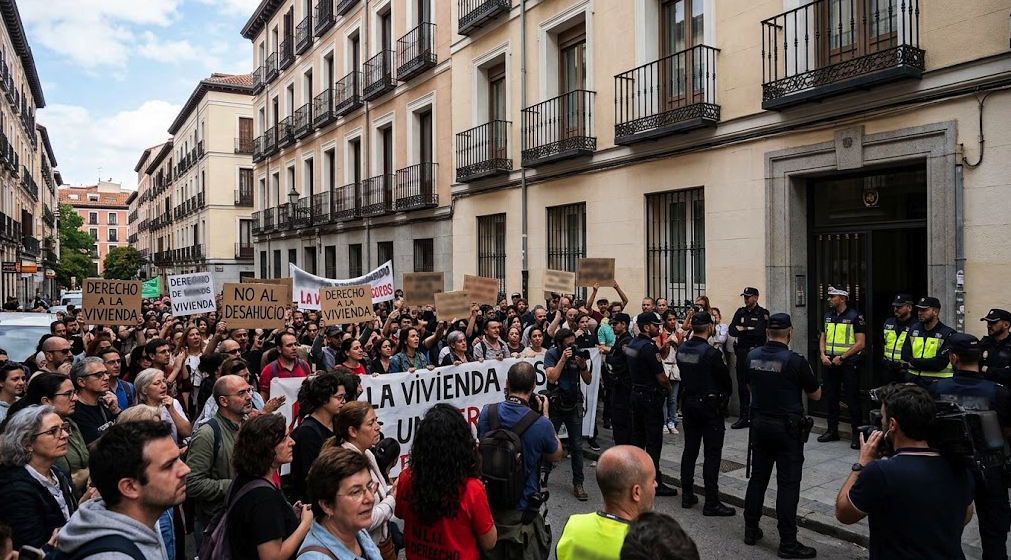
Housing activists, neighbors and supporters gathered outside the building in the hours before the judicial commission arrived. The Madrid Tenants’ Union organized a demonstration and overnight protest, with people remaining outside the entrance in an effort to prevent Maricarmen from being removed.
The gathering attracted hundreds of people. Supporters repeatedly shouted messages of solidarity, including “Maricarmen, you’re not alone.”
Several well-known Spanish cultural figures also joined the campaign. Among those reported at demonstrations or expressing support were actors and musicians including Juan Diego Botto, Carlos Bardem, Sergio Peris-Mencheta and singer Marwan.
Ana Belén also appeared at one of the gatherings. She recited a poem by Rafael Alberti and performed an adapted version of the song “La Puerta de Alcalá.”
The presence of public figures brought additional national attention to a dispute that had already become a prominent housing story in Madrid.
Before the eviction, Maricarmen had spoken to supporters outside her building. Despite her physical condition, she urged other people experiencing housing difficulties to defend their rights.
Her message was direct: “Fight, don’t stay at home, fight for your housing, because we have the right to live.”
The statement became part of the wider campaign surrounding her case.
Police clear protesters before the eviction
The operation began with a significant police presence around the building.
According to reports, officers established a perimeter and cleared tents and demonstrators from the area so that the judicial commission could enter the property.
Activists accused police of using excessive force during the operation. The Madrid Tenants’ Union also alleged that officers used gas against protesters. Other reporting described clashes as police cleared the entrance and surrounding area.
The police action allowed the judicial delegation to proceed with the eviction.
Inside the building, some protesters attempted to resist peacefully by remaining in areas that obstructed access. Officers removed people from the entrance and stairwell.
The operation continued despite negotiations and proposals aimed at finding an alternative solution.
Eventually, Maricarmen was removed from the apartment.
Because of her mobility problems, emergency medical personnel assisted her and transported her on a stretcher to an ambulance. Footage and photographs from the scene showed supporters gathered behind the police cordon as she left the building.
An offer to pay the rent failed to stop the eviction
In the final days before the eviction, another possible solution emerged.
A well-known writer, who chose not to make her identity public, offered to cover the difference between Maricarmen’s existing payment and the higher rent demanded by the property owner.
Under the proposal, Maricarmen would continue paying approximately €500 a month while the donor would cover the remaining amount needed to reach the €2,650 requested by the company.
The writer also reportedly offered to assume the debt and continue paying the additional amount for as long as necessary.
The offer was communicated through the Madrid Tenants’ Union, which sought to negotiate with the company’s lawyer. However, the proposal did not stop the eviction.
The case also attracted attention from public institutions.
Reports said the Ministry of Housing sought alternatives and that Spain’s government supported efforts to find a solution. There were also calls for the authorities to suspend the eviction and provide suitable accommodation.
The City of Madrid said it had offered assistance, including help finding alternative accommodation. Housing campaigners and Maricarmen disputed aspects of those offers, arguing that some proposed alternatives were unsuitable or financially inaccessible.
The disagreement over possible alternative housing remained unresolved when the judicial eviction took place.
A seven-decade connection to one Madrid apartment
For Maricarmen, the dispute was not simply about the amount of monthly rent.
The apartment had been her home since childhood. She had lived there with her parents and remained there after their deaths.
Her father died first, after which her mother continued under the tenancy arrangement. When her mother died in 2005, Maricarmen remained in the apartment.
Over the years, the home became closely connected to her family history and personal memories.
By the time the eviction was carried out, she had spent more than seven decades in the same building.
Her physical condition had also deteriorated during the prolonged legal dispute. Reports before the eviction said she had lost strength and muscle mass and had begun using a wheelchair. Her recognized disability stands at 50%.
The combination of her age, disability, limited income and long connection to the property made the case particularly prominent among housing campaigners.
Supporters described her situation as an example of the tension between older protected rental agreements and Madrid’s current property market.
The property owner, however, pursued the case through the courts and ultimately obtained possession of the apartment.
What the Maricarmen Abascal eviction means for the housing debate
The case has become part of a wider discussion in Spain about affordable housing, older rental agreements and the difficulties faced by tenants when properties change ownership.
It also highlights the legal complexity surrounding contracts created under earlier rental legislation.
For tenants, the issue can involve more than the current market value of a property. Long-term agreements may contain historical rights and obligations that have changed through successive pieces of legislation.
For property owners, disputes over these agreements can involve questions about possession, succession and the legal limits of older contracts.
Maricarmen’s case brought those issues into public view because of the unusually long period she had lived in the apartment and the large difference between her existing rent and the amount demanded by the property owner.
The eviction also demonstrated how a single housing dispute can generate a broad public response.
Neighbors, activists, lawyers, artists and members of the public gathered around the building. A proposed private payment solution was discussed. Government institutions became involved in attempts to identify alternatives. International attention was also reported.
None of those efforts prevented the judicial commission from carrying out the eviction.
Maricarmen ultimately left the apartment on a stretcher and was taken to hospital after the operation.
The case therefore closes one chapter of a long legal dispute while leaving wider questions about housing affordability, older tenancy agreements and protection for vulnerable renters at the center of public discussion.
Frequently Asked Questions
Who is Maricarmen Abascal?
Maricarmen Abascal is an 87-year-old Madrid resident who had lived in the same apartment for more than seven decades.
Why was Maricarmen Abascal evicted?
The dispute centered on her right to continue under an old rent-controlled tenancy agreement after successive transfers of the contract within her family.
How much rent had Maricarmen been paying?
Reports put her previous monthly rent at around €500, while the property owner sought a substantially higher monthly payment.
Where did Maricarmen go after the eviction?
She was removed from the apartment on a stretcher and taken by ambulance to Gregorio Marañón Hospital because of her mobility difficulties…….MORE