
CITY – HIGRH NEWS: Ceuta migration crisis has become a central issue in Spain’s international message, with Prime Minister Pedro Sánchez defending Madrid’s response to the mass arrival of migrants and insisting that Spain will not abandon international law or human rights. What happened at the border, and what position has Sánchez presented before the international community?

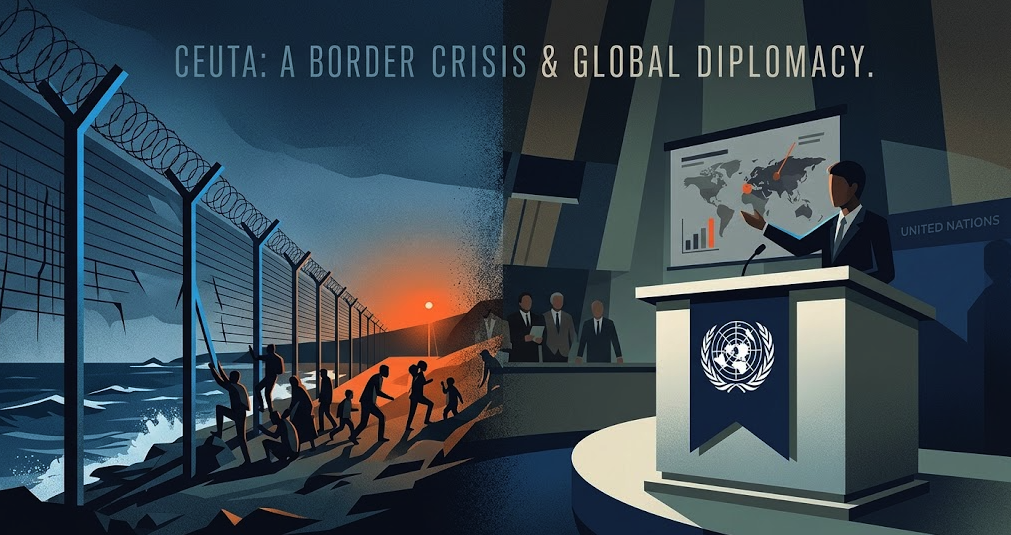
Pedro Sánchez used his appearance at the United Nations in New York to defend Spain’s handling of the migration emergency in Ceuta and to outline the principles that, he said, should guide the response to irregular migration.
The Spanish prime minister said his country would not respond to migration by turning migrants into an enemy. He also rejected abandoning international law or human rights in response to pressure at the border.

The remarks came after one of the largest migration emergencies experienced by Ceuta, when tens of thousands of people entered the Spanish autonomous city after crossing from Morocco.
According to figures presented by the Spanish government, around 70,000 people entered Ceuta irregularly during the events of July 30 and 31.
The scale of the arrival placed considerable pressure on the city’s security, accommodation and humanitarian resources. Spanish authorities subsequently reinforced the border and accelerated procedures for people who had no legal right to remain in Spain.
The Ceuta migration crisis brought around 70,000 arrivals
The events began with a mass movement of people towards Ceuta from the Moroccan side of the border.
The Spanish government said that approximately 70,000 people had entered the autonomous city irregularly by the time the emergency reached its most intense stage.
The number presented an immediate challenge for local and national authorities. Ceuta has a limited geographical area and a population that could not absorb such a large and sudden arrival without substantial reinforcement from the central government.
Spain responded by increasing the presence of the National Police and Civil Guard. The government also mobilised the Armed Forces and deployed additional maritime and aerial resources.
A 500-metre inflatable barrier was installed at the Tarajal breakwater, which Spanish authorities identified as the point where many migrants had entered by swimming.
The government said the additional security measures helped prevent further crossings during the days that followed.
At the same time, Spanish authorities began processing migrants who had entered the country and did not have the right to remain.
The government reported that around 50,000 people had returned to Morocco within less than 24 hours. After 72 hours, the number of returns had risen to approximately 63,000, representing more than 90% of those who had crossed during the crisis.
Spanish authorities described the operation as one of the fastest large-scale return processes carried out in recent European history.
Sánchez rejects treating migrants as an enemy
The political message delivered by Sánchez at the United Nations focused on how governments should respond when migration creates intense pressure on borders.
The prime minister said Spain would not choose fear as its response to migration. He defended an approach based on the application of the law while maintaining respect for the dignity and rights of migrants.
That position reflects the argument Sánchez has also presented domestically: border control and humanitarian treatment, in the government’s view, do not have to be mutually exclusive.
The Spanish government has argued that authorities must reinforce borders while applying the legal procedures required for individual cases.
Sánchez has also rejected the idea of indiscriminate expulsions. His position is that migrants must be dealt with according to the applicable legal framework rather than treated collectively because of their method of entry.
The issue has remained politically sensitive in Ceuta, where the sudden arrival of tens of thousands of people created pressure on public services and generated an intense debate over border security.
The prime minister has nevertheless continued to present the response as a combination of stronger border controls, returns, humanitarian assistance and cooperation with Morocco.
Morocco and the failure of border controls
The Ceuta migration crisis also placed Spain’s relationship with Morocco under renewed scrutiny.
Sánchez acknowledged that Morocco’s border-control mechanisms failed during the mass arrival. He said Spain had asked the Moroccan authorities for explanations and for measures to prevent a repetition of the situation.
At the same time, the Spanish government has not presented the episode as proof that Moroccan authorities deliberately organised the mass crossing.
That distinction has remained important in Madrid’s public explanation of the crisis.
Sánchez has continued to recognise Morocco’s subsequent role in preventing new attempts to cross the border. Spanish authorities have highlighted the Moroccan security deployment around Ceuta and Melilla following the July events.
The Spanish prime minister also rejected suggestions that acknowledging the failure of the border-control system represented a fundamental change in Spain’s position towards Morocco.
He said the government’s position remained consistent: the controls had not been sufficient during the mass arrival, while Moroccan cooperation afterwards had helped prevent further crossings.
The issue illustrates the complexity of Spain’s relationship with its North African neighbour. Morocco is simultaneously a key partner in border control and a country whose cooperation is essential to Spain’s migration-management strategy.
Humanitarian assistance alongside border security
The emergency in Ceuta was not limited to border security.
Spanish authorities also had to provide food, accommodation and other humanitarian assistance to thousands of people who remained in the city after the mass arrival.
The government announced an initial humanitarian assistance package worth €7 million.
That funding supported the distribution of food and other immediate assistance while authorities worked to identify migrants and determine the legal procedures applicable to each case.
The government also increased temporary accommodation capacity and reinforced immigration teams.
The scale of the emergency meant that existing resources were insufficient to deal with the sudden increase in the number of people requiring assistance.
The Spanish authorities therefore combined emergency humanitarian measures with the accelerated processing of returns.
Sánchez has repeatedly argued that this combination demonstrates that governments can protect their borders without abandoning humanitarian obligations.
The same argument formed part of his international message: migration management, according to the Spanish government, requires both effective control and respect for individual rights.
The role of misinformation and social media
Sánchez has also pointed to the growing role of social media and misinformation in modern migration emergencies.
In his explanation of the Ceuta events, the Spanish prime minister said false information circulated before the mass crossing and contributed to the circumstances surrounding the crisis.
He also argued that new technologies can create what he described as new forms of hybrid threats that governments must learn to identify and counter.
The issue has become particularly relevant to border management because information can spread rapidly across digital platforms, potentially encouraging large groups of people to move towards a border within a short period.
For Spain, the Ceuta episode demonstrated the difficulty of predicting such movements using traditional intelligence and border-monitoring systems.
Sánchez acknowledged that Spain needs to strengthen its capabilities in this area.
The government has also rejected claims that it received a clear warning predicting the arrival of approximately 70,000 people and deliberately failed to act.
According to Sánchez, no report reaching the Spanish government had predicted an event of that magnitude.
Spain links migration to international cooperation
The Spanish prime minister used his United Nations appearance to place the Ceuta crisis within a broader discussion about migration and international cooperation.
Sánchez linked major migration movements to factors including inequality, desperation and disinformation.
His argument was that migration cannot be managed exclusively through border controls. Cooperation with countries of origin, transit and destination also forms part of Spain’s approach.
Madrid has repeatedly emphasised cooperation with African countries as an important element of its migration policy.
In the case of Morocco, that cooperation is particularly significant because of the country’s geographical position and its role in controlling movement towards Spain.
The Ceuta crisis demonstrated how quickly a breakdown in border control can generate consequences for Spain and the wider European Union.
It also showed the dependence of European migration policy on cooperation with countries outside the EU.
Sánchez therefore presented the issue at the United Nations as part of a wider challenge requiring international coordination rather than isolated national responses.
Sánchez criticises cuts to international development assistance
Migration was not the only international issue raised by Sánchez.
The Spanish prime minister also criticised the reduction in international development assistance and defended multilateral cooperation.
He said global development assistance had fallen by almost one-third over a two-year period, while Spain had doubled its international cooperation investment.
Sánchez also said Spain had increased its contribution to the multilateral system by 60%.
The Spanish government has presented development cooperation as one element of a broader effort to address the conditions that can contribute to migration and humanitarian crises.
His argument before the United Nations was that governments cannot address global challenges effectively if international cooperation continues to weaken.
The prime minister also criticised what he described as political forces that favour an increasingly narrow and self-interested approach to international relations.
He defended the United Nations and the principle of multilateral action, arguing that global problems require institutions capable of coordinating responses among different states.
Gaza, Ukraine and Spain’s defence policy
Sánchez also used his international appearance to address several armed conflicts.
He reiterated Spain’s opposition to wars of aggression and referred to conflicts involving Ukraine, Lebanon and Iran.
The Spanish government has maintained sanctions against Russia and has adopted measures relating to arms transfers to Israel.
Sánchez again described Israel’s actions in Gaza using the term “genocide”. The Spanish government has used that terminology, while Israeli authorities reject the characterisation.
The prime minister also defended Spain’s position on defence spending.
Spain has resisted the proposal to increase military expenditure to 5% of gross domestic product, arguing instead for a different approach to security and defence commitments.
These positions formed part of Sánchez’s broader argument that international security must operate within the framework of international law.
The prime minister linked questions of war, military policy and international institutions to the same principles he invoked when discussing migration.
Technology regulation becomes part of the international debate
Sánchez also addressed technological change and the growing influence of major technology companies.
He called for stronger regulation of large technology interests and raised concerns about the influence of major social-media platforms.
Artificial intelligence was another issue included in his international agenda.
The Spanish government has increasingly presented technological regulation as an international challenge because digital platforms and artificial-intelligence systems operate across national borders.
The discussion also connects with the migration crisis because social-media platforms played a role in the circulation of information before and during the events in Ceuta.
For Spain, the challenge is therefore not only how governments manage physical borders but also how they respond to digital information environments capable of influencing behaviour at large scale.
Sánchez calls for a Latin American woman to lead the UN
The Spanish prime minister also addressed the future leadership of the United Nations.
Sánchez argued that a woman from Latin America should become the next UN secretary-general.
He pointed out that nine men had held the position during the organisation’s history and highlighted the absence of a Latin American secretary-general for several decades.
His proposal formed part of a broader argument about equality and regional representation within international institutions.
Sánchez said the issue should be understood as part of the effort to improve representation within global organisations.
The proposal adds another dimension to his defence of multilateralism and the United Nations.
What the Ceuta crisis means for Spain’s migration policy
The response to the Ceuta emergency remains an important test of Spain’s migration policy.
The government has sought to demonstrate that stronger border protection can operate alongside humanitarian assistance and legal procedures.
The figures provided by the Spanish government show the extraordinary scale of the July events, with approximately 70,000 irregular arrivals and around 63,000 returns within 72 hours.
The episode also exposed the dependence of Spain’s border-management system on cooperation with Morocco.
At the same time, the government has acknowledged the need to improve its ability to identify rapidly developing threats involving social media and other technologies.
Sánchez’s message at the United Nations therefore combined several elements: stronger border control, cooperation with Morocco, humanitarian assistance, individual legal procedures and international cooperation.
The prime minister presented the response as an example of Spain’s broader approach to migration.
Rather than treating the Ceuta crisis as an isolated border incident, Sánchez placed it within a wider debate about inequality, misinformation, international cooperation and the rules governing relations between states.
The Spanish government’s position remains that border security and the protection of human rights should operate together.
For Ceuta, however, the events have left a lasting impact on public services, security planning and the political debate surrounding migration.
The crisis has also reinforced the importance of Morocco’s role in Spain’s migration strategy.
Sánchez’s appearance before the United Nations ultimately connected the local experience of Ceuta with broader international questions: how states manage migration, how they cooperate across borders and how they respond when established systems face sudden and exceptional pressure.
Official information about: Government of Spain regarding the Ceuta crisis
Frequently Asked Questions
What happened during the Ceuta migration crisis?
Around 70,000 people entered Ceuta irregularly during the mass arrival on July 30 and 31.
How many migrants returned to Morocco?
The Spanish government said around 63,000 people had returned within 72 hours.
What did Sánchez say about Morocco?
He acknowledged that Morocco’s border-control mechanisms had failed during the mass arrival while also recognising Morocco’s subsequent cooperation in preventing new crossings.
What was Sánchez’s position on migrants?
He said Spain would not treat migrants as the enemy and would continue to uphold international law and human rights…….MORE