
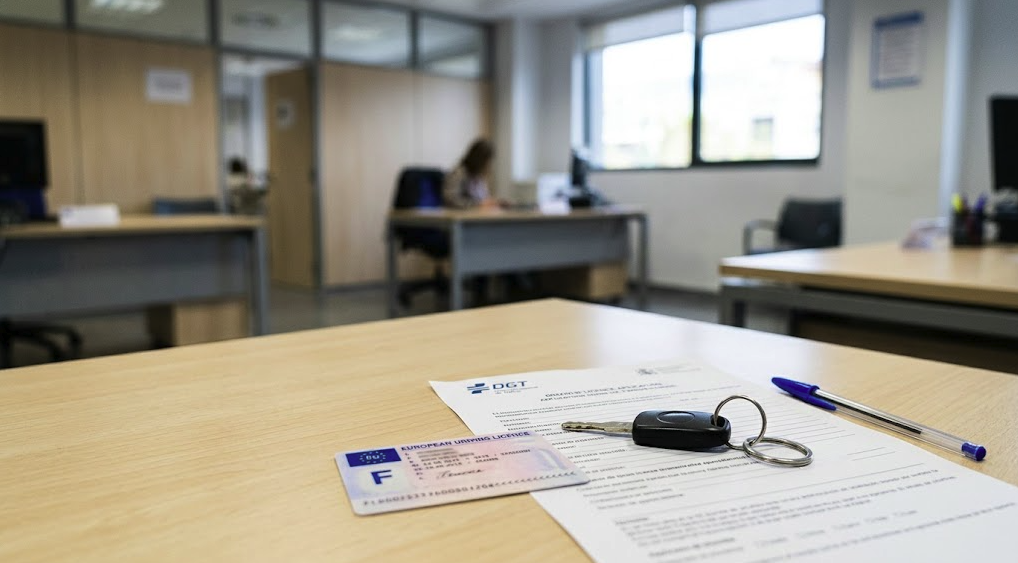

MADRID – HIGRH NEWS: EU and EEA driving licence exchange in Spain remains an important issue for European residents who drive in Spain and need to understand whether they must replace their foreign licence with a Spanish one. The Directorate-General for Traffic (DGT) states that holders of licences issued by European Union and European Economic Area countries can drive in Spain while their licences remain valid, meaning that an exchange is generally voluntary. However, special rules apply to licences with no expiry date or unusually long validity periods. So, when does a European driving licence need attention after moving to Spain?

EU and EEA driving licence exchange in Spain: what the DGT says
For residents in Spain, a driving licence issued by a European Union or European Economic Area country remains valid for driving in Spain as long as the document is still in force.
The DGT makes an important distinction here. Simply becoming resident in Spain does not, by itself, mean that the driver must immediately exchange a valid European licence for a Spanish one.

Instead, the exchange is voluntary for a valid EU or EEA licence under the conditions described by the traffic authority.
An exchange means replacing the foreign driving licence with an equivalent Spanish driving licence. Once the process is completed, the Spanish authority takes back the licence that the driver previously held.
This point matters for people who have recently moved to Spain. They may continue to use a valid European licence rather than automatically applying for a Spanish document.
The system covers licences issued by countries belonging to the European Union and the European Economic Area. The DGT’s information specifically addresses this group of foreign driving licences and explains the conditions applicable to residents in Spain.
For many drivers, the first question is therefore not whether they can exchange their licence, but whether they actually need to do so.
The answer depends primarily on the validity of the licence and its duration.
A normal EU or EEA driving licence that remains within its period of validity can continue to be used in Spain under the rules described by the DGT. The exchange becomes particularly relevant when the licence has an indefinite validity period or a validity period longer than the limits established for certain driving categories.
When a European driving licence requires renewal
The DGT sets out specific rules for European driving licences that have no expiry date.
The same rules apply to licences whose validity period exceeds certain limits.
For cars and motorcycles, the relevant categories listed by the DGT are AM, A1, A2, A, B and B+E. Where one of these licences has a validity period of more than 15 years, the holder must proceed with its renewal after two years have passed since establishing normal residence in Spain.
The rule also covers licences that have no expiry date at all.
This means that a driver cannot simply assume that an indefinite European licence will remain outside the Spanish renewal system after moving to the country.
The timing is important. The DGT refers to two years from the moment the driver establishes normal residence in Spain.
For professional and larger vehicle categories, the period is shorter.
The categories C1, C1+E, C, C+E, D1, D1+E, D and D+E cover trucks and buses. Where these licences have a validity period of more than five years, the same two-year residence point becomes relevant for renewal.
The DGT therefore uses different validity thresholds depending on the type of vehicle covered by the licence.
The 15-year and five-year thresholds
The distinction can be summarised clearly.
For the AM, A1, A2, A, B and B+E categories, the relevant threshold is more than 15 years.
For the C1, C1+E, C, C+E, D1, D1+E, D and D+E categories, the relevant threshold is more than five years.
Licences without an expiry date also fall within the specific renewal rules.
In these circumstances, the driver must proceed with renewal once two years have elapsed from establishing normal residence in Spain.
This is different from the general voluntary exchange of a valid EU or EEA licence.
EU and EEA driving licence exchange in Spain: residence requirements
Residence is another central part of the procedure.
A person cannot simply approach the exchange process without demonstrating their residence status in Spain. The DGT specifies different documents depending on whether the applicant is an EU citizen or a non-EU citizen.
For European Union citizens, the DGT requires evidence of registration as a foreign national in Spain.
For non-EU citizens holding a European driving licence, the information refers to a valid residence card.
The distinction is important because the driving licence and immigration or residence documentation serve different purposes.
The European driving licence establishes the driver’s entitlement to drive, while the residence documentation demonstrates the person’s status in Spain for the purposes of the procedure.
Once the relevant residence requirement is met, the applicant can proceed with the exchange process.
The DGT states that the foreign licence is exchanged for an equivalent Spanish driving licence. The original licence is withdrawn as part of the process.
Drivers should therefore understand that the exchange is not simply an additional registration of the European document. It is a replacement procedure.
The applicant ultimately receives a Spanish licence corresponding to the driving entitlements covered by the original document.
How the exchange process works
The procedure involves submitting the required documentation and completing the exchange through the DGT system.
The authority provides a provisional driving document while the permanent Spanish licence is being processed.
According to the information supplied by the DGT, the definitive licence may take approximately one and a half months to arrive.
The provisional document therefore plays an important role during the period between the exchange application and the arrival of the final Spanish driving licence.
The DGT also provides a way to check the status of the application after the procedure has started.
This allows applicants to follow the administrative progress rather than having to rely only on the expected delivery period.
The exchange itself does not require the applicant to take a new driving test for an EU or EEA licence under the procedure described by the DGT.
That distinguishes these licences from certain arrangements involving driving licences issued outside the European system.
For European licence holders, the process is based on the recognition and replacement of the existing entitlement rather than retaking the driving examination.
The exact documentation and administrative steps should always be checked against the official DGT information before an application is submitted, particularly where the licence has an unusual validity period or the driver’s residence situation has changed.
What happens when the licence is about to expire?
A European licence that is approaching its expiry date requires a different approach from a licence that remains comfortably within its validity period.
The DGT provides procedures for situations involving replacement or duplication of European driving licences.
The information also covers circumstances in which the document has been lost, stolen or damaged.
For drivers living in Spain, the condition of the physical licence therefore matters alongside its legal validity.
A licence may still represent a valid entitlement, but a damaged or missing document can require a separate administrative procedure.
Drivers should also distinguish an ordinary expiry date from a licence that has no expiry date or remains valid for an unusually long period.
The latter category is particularly important for residents who have lived in Spain for two years or more, because the DGT’s rules introduce a renewal requirement for licences with indefinite validity or validity beyond the applicable thresholds.
The timing of residence is therefore a key factor.
A person who has just established normal residence in Spain does not face the same immediate situation as someone who has already passed the two-year period covered by the DGT’s rule.
The difference between exchange and renewal
The words “exchange” and “renewal” describe different situations within the DGT framework.
An exchange involves replacing an EU or EEA driving licence with an equivalent Spanish licence. The DGT describes this exchange as voluntary when the European licence remains valid.
Renewal becomes particularly relevant for licences with no expiry date or with validity periods exceeding the thresholds established for the relevant categories.
This distinction is especially important for long-term residents.
A driver might have a valid European licence and decide voluntarily to obtain a Spanish equivalent. Another driver might hold a licence whose validity falls within the special rules and therefore need to complete the renewal process after the required residence period.
The two procedures should not be treated as identical simply because both can result in a Spanish driving document.
The DGT’s framework separates ordinary voluntary exchange from the specific renewal requirement connected with indefinite or unusually long validity.
For residents, checking the expiry information printed on the licence is therefore one of the first practical steps.
The category of vehicle covered by the licence should also be checked because the applicable validity threshold differs between cars and motorcycles on one side and trucks and buses on the other.
EU and EEA licences are different from licences issued outside Europe
Another important distinction concerns licences issued by countries outside the European Union and European Economic Area.
The rules for those documents are not automatically the same.
The DGT maintains separate information for foreign licences issued outside the EU and EEA framework. Their validity and exchange conditions depend on the applicable Spanish rules and, where relevant, agreements with the country that issued the licence.
For an EU or EEA licence, the general position described by the DGT is that the document remains valid in Spain while it remains in force.
That is why a resident should not automatically assume that a Spanish exchange is mandatory simply because the person has moved to Spain.
The European framework provides a different treatment from that applicable to many third-country licences.
This distinction can prevent unnecessary administrative steps and, equally importantly, help drivers identify when a renewal obligation does apply.
The safest approach is to identify the country that issued the licence, check its validity period, identify the driving category and establish when normal residence in Spain began.
Those details determine which part of the DGT rules applies.
What drivers should check before applying
Before starting an exchange, European licence holders should check several basic details.
First, they should confirm whether the licence is still valid.
Second, they should look at the period of validity. A document with no expiry date requires particular attention because the DGT applies a specific renewal rule to residents in Spain.
Third, drivers should identify the category appearing on the licence. The 15-year threshold applies to AM, A1, A2, A, B and B+E, while the five-year threshold applies to C1, C1+E, C, C+E, D1, D1+E, D and D+E.
Fourth, they should establish the date on which they became normally resident in Spain.
Finally, they should prepare the residence documentation required for the application.
For EU citizens, the DGT refers to registration as a foreign national. For non-EU citizens, the relevant document is a valid residence card.
Once the exchange takes place, the original foreign driving licence is withdrawn and the Spanish equivalent becomes the replacement document.
A practical point for EU and EEA residents in Spain
For many European residents, the most important information is reassuring: holding an EU or EEA driving licence does not automatically create an obligation to exchange it immediately after moving to Spain.
The licence remains valid while it is in force.
However, the situation changes for licences without an expiry date and for those whose validity exceeds the periods specified by the DGT.
For car and motorcycle categories AM, A1, A2, A, B and B+E, the relevant period is more than 15 years.
For truck and bus categories C1, C1+E, C, C+E, D1, D1+E, D and D+E, the relevant period is more than five years.
In these cases, the DGT states that renewal must take place after two years from establishing normal residence in Spain.
The exchange process itself replaces the European licence with an equivalent Spanish licence. The foreign document is withdrawn, and the DGT provides a provisional document while the definitive Spanish licence is processed.
The information published by the DGT and referenced for this report was updated on 17 November 2020. Drivers dealing with an individual case should verify the applicable procedure and documentation directly with the traffic authority before submitting an application.
For official information, readers can consult the Dirección General de Tráfico (DGT).
Frequently Asked Questions
Do EU driving licences remain valid in Spain?
Yes. According to the DGT information covered in this report, an EU or EEA driving licence remains valid in Spain while it is in force.
Is exchanging an EU or EEA licence mandatory?
No. The DGT describes the exchange as voluntary for a valid EU or EEA licence, subject to the specific rules concerning licences with indefinite or unusually long validity.
What happens to the original licence after an exchange?
The foreign driving licence is withdrawn and replaced with an equivalent Spanish driving licence.
When must a long-validity licence be renewed?
For the licences covered by the DGT’s special rules, renewal takes place after two years from establishing normal residence in Spain. The relevant validity threshold is more than 15 years for certain car and motorcycle categories and more than five years for certain truck and bus categories.