
Daylight Saving Time in October 2026: Date, Time, and What the Official Bulletin Says
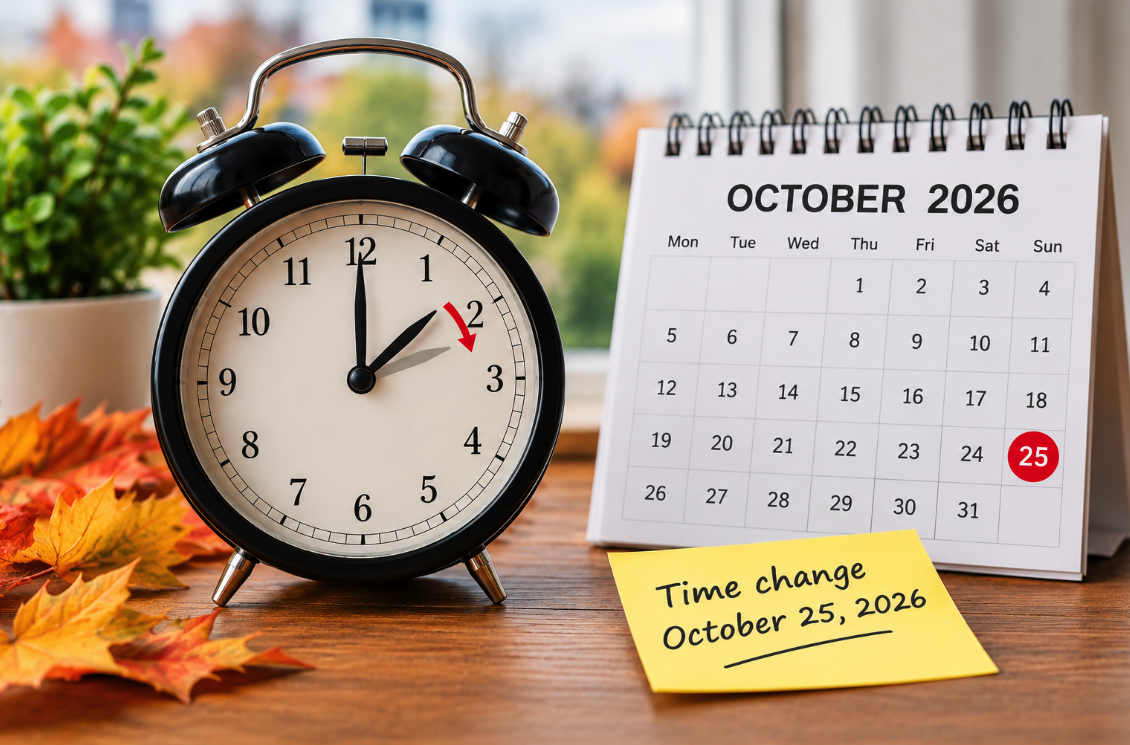
Autumn is well underway, and with it comes the annual transition back to standard time across Spain and Europe. During the early hours of Sunday, October 25, clocks will be turned back one hour to welcome winter time. In mainland Spain and the Balearic Islands, at 03:00 AM the clock hands will move back to 02:00 AM (in the Canary Islands, 02:00 AM will become 01:00 AM).

This official adjustment adds an extra hour to the weekend night, resulting in a 25-hour day. From that date onward, sunrise will occur earlier across the country, though evenings will lose daylight as dusk arrives sooner.
The Official Bulletin Calendar and the Future of Time Changes in Europe
The clock change on October 25 is among the dates scheduled in Order PCM/186/2022, published in Spain’s Official State Gazette (BOE). This regulation established the official seasonal time change schedule for the five-year period spanning 2022 to 2026.

Reaching the final date of this published calendar does not mean time changes will automatically end or that the current system will lose its legal backing. Spain’s regulatory framework rests on Royal Decree 236/2002 and the European Union’s Summer-Time Directive, both of which establish an indefinite legal basis for seasonal adjustments.
Abolishing these bi-annual changes remains an unresolved debate within the European Union. Although the European Commission proposed eliminating daylight saving time in 2018 following a massive public consultation, the proposal requires a formal agreement between the Council of the European Union and the European Parliament to become binding law. According to official Council of the EU records, member states have yet to adopt a common position.
Therefore, until new legislation is passed to modify the existing system, seasonal time changes will continue as standard practice. The wider debate over permanently adopting summer time or winter time remains open, with no definitive consensus reached by EU member states.
A similar dynamic is unfolding globally. In the United States, legislative proposals like the Sunshine Protection Act aimed to make Daylight Saving Time permanent nationwide, but the measure has not completed the required congressional approval process to take effect.
Spain’s Time Zone Debate: Daylight vs. Circadian Rest
Beyond the bi-annual clock adjustment, Spain faces an ongoing discussion regarding its geographical time zone. Spain currently operates on Central European Time (UTC+1 in winter and UTC+2 in summer). However, given the Iberian Peninsula’s geographical position, its territory aligns naturally with Western European Time (UTC+0)—the same zone used by neighboring Portugal and the UK.
Experts and institutions debate several potential scenarios for the country’s clock setup:
Permanent Daylight Saving Time (UTC+2): Favored for maximizing evening daylight, which supports retail, hospitality, and outdoor leisure activities.
Permanent Winter Time (UTC+1): Maintains the current mainland winter clock year-round, prioritizing consistency in daily routines.
Western European Time / Greenwich Mean Time (UTC+0): Retraces mainland time by one full hour compared to the current winter standard to match Greenwich Mean Time. This option is advocated by chronobiologists to align sleep schedules with morning sunlight.
Our Editorial Opinion
From the perspective of HIGH NEWS, the lack of resolution on seasonal time changes highlights the ongoing difficulty European institutions face in reaching consensus on matters that directly impact daily life. Leaving a policy debate open for years without establishing a clear long-term direction creates unnecessary confusion each time a published calendar window draws to a close.
In our editorial team’s view, public authorities should resolve this debate using clear scientific and health data, evaluating once and for all whether bi-annual time changes still deliver genuine energy savings and social benefits in the modern era.
Frequently Asked Questions
What exact time do the clocks change?
In mainland Spain and the Balearic Islands, at 03:00 AM on Sunday, October 25, clocks fall back to 02:00 AM. In the Canary Islands, the adjustment occurs at 02:00 AM, moving back to 01:00 AM.
What happens when the 2022–2026 BOE calendar ends?
The conclusion of the dates listed in Order PCM/186/2022 does not repeal the legal requirement to change the time. The legal mandate remains active under Royal Decree 236/2002 and EU Directive 2000/84/EC.
Has the European Union agreed to end seasonal time changes?
No. The European Commission’s proposal to end clock changes is still pending legislative agreement. The Council of the European Union has not adopted a final position, so current rules remain in force.
Official Sources
Official State Gazette (BOE) — Order PCM/186/2022 publishing the 2022–2026 time change schedule — https://www.boe.es/eli/es/o/2022/03/11/pcm186
Official State Gazette (BOE) — Royal Decree 236/2002 on Summer-Time Regulations — https://www.boe.es/buscar/doc.php?id=BOE-A-2002-4217
Council of the European Union (Consilium) — EU Daylight Saving Time Policy Overview — https://www.consilium.europa.eu/en/policies/daylight-saving-time/