We also provide our news in Spanish and Arabic. For inquiries, please contact us via the website's email.


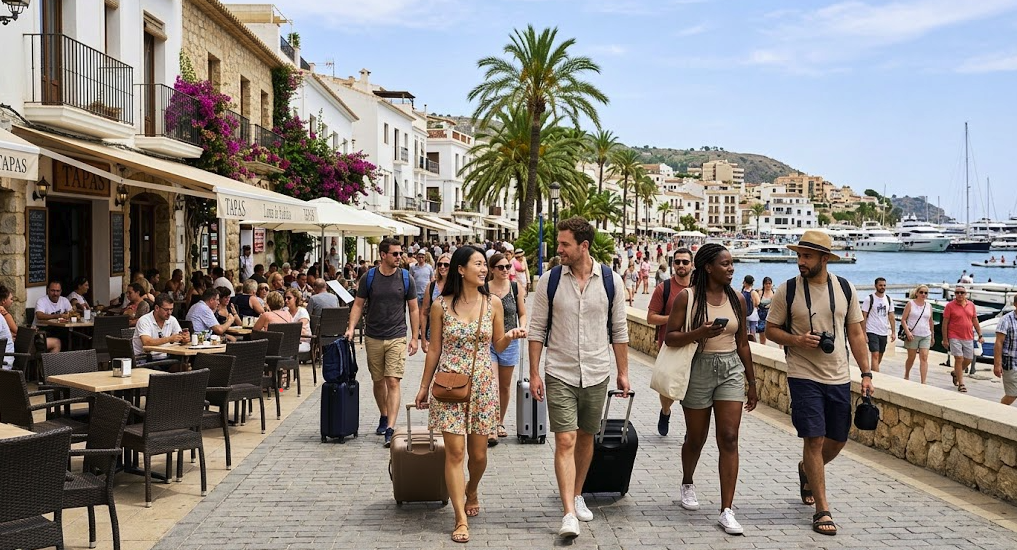
Madrid – HIGRH NEWS: Spain tourism record

Spain has reached another historic high in international tourism, with 58.1 million foreign visitors arriving during the first seven months of the year and spending more than €82 billion. International tourists spent exactly €82.05 billion, 7.8% more than during the same period a year earlier, while the number of arrivals increased by 4.6%. What is behind this new Spain tourism record, and which destinations and markets are driving the increase in spending?
Spain surpasses new historic figures in international tourism
Official data from the Frontur and Egatur surveys, compiled by Spain’s National Statistics Institute (INE), show particularly strong activity across the Spanish tourism sector.

Between January and July, Spain received 58.1 million international tourists. The figure represents a 4.6% increase compared with the same period of the previous year.
However, the figure that carries greater importance for the tourism economy is the performance of expenditure. Foreign visitors spent €82.05 billion, 7.8% more than a year earlier.
The difference between the two growth rates shows that spending is rising faster than visitor numbers. International arrivals increased by 4.6%, while total expenditure advanced by three percentage points more.
July again concentrated a significant share of tourism activity. During the month, 11.5 million international tourists travelled to Spain, an increase of 4.6% compared with July of the previous year.
Spending also reached a new monthly high. Foreign visitors spent €18.22 billion, 10.9% more than during the same month a year earlier.
Average spending per tourist reached €1,579 in July, an increase of 5.9%. Average daily expenditure stood at €218 per person, up 3.7%.
The average stay was 7.2 days. These figures show that the increase in tourism revenue does not depend solely on more people arriving, but also on higher average spending during their trips.
The official figures are available through the tourism section of the National Statistics Institute (INE).
The main Spanish destinations receive millions of foreign tourists
The United Kingdom remains Spain’s leading source market for international tourists. Between January and July, 11.5 million visitors from the country travelled to Spanish destinations, an increase of 4.6% compared with the same period previously.
France ranked second, with 7.2 million tourists and growth of 1.2%. Germany came third, with 6.9 million visitors, although arrivals from the country declined by 0.5%.
Italy recorded one of the strongest increases among the main source markets. Spain received 3.5 million Italian tourists during the first seven months, 10.3% more than during the comparable period.
The importance of the United Kingdom is also clear when spending is taken into account. British tourists represented 16.9% of all expenditure by international visitors in Spain during the first seven months.
Germany accounted for 11.3% of international tourism expenditure, while France represented 7.8%.
During July alone, around 2.2 million British tourists visited Spain. The figure increased by 5.6% year-on-year, while their spending reached approximately €3.04 billion.
Expenditure by British visitors increased by 4.8% compared with July of the previous year.
Germany and France also recorded significant increases in spending during the month. German tourists increased their expenditure by 11.5%, while French visitors increased theirs by 12.6%.
The performance of the source markets therefore shows a combination of high visitor numbers and differing spending trends. While some traditional markets retain their leading positions, others are growing at a faster rate.
Catalonia leads arrivals while Andalusia accelerates its growth
Catalonia remained the Spanish autonomous community receiving the largest number of international tourists during the first seven months. It recorded 11.94 million foreign visitors, an increase of 2.9% compared with the same period of the previous year.
The Balearic Islands ranked second, with 9.16 million tourists and growth of 1.8%.
The Canary Islands received 9.02 million international visitors, although arrivals declined by 0.6%.
Andalusia also attracted around 9.02 million foreign tourists. Its performance was considerably stronger in terms of growth, with arrivals increasing by 8.2%.
Madrid and the Valencian Community also stood out for their increases in visitor numbers. Madrid recorded growth of 9.6%, while the Valencian Community increased by 8.9% during the first seven months.
The July figures reinforced this trend. The Valencian Community welcomed 1.63 million international tourists, 9.5% more than a year earlier.
Madrid received around 800,000 foreign visitors during the same month, representing an increase of 11%.
Spain’s tourism map therefore shows significant differences between destinations. Catalonia retains the lead in cumulative visitor numbers, while other regions are recording stronger percentage increases.
Andalusia stands out particularly for combining a high number of visitors with strong year-on-year growth.
Tourism spending changes the ranking among major destinations
The ranking changes when the measure shifts from visitor numbers to spending.
During July, the Balearic Islands attracted the largest share of international tourism expenditure. Foreign visitors spent €4.15 billion there, equivalent to 22.8% of the national total.
Catalonia ranked second, with €3.71 billion and a 20.4% share.
Andalusia received €2.69 billion, representing 14.8% of international expenditure recorded in Spain during the month.
Andalusia recorded the strongest increase among the major destinations analysed. Foreign visitor spending increased by 23.4% compared with the same month a year earlier.
Catalonia recorded growth of 13%, while the Valencian Community increased by 11.6%. Spending in the Balearic Islands rose by 8.3%.
The cumulative figures for the first seven months provide another picture. Catalonia generated 18.9% of total international tourism expenditure, placing it in first position.
The Canary Islands accounted for 17.1%, while Andalusia represented 15.2%.
The difference between visitor numbers and spending is particularly significant. A destination can receive fewer tourists than another region and still account for a larger share of overall expenditure.
The figures therefore underline the growing importance of spending as an indicator when assessing tourism’s economic impact.
Accommodation, organised trips and transport account for major spending
Accommodation was the largest individual spending category for international tourists during July.
Visitors spent €3.61 billion on accommodation, representing 19.8% of all tourism expenditure recorded in the country. The figure increased by 6.7% compared with the previous year.
Package holidays accounted for another 19.3% of spending, while international transport represented 19.2%.
Package holiday expenditure recorded particularly strong growth. Spending linked to these products increased by 19%, while expenditure on international transport rose by 12.8%.
Tourists staying in hotels and other market accommodation generated 62.5% of total expenditure.
There were also differences between visitors who organised their trips through packages and those who travelled independently.
Spending by tourists travelling on package holidays increased by 17.4% compared with the previous year. Among those who organised their trips independently, expenditure rose by 8.6%.
Despite the stronger growth in package-related spending, independent travel remained much more common.
During July, almost 8.5 million tourists arrived in Spain without a package holiday, compared with around 3.1 million who used one.
The most common trip length was between four and seven nights. This category accounted for 5.7 million visitors during the month.
The figures help outline the profile of a significant part of international demand: medium-length trips, with leisure as the main motivation and accommodation representing a substantial part of the travel budget.
Leisure dominates international tourism while business travel grows
Holidays and leisure remained, by a wide margin, the main reason for travelling to Spain.
Tourists travelling for these purposes spent €16.25 billion during July. This represented 89.2% of all expenditure by international visitors.
Business tourism accounts for a much smaller share, but its growth was considerably faster.
International business travellers spent €782 million during July, an increase of 37.7% compared with a year earlier.
The difference between the two categories is notable. Leisure accounts for the overwhelming majority of tourism spending, while business travel is recording a significantly faster growth rate.
The figures also confirm the importance of tourism activity across Spain’s main destinations during the busiest months.
Catalonia maintains a strong position in both visitor numbers and cumulative spending. The Balearic Islands stand out particularly for monthly expenditure, while Andalusia combines high visitor numbers with one of the strongest rates of growth.
Madrid and the Valencian Community, meanwhile, are recording significant increases in international arrivals.
A Spain tourism record driven by higher spending
The Frontur and Egatur figures highlight a central point: international tourism continues to grow both in visitor numbers and revenue.
The 58.1 million tourists recorded between January and July represent an increase of 4.6%. At the same time, the €82.05 billion in expenditure represents growth of 7.8%.
July strengthened that difference even further. Arrivals increased by 4.6%, while spending rose by 10.9%.
Average spending per visitor also increased to €1,579, while average daily expenditure reached €218.
The United Kingdom remained the leading source market, while France and Germany retained the next positions by visitor numbers. Italy, meanwhile, recorded particularly strong growth among the main countries of origin.
By autonomous community, Catalonia led cumulative arrivals. The Balearic Islands recorded the largest monthly spending share, while Andalusia registered one of the strongest increases in both visitor numbers and expenditure.
The official figures therefore present a tourism market reaching record levels, with revenue growing faster than international arrivals.
What the figures show about Spanish tourism
The evolution of spending is one of the central elements of the latest statistics. Growth is not limited to the overall number of visitors, but is also reflected in average expenditure and in specific categories of travel spending.
Accommodation, package holidays and international transport accounted for the main spending categories during July.
At the same time, independent travel remained considerably more common than package holidays.
Leisure retained its dominant position, with almost nine out of every ten euros of international tourism spending linked to holidays and free time.
Overall, the figures place international tourism among the major contributors to economic activity in Spain during the first seven months of the year.
Frequently asked questions about Spain’s tourism record
How many international tourists visited Spain?
Spain received 58.1 million international tourists during the first seven months of the period analysed.
How much did foreign visitors spend?
International tourism expenditure reached €82.05 billion between January and July.
Which country sent the most tourists?
The United Kingdom was the leading source market, with 11.5 million visitors during the first seven months.
Which destination received the most tourists?
Catalonia led international arrivals, with 11.94 million visitors during the period analysed…….MORE
Contact us: info@higrh.com