
All Saints’ Day in Spain: Origins, Fascinating Facts and Traditional Celebrations
All Saints’ Day is one of Spain’s most deeply rooted annual celebrations. Every 1 November, families across the country visit cemeteries, place flowers on graves and remember relatives and friends who have passed away. Yet the occasion is about much more than religious observance. It also brings together centuries-old customs, regional celebrations and some of Spain’s best-loved autumn foods.

From roasted chestnuts in Galicia to the colourful market displays of Cádiz and the traditional panellets of Catalonia, each region has its own way of marking the occasion. Understanding these traditions offers a fascinating insight into Spanish history, family life and cultural identity.
What Are the Origins of All Saints’ Day?
All Saints’ Day, known in Spain as Día de Todos los Santos, is a Christian solemnity celebrated on 1 November. It honours all saints, including those who do not have an individual feast day in the religious calendar.

The tradition developed over several centuries. Early Christian communities commemorated martyrs who had died for their faith. As the number of recognised martyrs and saints grew, collective celebrations became an important way of honouring them.
One significant moment came during the papacy of Boniface IV. In 609 or 610, he consecrated the Pantheon in Rome as a Christian church dedicated to the Virgin Mary and all martyrs.
Later, Pope Gregory III, who served from 731 to 741, dedicated a chapel in St Peter’s Basilica in Rome to all saints and established 1 November as the date of their celebration in Rome. The observance subsequently spread throughout the Western Church.
Is All Saints’ Day connected to the Celtic festival of Samhain?
All Saints’ Day is often discussed alongside Samhain, an ancient Celtic seasonal festival associated with the end of the harvest and the beginning of winter.
Samhain was traditionally observed around 31 October and 1 November. It was connected with seasonal change, community gatherings and beliefs about the relationship between the living and the dead.
Because the dates are close, some accounts suggest that the Christian celebration was deliberately introduced to replace older pagan customs. However, historians do not regard this explanation as conclusively established. The development of All Saints’ Day involved a longer process, and its history cannot be reduced to a single attempt to replace Samhain.
What is the difference between All Saints’ Day and All Souls’ Day?
Although the two occasions are closely connected, they have different meanings in the Catholic calendar.
All Saints’ Day – 1 November: honours all saints, both officially recognised and those whose holiness is known only to God.
All Souls’ Day – 2 November: is dedicated to praying for the faithful departed.
In Spain, families often visit cemeteries around both dates, although 1 November remains the main public holiday associated with the tradition.
All Saints’ Day Traditions Across Spain
Spain’s regional diversity is particularly visible during this time of year. Alongside the religious observances, many communities maintain celebrations connected with autumn harvests, local food and family gatherings.
Visiting Cemeteries and Bringing Flowers
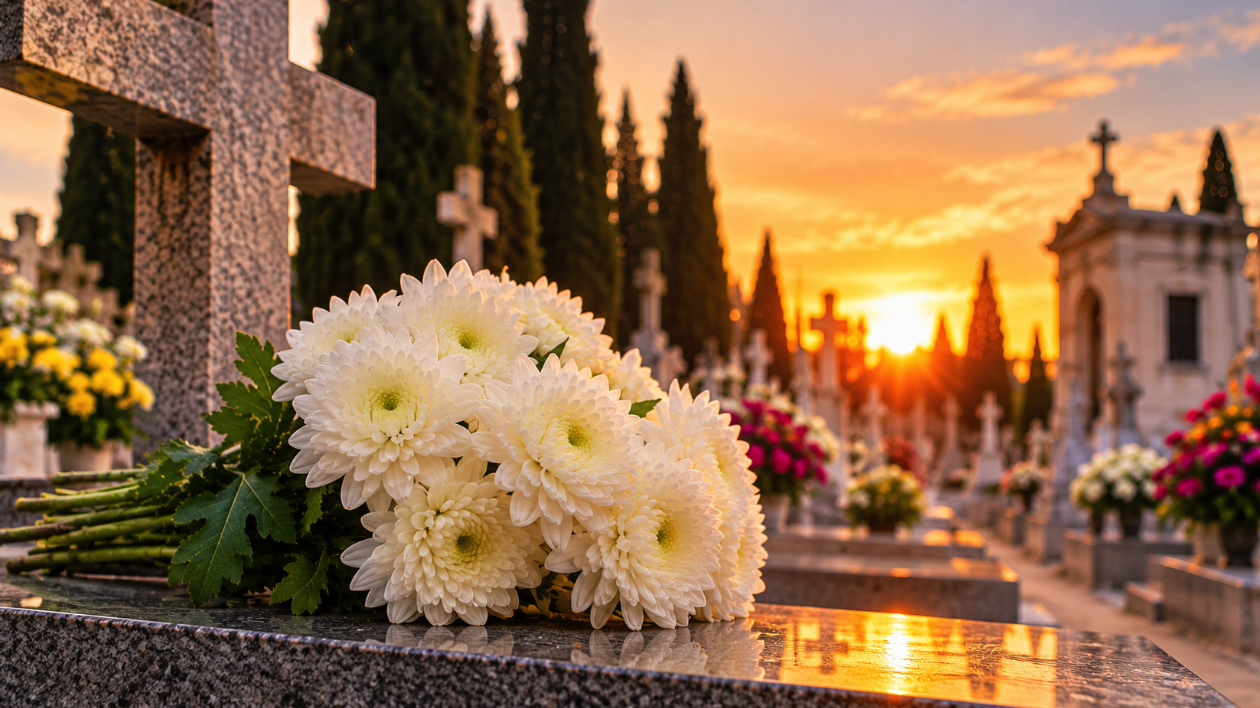
One of the most recognisable Spanish All Saints’ Day traditions is visiting family graves.
In the days leading up to the celebration, relatives often clean and decorate graves before placing fresh flowers on them. Chrysanthemums are especially popular, although roses, carnations and gladioli are also common choices.
For many families, this is an opportunity to remember loved ones, share stories and introduce younger generations to their family history.
The tradition is not exclusively religious. It also reflects the importance of family remembrance and respect for previous generations in Spanish society.
La Castanyada in Catalonia
La Castanyada is one of Catalonia’s best-known autumn celebrations.
The main ingredients of this traditional occasion are roasted chestnuts, sweet potatoes and panellets. These small sweets are traditionally made with ground almonds, sugar and egg, often covered with pine nuts.
Families and friends gather to enjoy these seasonal foods, while bakeries prepare different varieties of panellets in the days surrounding the celebration.
Although particularly associated with Catalonia, similar almond-based sweets can be found in other parts of Spain.
Magosto in Galicia
Galicia celebrates autumn with the traditional magosto, a gathering centred on roasted chestnuts and open fires.
Friends, neighbours and families come together to roast chestnuts, share food and enjoy the atmosphere of the season. In Ourense, the magosto is especially popular and traditionally includes chestnuts, grilled chorizo, young wine, songs and storytelling.
The celebration has deep connections with the harvest and rural life. It is also recognised as a Galician Festival of Tourist Interest.
Amagüestu, Magosta and Other Chestnut Celebrations
The tradition of roasting chestnuts is not limited to Galicia. Different regions have developed their own names and customs:
Amagüestu – Asturias: a traditional autumn gathering featuring roasted chestnuts and, in many places, cider.
Magosta – Cantabria: a popular chestnut celebration associated with community gatherings.
Gaztañerre Eguna – Basque Country: a traditional occasion associated with eating roasted chestnuts.
Chaquetía – Extremadura: an autumn custom involving outdoor gatherings and seasonal foods.
Castanyada – Catalonia: a celebration featuring chestnuts, sweet potatoes and panellets.
Although the details vary, these traditions share a common theme: celebrating the autumn harvest through food, family and community.
Los Tosantos in Cádiz: When Markets Become Theatres
One of the most unusual All Saints’ Day celebrations takes place in Cádiz, Andalusia.
Known as Los Tosantos, this tradition transforms market stalls into humorous displays. Traders decorate their stalls using fruit, vegetables, fish and meat to create scenes inspired by everyday life, public figures and current events.
The displays often contain social commentary and the characteristic irony associated with Cádiz.
The Central Market is particularly connected with the tradition, which offers a lively contrast to the more solemn atmosphere of cemetery visits.
Traditional All Saints’ Day Food in Spain
Food is an essential part of the celebration. Many Spanish bakeries prepare special seasonal sweets, while families enjoy chestnuts and other autumn produce.
Some of the most popular treats include:
Huesos de Santo
Huesos de santo, literally translated as “saints’ bones”, are among Spain’s most recognisable All Saints’ Day sweets.
They are traditionally made from marzipan and shaped into small cylindrical pieces resembling bones. The classic filling is sweet egg yolk, although modern bakeries offer other flavours.
Their distinctive appearance and name make them particularly associated with the religious celebration.
Buñuelos de Viento
These light, deep-fried pastries are another favourite during the first days of November.
Buñuelos de viento are usually dusted with sugar and can be enjoyed plain or filled with whipped cream, custard or chocolate.
Their delicate texture and variety of fillings have made them a familiar sight in Spanish pastry shops during the autumn season.
Panellets
Panellets are traditional Catalan sweets closely associated with La Castanyada.
The classic recipe combines ground almonds, sugar and egg. Pine nuts are one of the most popular coatings, although other varieties include coconut, chocolate and different flavourings.
Roasted Chestnuts and Sweet Potatoes
Roasted chestnuts are among the most recognisable flavours of autumn in Spain.
They are sold by street vendors, prepared at home and shared during local celebrations. Sweet potatoes are also popular, particularly in Catalonia and other areas where autumn food traditions remain strong.
Fascinating Facts About All Saints’ Day
Beyond its religious meaning, All Saints’ Day has several interesting historical and cultural details.
1. Its origins go back more than a thousand years. Early collective Christian commemorations of martyrs date back to the first centuries of Christianity, while the celebration on 1 November developed later.
2. Rome played an important role in its history. The conversion of the Pantheon into a Christian church during the papacy of Boniface IV was an important milestone in the development of the celebration.
3. Chestnuts are a symbol of autumn celebrations. Their importance in regional festivities reflects Spain’s agricultural traditions and the historical role of seasonal harvests.
4. Halloween and All Saints’ Day are not the same celebration. Halloween takes place on 31 October and has its own historical and cultural development. All Saints’ Day is a Christian solemnity celebrated on 1 November.
5. Spain has a rich variety of local customs. The names and traditions associated with this period change from one region to another, demonstrating the country’s cultural diversity.
The Editorial View: Why These Traditions Still Matter
All Saints’ Day is an important part of Spain’s cultural heritage. Its significance goes beyond religious observance, bringing together family memories, regional identity, traditional food and community celebrations.
The variety of customs is particularly remarkable. Galicia’s magostos, Catalonia’s panellets and Cádiz’s humorous market displays show how different communities have developed their own ways of marking the same period of the year.
At HIGRH NEWS, we believe these traditions deserve to be documented and passed on to future generations. Preserving cultural heritage does not mean rejecting modern celebrations or changing social habits. It means understanding where traditions come from and recognising the value they continue to have.
Whether through a visit to a cemetery, a family recipe or a gathering around a fire, All Saints’ Day remains an opportunity to remember the past while sharing meaningful moments with the people around us.
Frequently Asked Questions About All Saints’ Day in Spain
When is All Saints’ Day celebrated in Spain?
All Saints’ Day takes place every year on 1 November. It is a national public holiday in Spain, although when it falls on a Sunday, the replacement day off can depend on the official regional holiday calendar.
Why do Spanish families visit cemeteries on 1 November?
Families visit cemeteries to remember deceased relatives, clean and decorate graves and leave flowers as a sign of affection and respect.
What are the traditional foods eaten on All Saints’ Day?
Popular foods include huesos de santo, buñuelos de viento, Catalan panellets, roasted chestnuts and sweet potatoes.
Which Spanish regions have special All Saints’ Day traditions?
Some of the best-known examples include La Castanyada in Catalonia, magostos in Galicia, the amagüestu in Asturias, the magosta in Cantabria, Gaztañerre Eguna in the Basque Country, the Chaquetía in Extremadura and Los Tosantos in Cádiz.
Is All Saints’ Day a public holiday in Spain?
Yes. 1 November is listed as a national public holiday under Spanish labour legislation. If it falls on a Sunday, the following Monday may be designated as a day off in accordance with the applicable holiday calendar.
Official Sources
Vatican City State — November 1: All Saints’ Day: https://www.vaticanstate.va/en/component/content/article/november-1-all-saints-day.html
- Vatican News — Solemnity of All Saints: https://www.vaticannews.va/en/liturgical-holidays/solemnity-of-all-saints.html
- Spanish Official State Gazette (BOE) — Royal Decree 2001/1983, Article 45: https://www.boe.es/buscar/act.php?id=BOE-A-1983-20906