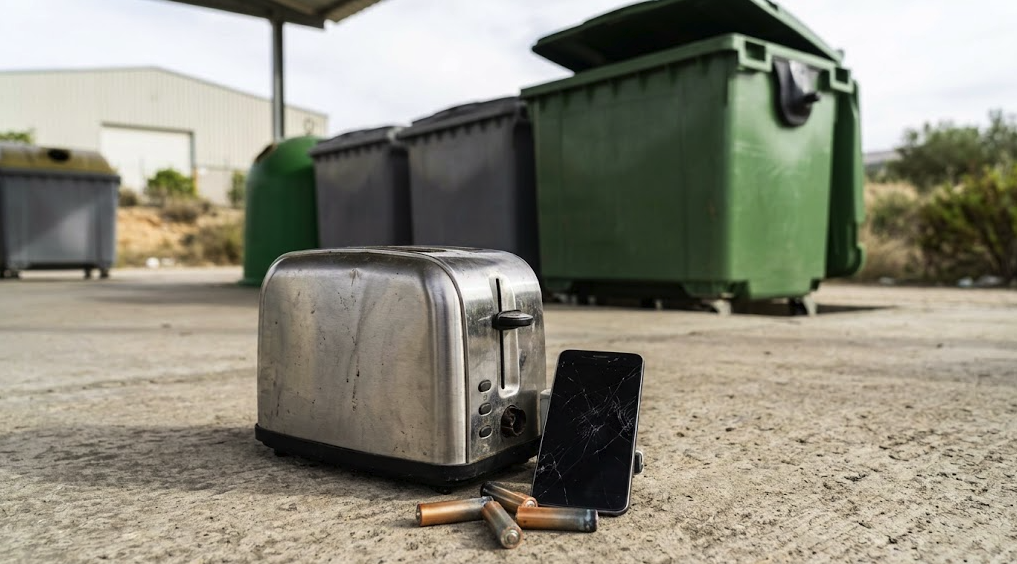

MADRID – HIGRH NEWS: what to do with an old battery, broken mobile phone or small appliance is a common question when an everyday item reaches the end of its useful life. Batteries, phones and electrical appliances do not all follow exactly the same waste collection route in Spain. So where should each one go, and what should consumers do before handing them over?

What to Do With an Old Battery
Old batteries and used accumulators should not be placed in ordinary household waste. Spain has separate collection systems designed specifically for these materials.
According to Spain’s Ministry for the Ecological Transition and the Demographic Challenge, used portable batteries and accumulators from homes, shops, offices and similar locations should be taken to selective collection points. These can include battery collection containers in public spaces, commercial establishments and municipal recycling centres, commonly known as puntos limpios.

The collection service is free for final users. When a collection point operates inside a shop or distributor, consumers do not have to purchase a new battery in order to hand over their used one.
This makes the simplest rule clear: an old household battery should go into a dedicated battery collection system rather than into the general rubbish.
Some batteries can contain substances that require controlled management. The Ministry identifies several battery waste categories, including lead batteries, nickel-cadmium accumulators, mercury-containing batteries and other types of batteries and accumulators. Batteries containing lithium or other hazardous substances can also fall under hazardous waste classifications.
There is an additional point to consider when a battery is installed inside another device.
Where it is possible and safe to do so, users can remove used batteries from electrical or electronic equipment according to the manufacturer’s instructions. The Ministry specifically advises consumers to follow those instructions rather than attempting an unsafe removal.
A damaged battery requires particular care. If it is visibly swollen, leaking or otherwise damaged, it should not be opened or dismantled casually. In such circumstances, asking the relevant collection facility how it should be delivered is the safer course.
What to Do With a Broken Mobile Phone
A broken mobile phone is an electrical and electronic device. Once its owner discards it or intends to discard it, it becomes waste electrical and electronic equipment, commonly referred to in Spain as RAEE.
The Spanish environmental authority states that household RAEE can be delivered to fixed, mobile or neighbourhood recycling centres established by local authorities. Collection can also take place through certain distributors when consumers purchase an equivalent new appliance. Authorised social organisations and reuse companies can provide additional collection routes.
That means a broken phone should not simply be placed in the ordinary rubbish bin.
The first step, however, should be to consider the personal information stored on the device.
If the phone still works sufficiently, the owner should back up important information and remove personal data before handing the device over. This can include photographs, contacts, documents, accounts and other information stored on the handset.
The exact procedure for deleting data varies between manufacturers and operating systems. Consumers should therefore use the manufacturer’s instructions when resetting the phone.
A cracked screen does not change the phone’s basic waste category. If the device has reached the end of its useful life, it enters the electrical and electronic waste collection system.
The situation requires greater caution if the phone has a damaged or swollen battery. In that case, consumers should avoid attempting to remove the battery without appropriate instructions.
Electronic devices contain a wide range of materials and components. Spain’s Ministry explains that electrical and electronic equipment can include metals, plastics, glass, circuit boards, cables, batteries and other components.
Proper collection allows these materials to enter specialised treatment processes rather than being mixed with conventional household waste.
What to Do With a Small Electrical Appliance
Small appliances such as toasters, blenders, hairdryers, irons and coffee machines can also become electrical and electronic waste when they are discarded.
Their small size does not mean they belong in the ordinary rubbish.
Spain’s official waste management system provides specific routes for household electrical and electronic equipment. Consumers can take these items to municipal recycling centres or use other collection systems available in their area.
Another option may apply when an old appliance is being replaced by a new equivalent product.
The Ministry states that household RAEE can be handed to a distributor when a consumer purchases a new appliance that is equivalent to the old one.
Consumers should check the collection arrangements with the retailer before completing the purchase, particularly when the old appliance needs to be taken away.
Small electrical appliances should also not be dismantled unnecessarily at home. An appliance can contain several different materials and components, and taking it apart does not automatically make recycling easier for the consumer.
The appropriate collection system is designed to handle these materials through authorised waste management channels.
Before throwing away an appliance, there is also another possibility worth considering: reuse.
If a toaster, coffee machine or other appliance still works, repairing it, giving it to someone else or finding a legitimate reuse option can extend its useful life. Spain’s official RAEE management hierarchy places prevention and preparation for reuse ahead of recycling, recovery and disposal.
Where to Take an Old Battery, Broken Mobile Phone or Small Appliance
The correct destination depends on the type of waste.
For an old household battery, consumers can use dedicated battery collection points, including containers in public spaces, shops and municipal recycling centres.
For a broken mobile phone, the relevant route is the collection system for electrical and electronic equipment. Municipal recycling centres are one option, while certain distributors and authorised organisations can provide other routes.
For a small electrical appliance, the same RAEE framework applies. A local recycling centre may accept it, while a distributor may take back an equivalent old appliance when a new one is purchased.
The exact facilities available can differ between municipalities. For that reason, consumers should check their local authority’s information before travelling to a collection point.
This is particularly useful for recycling centres with separate collection areas. Not every facility necessarily accepts every type of waste under identical conditions.
Why the Correct Collection Point Matters
The purpose of separate collection is not simply to keep streets and bins tidy.
Electrical and electronic equipment can contain many different materials and, in some cases, substances that require controlled treatment. The Ministry notes that some electrical and electronic equipment can contain substances such as cadmium, mercury and lead, as well as other substances requiring appropriate management.
Separate collection also makes it possible to recover useful materials.
The official Spanish waste hierarchy gives priority to preventing waste, preparing products for reuse and recycling before recovery and disposal.
Once an appliance or electronic device enters the correct collection system, authorised operators can sort and manage it according to its characteristics.
That process matters because electrical and electronic equipment is not made from one single material. A small appliance can contain metal, plastic, wiring, electronic components and other materials that require different treatment.
Official source link:
Spanish Ministry for the Ecological Transition – Electrical and Electronic Equipment Waste (RAEE)
What to Do Before Taking Electronic Waste to a Collection Point
There are several simple checks consumers can make before delivering an old device.
For a mobile phone, protecting personal data should come first. If the device remains operational, the user should back up important information and then follow the manufacturer’s procedure for removing personal data.
For an appliance, there is normally no need for the consumer to dismantle its internal components. The collection and treatment system is designed to handle the appliance after delivery.
For batteries, consumers should follow the manufacturer’s instructions when removal is possible and safe. The Spanish Ministry specifically recommends removing batteries from equipment only when this can be done safely and in accordance with those instructions.
If a battery appears damaged, consumers should avoid unnecessary handling and ask the collection point for instructions.
The same principle applies to electrical devices that have suffered serious physical damage. Rather than attempting an improvised repair or dismantling operation, the consumer can ask the relevant collection service how the item should be delivered.
Another useful step is to check whether the item can still be reused.
A working phone, appliance or other electronic product does not necessarily need to become waste immediately. Repair and reuse can extend the product’s useful life and reduce the amount of material entering the waste stream.
Common Mistakes When Disposing of Batteries and Electronics
One of the most common mistakes is putting a used battery into the general household rubbish.
Spain’s Ministry specifically directs used portable batteries and accumulators towards selective collection points and states that they should not be disposed of with ordinary household waste.
Another mistake is leaving an unwanted electrical appliance beside a street rubbish container.
A small appliance remains electrical and electronic waste regardless of its size. It needs to enter an appropriate collection system.
Consumers can also make the mistake of assuming that every recycling centre accepts exactly the same materials. Local collection arrangements can vary, so checking in advance can save time.
A further issue concerns mobile phones. Handing over a phone without first considering the personal information stored on it can create an unnecessary privacy problem.
Finally, consumers sometimes dismantle devices in an attempt to separate valuable materials themselves. This is not normally necessary. Proper treatment takes place through authorised collection and recycling channels.
The most practical approach is therefore straightforward: identify the waste, check the appropriate local collection route and deliver it through the designated system.
The Simple Rule for Batteries, Phones and Small Appliances
There is no need to memorise a complicated waste management system.
An old battery belongs in a dedicated battery collection point.
A broken mobile phone belongs in the electrical and electronic waste collection system.
A discarded small electrical appliance also belongs in the RAEE system.
A municipal recycling centre can be an important destination for both phones and small appliances, while distributors and other authorised collection channels may also be available.
For batteries, dedicated containers and collection points are widely used, including locations in shops and public spaces.
The important thing is not to treat all unwanted household objects as ordinary rubbish.
Correct separation allows authorised operators to recover materials, manage components appropriately and give products the treatment required at the end of their useful life.
For consumers, the process can begin with one simple question: What type of waste is this?
Once that is clear, finding the right collection route becomes much easier.
Frequently Asked Questions
Where should I take an old battery?
Take it to a dedicated battery collection point, participating shop or municipal recycling centre that accepts batteries.
Can I put a broken mobile phone in the rubbish bin?
No. A discarded mobile phone should enter the appropriate electrical and electronic waste collection system.
Where can I take a small appliance that no longer works?
A municipal recycling centre is one option. Depending on the circumstances, a distributor may also take back an equivalent old appliance when a new one is purchased.
Should I remove a battery from an electronic device?
Only when it can be done safely and according to the manufacturer’s instructions. If the battery is damaged, seek guidance from the appropriate collection service…….MORE