
Spain’s Intelligence Service Finds No Evidence Morocco Organised Mass Migrant Crossings into Ceuta
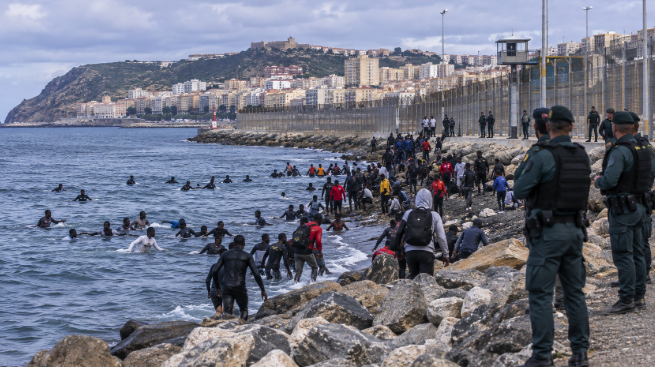
Spain’s National Intelligence Centre (CNI) has found no evidence that Moroccan authorities organised or coordinated the mass migrant crossings into Ceuta on 30 and 31 July, when more than 80,000 people attempted to enter the Spanish enclave.

In a report submitted to the National Court on 11 November, Spanish intelligence officials said the mobilisation appeared to have developed through independent calls circulated on social media rather than through a centrally organised operation directed by the Moroccan state.
The findings offer an important clarification in a crisis that raised serious questions about border security, Spanish intelligence assessments and Morocco’s role in managing migration towards Spain.

Although the CNI says Moroccan authorities were aware that calls to cross into Ceuta were spreading widely online, investigators have found no evidence linking the campaign to the Moroccan government or its intelligence services.
A separate Guardia Civil report also raises concerns about the information available to Spanish security forces before the crossings began, suggesting that warnings received beforehand were insufficient to anticipate the scale of the crisis.
CNI Finds No Evidence of a Moroccan State Operation
The CNI submitted its report to National Court investigating judge María Tardón following a request for further information about the events in Ceuta.
According to the intelligence assessment, investigators have not established that the mass crossings were instigated, planned or coordinated by Moroccan authorities.
Instead, the mobilisation appears to have originated from several individuals independently encouraging people to enter Ceuta through messages shared on social media platforms.
The calls spread rapidly among people who were already considering emigrating, as well as a much wider population living in Moroccan areas close to the Spanish territory.
Investigators identified several people involved in spreading the messages but found no evidence of a central organisation directing the campaign.
The CNI also reported that it had not established links between the identified online organisers and the Moroccan state. Nor had investigators found evidence that organised people-smuggling networks were behind the mobilisation.
The intelligence service acknowledged that a government could theoretically use migration pressure on such a scale as a form of political or hybrid warfare against another country.
However, it said an operation of that nature would require authorisation at the highest political level and would probably involve state intelligence services.
Its investigation has not produced evidence that Morocco organised or carried out such an operation during the July crisis.
Why the 2021 Ceuta Migration Crisis Was Different
The latest assessment contrasts with the CNI’s conclusions about the events of May 2021, when approximately 10,000 people entered Ceuta from Morocco.
On that occasion, Spanish intelligence concluded that Moroccan authorities had deliberately used migration pressure to exert diplomatic pressure on Madrid.
The crisis followed Spain’s decision to allow Brahim Ghali, leader of the Polisario Front, to receive hospital treatment in the country. The decision contributed to a serious deterioration in relations between Spain and Morocco.
According to the CNI’s previous assessment, elements of the Moroccan security apparatus circulated voice messages and rumours concerning border surveillance, contributing to the movement of people towards Ceuta.
The comparison is significant because it demonstrates that Spanish intelligence does not rule out the possibility of Morocco using migration as a political instrument.
Its conclusion regarding July is more specific: despite the possibility of such a strategy, investigators have found no evidence that the Moroccan state organised the latest mass crossings.
Morocco Knew About the Online Calls Before the Crossings
One of the most important aspects of the new report concerns what Moroccan authorities knew before the crisis began.
On the afternoon of 29 July, the CNI sent a formal warning to Moroccan intelligence services about possible attempts to enter Ceuta during the week of the Throne Day celebrations.
According to the intelligence assessment, Moroccan authorities were already aware that calls encouraging people to cross the border had gained considerable visibility online.
The report suggests that Moroccan security priorities were focused heavily on protecting the official celebrations, attended by King Mohammed VI at the royal palace in Rincón, near Ceuta.
The CNI considers that this prioritisation affected the effectiveness of the response once the mass crossings were under way.
However, awareness of the planned crossings and an alleged failure to prevent them are not the same as evidence of direct involvement in organising them.
The distinction is central to the investigation: Spanish intelligence has identified prior knowledge on the Moroccan side but has not established that Moroccan state institutions designed or coordinated the operation.
Guardia Civil Records Hundreds of Intercepted Attempts Before the Crisis
A separate report from Spain’s Guardia Civil provides further information about the situation along the border in the hours before the mass crossings.
According to the document, Moroccan security forces intercepted 493 of the 1,109 attempts to enter Ceuta by swimming between the morning of 29 July and the morning of 30 July.
The figures suggest that Moroccan border controls were still operating and intercepting significant numbers of people before the situation escalated.
The Guardia Civil also reported that Moroccan officers appeared to have detained numerous people in the preceding days.
These findings led Spanish security officials to believe that Moroccan forces retained both the operational capacity and the willingness to control irregular crossings before the crisis.
Military assessments subsequently considered several possible explanations for what happened.
One possibility was that Moroccan forces were overwhelmed by the unexpectedly large number of people attempting to enter Ceuta. Other scenarios included the reassignment of security personnel to official Throne Day celebrations or a decision to avoid using force during the festivities.
Deliberate Moroccan involvement was ranked as the least likely explanation among the scenarios examined by military analysts.
Guardia Civil Questions the Intelligence Warnings Received Before the Crisis
The investigation has also highlighted problems concerning the communication and assessment of intelligence within Spain’s own security institutions.
On 29 July, a CNI officer contacted the Guardia Civil after identifying Facebook and WhatsApp groups encouraging people to swim into Ceuta or climb the border fence the following day.
The two services discussed the online messages and the potential implications of a Supreme Court ruling concerning the immediate return of people entering Ceuta or Melilla by swimming.
However, the Guardia Civil says the information it received was partial and insufficient to assess the true scale of the threat.
Officers were unable to establish who was behind the online calls, how credible they were or how many people might respond.
The warnings also failed to indicate that the mobilisation could overwhelm Moroccan security forces or that the situation might develop into a crisis of such magnitude.
According to the Guardia Civil, intelligence pointing towards a potential national security crisis should have been communicated to senior commanders and political decision-makers rather than remaining at a tactical level.
The handling of the information has also become a political issue in Ceuta.
Gonzalo Sanz, chief of staff to the Spanish government’s delegate in the city, resigned on 11 September after maintaining that he had passed the available information to his superior.
The investigation therefore raises questions not only about Morocco’s response but also about how effectively Spanish institutions collected, assessed and shared intelligence before the crossings began.
Social Media, Economic Hardship and the Throne Day Celebrations
The Guardia Civil believes the July crisis resulted from several factors converging within a relatively short period.
Among the circumstances identified in the investigation were:
- Social media mobilisation: Online messages spread rapidly, reaching large numbers of people in areas close to Ceuta.
- Economic difficulties: Many young Moroccans were facing economic hardship and considering migration.
- Throne Day celebrations: The official festivities may have created an opportunity to attempt crossings while security resources were focused on other priorities.
- Weather conditions: Meteorological circumstances may have made attempts to reach Ceuta by sea easier.
- The legal situation: A Spanish Supreme Court ruling concerning immediate returns of people entering Ceuta or Melilla by swimming may also have influenced decisions to attempt the crossing.
Investigators also identified a recurring pattern of online calls coinciding with major holidays and celebrations, including Eid al-Fitr, the Prophet’s birthday and Throne Day.
Once large numbers of people entered the water, security officers had to concentrate heavily on preventing deaths and accidents at sea and around the border breakwater.
The Guardia Civil’s assessment therefore points towards a combination of social, technological, meteorological and operational factors rather than a clearly established centrally directed operation.
What Has Been Established and What Remains Unproven?
The available findings allow several important distinctions to be made.
| Issue | Findings |
|---|---|
| Online calls encouraging crossings | Confirmed |
| Moroccan authorities’ prior knowledge of the calls | Reported by the CNI |
| Moroccan state organisation of the crossings | No supporting evidence found by the CNI |
| Involvement of people-smuggling networks | No evidence identified |
| Attempts intercepted by Moroccan forces | 493 out of 1,109 recorded attempts |
| Advance intelligence received by the Guardia Civil | Described as partial and insufficient |
| Deliberate Moroccan use of migration pressure in May 2021 | Previously concluded by the CNI |
The findings do not resolve every question surrounding the July crisis.
In particular, they do not remove the need to examine the effectiveness of Moroccan border controls once the mass crossings began or the preparedness of Spanish security institutions.
They also highlight the difference between knowing that a migration movement may occur, failing to prevent it and deliberately organising it. These are separate issues that require different evidence.
HIGRH NEWS Editorial Analysis
The CNI’s conclusions are an important development because they introduce a clearer distinction between political speculation and what investigators have actually established.
The possibility that Morocco could use migration as a diplomatic instrument cannot be dismissed simply because the latest investigation has not found evidence of such an operation.
The events of May 2021 demonstrate why Spain must remain attentive to the political dimension of migration management. However, conclusions about the July crisis must be based on the evidence available rather than assumptions drawn from previous diplomatic disputes.
Our assessment is that the investigation raises equally important questions about Spain’s own security preparations.
If intelligence services were aware of online calls encouraging mass crossings, it is reasonable to examine whether the available information was properly assessed and communicated to the authorities responsible for border security.
The Guardia Civil’s criticism of the warnings it received deserves particular attention. Detecting a potential threat is only useful if the information reaches the appropriate decision-makers in time and provides a realistic assessment of its possible consequences.
For Spain, the priority should now be to establish exactly what happened, identify any institutional failures and improve cooperation between intelligence services, border authorities and political leaders.
The evidence currently presented does not establish that Morocco organised the mass crossings. It does, however, reveal serious questions about border management, intelligence coordination and the ability of both countries to respond to sudden migration movements.
Those questions deserve clear answers, without confusing unproven allegations with established facts.
Frequently Asked Questions
Did Morocco organise the mass migrant crossings into Ceuta?
Spain’s National Intelligence Centre says it has found no evidence that Moroccan authorities instigated, planned or coordinated the mass crossings of 30 and 31 July.
How many people attempted to enter Ceuta?
More than 80,000 people were reported to have taken part in the mass movement towards Ceuta during the two days.
Did Morocco know about the planned crossings?
Yes. The CNI says Moroccan authorities were aware that online calls encouraging people to enter Ceuta were circulating widely. Spanish intelligence also sent a formal warning to its Moroccan counterparts on 29 July.
What happened during the 2021 Ceuta migration crisis?
In May 2021, approximately 10,000 people entered Ceuta from Morocco. The CNI concluded that Moroccan authorities had deliberately used migration pressure to exert diplomatic pressure on Spain following the arrival of Polisario Front leader Brahim Ghali for medical treatment.
Why is the Guardia Civil questioning the intelligence warnings?
The Guardia Civil says the information received before the July crossings was partial and insufficient to assess the scale of the potential threat. It argues that a crisis of this magnitude should have been anticipated and communicated at a higher institutional level.
Official Sources
- Government of Spain – La Moncloa: Official reports, alerts and communications concerning the Ceuta crisis, including documents from the CNI, Guardia Civil and other security institutions.
https://www.lamoncloa.gob.es/consejodeministros/paginas/informes-y-comunicaciones-situacion-ceuta.aspx