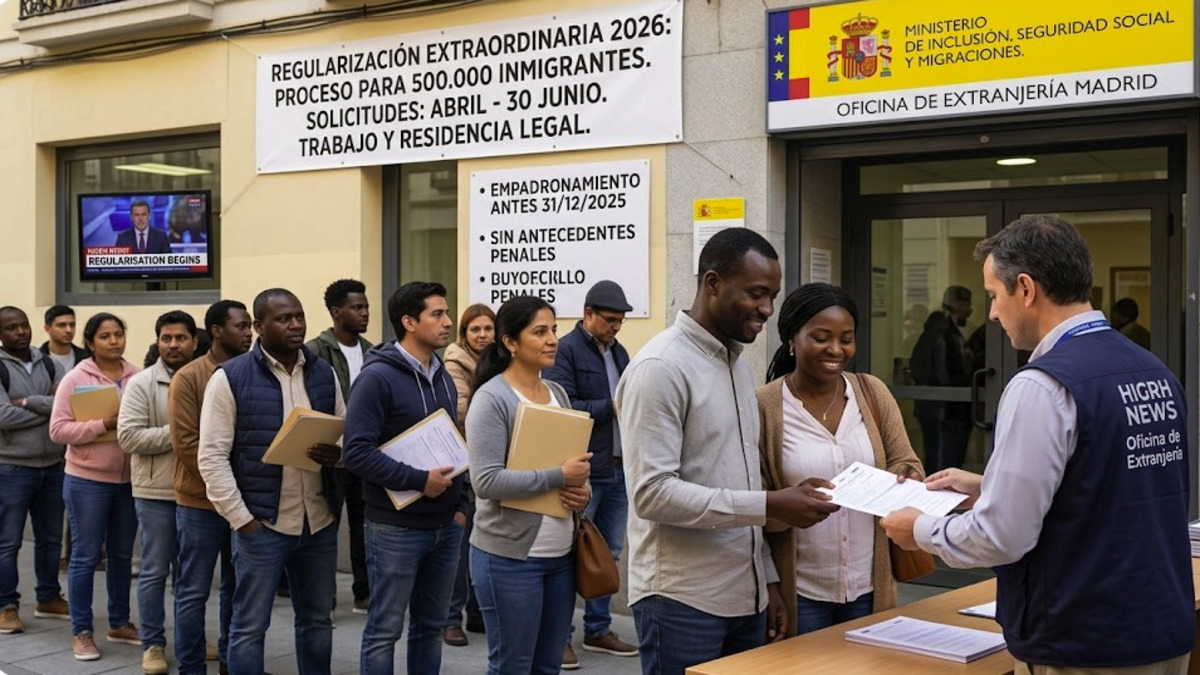

Madrid. HIGRH NEWS :Regularisation of 500.000 undocumented immigrants in Spain stands as the headline echoing through every administrative office across the country today. Is it possible for a single political decision to change the destiny of half a million people overnight? Starting this April 2026, what once seemed like a bureaucratic labyrinth for many is finally revealing a clear exit with the launch of this historic process.

A 180-Degree Turn in European Policy
Spain has decided to walk in the opposite direction of the restrictive border trends currently prevailing across the rest of the continent. The government, led by Pedro Sánchez, will approve a decree this Tuesday aimed at the regularisation of 500.000 undocumented immigrants in Spain. This is not merely a humanitarian gesture; it is a deep-seated strategy to integrate these individuals into the economic and social fabric legally.
This measure positions itself as one of the most ambitious migration policies in modern Europe. The primary goal is to bring hundreds of thousands of people out of the shadows so they can actively contribute. According to official data managed by HIGRH NEWS, estimates suggest that the number of beneficiaries could even exceed the half-million mark.

From my perspective, we are witnessing a total reconfiguration of the labor market. By regularising this volume of the population, the State does not just grant rights; it formalizes a workforce that already exists but operates under the radar. It is, in plain terms, a bet on economic growth through legality.
Deadlines and Requirements: Who Can Apply?
The clock has already started ticking. The application period opens this April and will have a very strict deadline: June 30, 2026. The selection criteria are rigorous to prevent any type of procedural fraud. To access this regularisation, interested parties must meet the following requirements:
Physical Presence: Prove they were in Spain before December 31, 2025.
Minimum Stay: Have resided in the country for at least 5 months.
Background Check: Have no criminal record.
History: Having a previous asylum application also counts as a valid basis.
Those who pass this filter will obtain a one-year residence permit and, most importantly, a legal work authorization. This will open the doors to Social Security and the public healthcare system in full. The possibility of subsequent renewal is included, granting a stability that was until now a pipe dream for many.
The Background of a Divisive Decision
Behind this decree lies unprecedented social support, backed by more than 600,000 citizen signatures and constant pressure from civil organizations. However, the political landscape in Madrid is far from unanimous. While the left wing of the government defends the measure as a solution to labor shortages and an aging population, the right wing rejects it outright, arguing it will create a “pull effect.”
On a logistical level, the challenge is massive. Immigration offices are already bracing for brutal administrative pressure. There is a real risk of significant delays due to a lack of human resources to manage such an avalanche of files in just three months. Can the Spanish administration handle this volume of work without collapsing?
This process of regularisation of 500.000 undocumented immigrants in Spain should not be understood as a simple amnesty. It is an attempt to reduce the underground economy and fill the gaps that demography is leaving in key sectors. Ultimately, it is a reorganization of society that puts Spain at the center of the global migration debate.
Frequently Asked Questions (FAQ)
When does the deadline for the regularisation expire?
The application period ends on June 30, 2026. This is a closed deadline with no initial extensions allowed.
What documents are needed to prove stay in the country?
It is essential to prove presence in Spain before December 31, 2025, using any valid documentary evidence (census registration, medical records, etc.).
How long does the initial permit last?
The decree provides for a residence and work permit for a period of one year, renewable under certain conditions.
Does the process guarantee access to public healthcare?
Yes, once legal residency is obtained, the beneficiary has full access to the Social Security system and public health services.
At HIGRH NEWS, we will closely follow the developments at the immigration offices, where the future of thousands of families and the country’s new economic course are at stake.