
Sailor Dies After Fuel-Laden Cargo Ship Capsizes Near Ibiza
A 46-year-old sailor has died and six other crew members have suffered minor injuries after the cargo ship Med Emre capsized in the Mediterranean Sea near Ibiza. The chemical tanker was carrying approximately 7,000 tonnes of fuel when it suffered a serious list and began taking on water. All 17 crew members have been rescued, while maritime authorities are monitoring the vessel for possible fuel leaks and environmental damage.

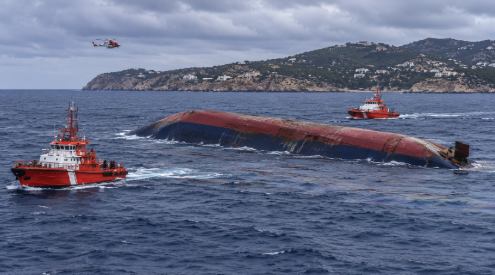
The accident triggered a major emergency response involving Spanish Maritime Rescue vessels, helicopters and other ships operating in the area. Although the vessel initially appeared to have sunk, subsequent inspections confirmed that it remains overturned and partially submerged, with its keel facing upwards.
What Happened to the Med Emre Near Ibiza?
The Med Emre, a Malta-flagged chemical cargo ship, encountered serious difficulties during its voyage from Algeciras to Barcelona on Wednesday night.

The Valencia Maritime Rescue Coordination Centre received a distress call at approximately 10:30 p.m. Six minutes later, the vessel reported water ingress and a list of around 90 degrees.
The emergency rapidly escalated, and the ship capsized during the night in waters between Ibiza and Valencia.
At approximately 9:26 a.m., Maritime Rescue located the vessel around 19 nautical miles northwest of Ibiza.
A subsequent assessment confirmed that the ship had not completely disappeared beneath the sea. Instead, it remained overturned and partially submerged.
Balearic Islands Emergency Director-General Pablo Gárriz described this situation as positive for potential recovery operations because it allows specialists to work on the vessel from the surface.
One Crew Member Dead and Six Injured
The accident has claimed the life of one sailor and left six others with minor injuries.
Seven crew members were transported to Ibiza for medical attention. Among them was a 46-year-old Turkish sailor who was taken to Can Misses Hospital, where his death was confirmed.
The other six crew members transported to the island suffered minor injuries. Hypothermia was among the main medical conditions reported by emergency services.
The remaining crew members were also rescued and received assistance.
The rescue operation involved three Maritime Rescue helicopters based in Palma, Valencia and Tarragona, alongside specialist rescue vessels and merchant ships operating near the accident site.
The Spanish Civil Guard also participated through personnel from its Valencia and Balearic Islands commands.
The Cargo Ship Was Carrying Approximately 7,000 Tonnes of Fuel
One of the biggest concerns surrounding the accident is the cargo carried by the Med Emre.
According to information provided by the Balearic authorities, the vessel was transporting approximately 7,000 metric tonnes of fuel when the accident occurred.
The cargo reportedly included:
- 4,850 tonnes of diesel.
- 2,000 tonnes of aviation fuel.
- 800 tonnes of gasoline.
The combined quantity represents a significant environmental risk if the vessel’s storage tanks have been damaged.
The tanker measured approximately 128 metres in length and was operating on the commercial route between Algeciras and Barcelona.
Any intervention involving the vessel must be carefully planned. Changes to its position or structural stability could increase the possibility of fuel escaping from its tanks.
For this reason, maritime authorities and the ship’s owners must establish a safe recovery strategy before attempting to move the vessel or remove its remaining cargo.
Fuel Sheen Detected, but No Major Spill Confirmed
The possibility of Mediterranean pollution has become one of the main concerns following the accident.
Initial reports from Maritime Rescue indicated that no floating debris, visible remains of the vessel or signs of pollution had been identified during the early morning assessment.
However, later observations revealed small iridescent patches on the water’s surface.
These patches, commonly described as fuel sheens, can indicate the presence of oily substances. Nevertheless, their detection does not automatically confirm that a significant quantity of fuel has escaped from the vessel’s tanks.
Balearic authorities have described the small reflections as potentially normal in an incident of this nature.
At present, there is no confirmed report of a major fuel spill involving the approximately 7,000 tonnes carried by the ship.
The distinction is important: an environmental threat does not necessarily mean that widespread marine pollution has already occurred.
Emergency Measures to Prevent Environmental Damage
Following the completion of the crew rescue operation, authorities shifted their attention towards monitoring the vessel and preventing possible environmental consequences.
Spain’s Directorate-General of the Merchant Marine activated the National Maritime Contingency Plan at Level 2.
The Balearic Government also activated its regional civil protection plan at Level 0.
In addition, the Ministry for Ecological Transition activated the Plan Ribera as a preventive measure to prepare for possible coastal pollution.
Maritime Rescue deployed specialist resources, including:
- Clara Campoamor: A specialist Maritime Rescue vessel equipped to respond to marine pollution emergencies.
- Guardamar Talía: A rescue vessel involved in monitoring and emergency operations.
- Aerial surveillance: Aircraft used to assess the vessel and monitor the surrounding waters.
These operations are intended to identify any changes in the ship’s condition and allow authorities to respond quickly if fuel leakage is detected.
Why Is It Important That the Ship Remains Partially Afloat?
Although the Med Emre has suffered serious damage, the fact that it remains partially above the water represents an important advantage for technical teams.
If the vessel had completely sunk to the seabed, inspecting its structure, recovering its cargo and removing potential pollutants would be significantly more complicated.
Its current position offers the possibility of carrying out surface operations and examining the condition of its tanks before deciding how to recover the remaining fuel.
However, any intervention must be carefully coordinated. Attempting to reposition a vessel of this size could alter its balance and increase the risk of further structural damage.
The immediate priority is to establish the condition of the hull, determine whether the cargo tanks have been compromised and develop a safe recovery strategy.
What Caused the Med Emre to Capsize?
The official cause of the accident has not yet been established.
Initial information indicates that the vessel suffered water ingress and developed a severe list before overturning.
Weather conditions will also form part of the investigation. Available navigation data pointed to strong winds in the Balearic Islands during the incident.
However, there is currently insufficient evidence to attribute the accident exclusively to weather conditions or a technical failure.
Agustí Martin Mallofré, president of the Catalan Association of Merchant Marine Captains, has highlighted that the vessel was built in 2019 and is therefore relatively modern.
Modern tankers generally incorporate independent compartments and safety systems designed to reduce the risk of cargo loss.
They can also feature double-hull construction, which provides additional protection against certain types of collision damage.
Investigators will need to establish whether the accident resulted from mechanical failure, water ingress, structural problems or another contributing factor.
Until the investigation produces further findings, any explanation of the cause should be considered preliminary.
HIGRH NEWS Editorial Assessment: Preventing an Environmental Disaster Is Now the Priority
The Med Emre accident has resulted in one fatality and highlights the risks associated with transporting large quantities of fuel by sea.
The immediate priority was rescuing all 17 crew members. Although the entire crew was accounted for, the incident tragically resulted in the death of one sailor.
Attention has now shifted towards preventing the accident from developing into a wider environmental emergency.
In HIGRH NEWS’s assessment, the absence of a confirmed major fuel spill is encouraging, but it should not be interpreted as the elimination of environmental risks.
As long as the vessel remains overturned and contains fuel, continuous monitoring and carefully coordinated recovery operations will be essential.
Cooperation between Maritime Rescue, maritime authorities and the relevant government agencies will be crucial to ensuring that the operation is conducted safely.
Protecting Ibiza’s marine ecosystem, coastal waters and biodiversity must remain the central objective during the next stages of the emergency.
Official Sources
- Government of the Balearic Islands — Emergency authorities activate the regional civil protection plan following the cargo ship accident near Ibiza: Official website.
- Spanish Ministry of Transport and Sustainable Mobility — Maritime safety and emergency response: Official website.
- Spanish Ministry for Ecological Transition — Marine and coastal environmental protection: Official website.
- Spanish Maritime Rescue — Maritime emergency and rescue operations: Official website.