
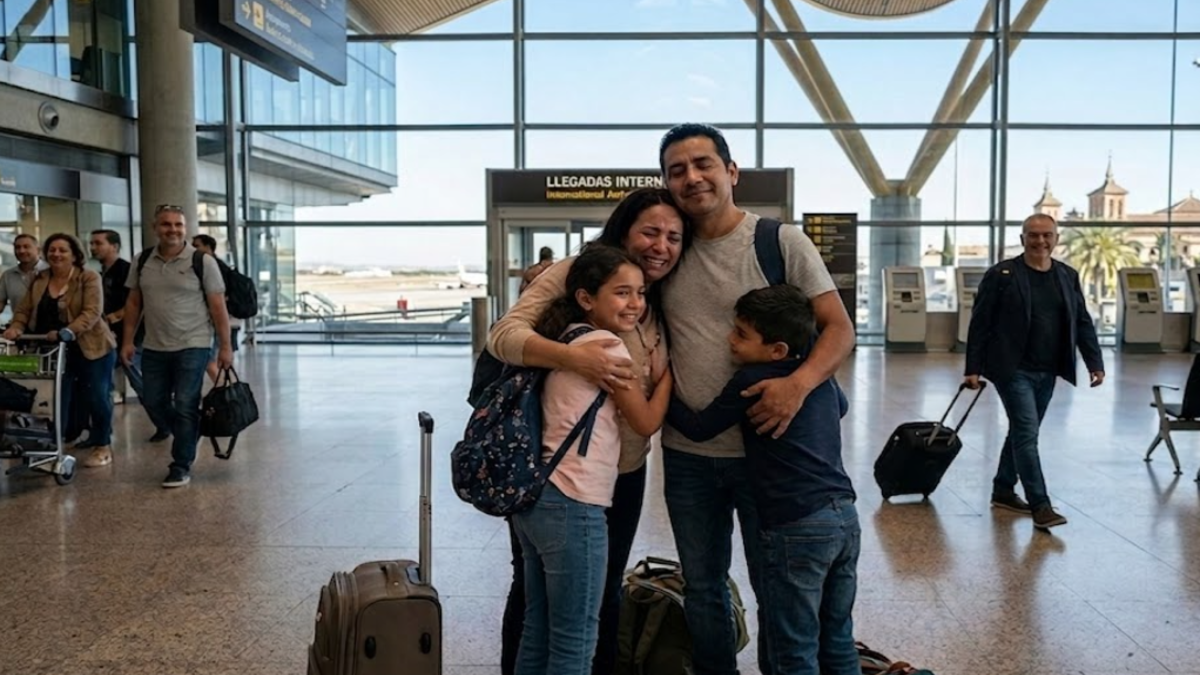

Madrid – HIGRH NEWS: Family reunification in Spain remains an important legal route for foreign residents seeking to live with eligible relatives, but who can qualify and which residence authorization applies?

Family Reunification in Spain: Who Can Apply?
Spanish immigration regulations recognize the right of foreign nationals who legally reside in Spain to reunite with certain family members, according to the Ministry of Inclusion, Social Security and Migration.
The relatives who may qualify include a spouse or a partner in a relationship comparable to marriage. Eligible children can also include the children of the resident and of the spouse or partner, including adopted children when the adoption has legal effect in Spain.

The official guidance also refers to other foreign minors or incapacitated persons, as well as the ascendants of the resident, the resident’s spouse or the domestic partner, depending on the applicable authorization and requirements.
The ministry stresses that the requirements depend on the specific type of application. Applicants therefore need to identify the correct residence authorization before preparing the required documents and starting the procedure.
Family Reunification in Spain for Relatives of Spanish Citizens
A separate residence route applies to certain foreign relatives of people who hold Spanish nationality.
According to the latest official information published by the Ministry of Inclusion, Social Security and Migration, this authorization concerns foreign nationals who are not citizens of the European Union, the European Economic Area or Switzerland and who have a qualifying family relationship with a Spanish citizen.
The official guidance states that the family relationship can have been created regardless of where or when it was established, provided the relevant conditions are met and the family member maintains the relationship and accompanies, joins or reunites with the Spanish national in Spain. The ministry also identifies a specific provision for children whose father or mother are, or were, Spanish by origin.
The ministry’s information sheet, updated in April, covers the type of authorization, the basic legal framework, the scope of application, requirements, required documentation, procedure and renewal.
Because immigration rules can depend on the applicant’s individual circumstances, the official guidance should be checked at the time an application is submitted.
What Applicants Should Know
Family reunification is not a single procedure that applies identically to every family. The applicable requirements vary according to the status of the person living in Spain and the relationship with the family member seeking residence.
For legally resident foreign nationals, the Spanish immigration authorities provide specific information sheets covering temporary residence through family reunification and the subsequent independent residence of reunited relatives. A separate information sheet addresses temporary residence for family members of Spanish nationals.
The distinction is important because applicants must follow the procedure corresponding to their particular legal situation. The documentation and conditions should therefore be confirmed through the official immigration administration before an application is filed.
Official information: Spanish Ministry of Inclusion, Social Security and Migration – Family Reunification
Latest Context on Spain’s Immigration System
The latest immigration news from Spain also includes a major extraordinary regularization process. The Ministry of Inclusion said the application period ended with 1,174,978 applications received, while 609,737 files had been processed. The ministry also reported that 83.2 percent of applications were submitted electronically and that 159,097 people were registered with Social Security as of June 30 as a result of the regularization process.
That process is separate from family reunification, but it forms part of the wider immigration landscape in Spain. For people considering family-based residence, the key issue remains identifying the correct legal route and meeting the requirements that apply to their circumstances.
FAQ
Can a foreign resident in Spain bring family members?
Yes. Spanish immigration rules allow legally resident foreign nationals to reunite with certain eligible relatives, subject to the applicable requirements.
Which relatives may qualify?
Depending on the applicable procedure, eligible relatives can include spouses or equivalent partners, children, certain minors or incapacitated persons, and ascendants.
Is there a separate route for relatives of Spanish citizens?
Yes. Spain provides a specific temporary residence authorization for qualifying foreign family members of Spanish nationals.
Are the requirements the same for every applicant?
No. The requirements, documents and procedure depend on the type of authorization and the applicant’s individual circumstances.
Conclusion
Family reunification in Spain continues to provide legal pathways for eligible relatives to join family members living in the country. The exact route depends on the resident’s status, the family relationship and the authorization being requested. Applicants should rely on the latest official immigration guidance when preparing their case.