
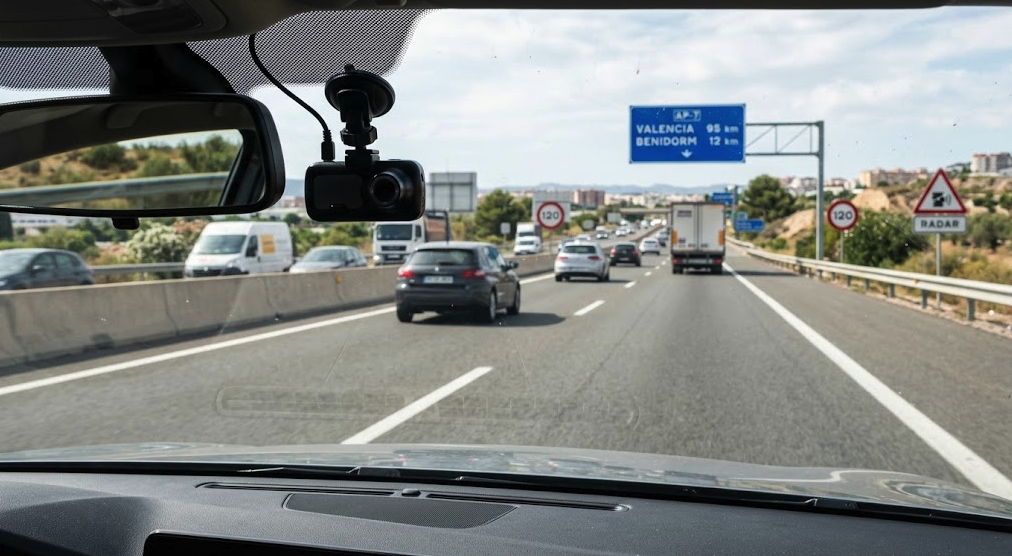

SPAIN – HIGRH NEWS: Dash cams in Spain are legal, but drivers need to understand how traffic rules and data-protection regulations apply before installing and using one. So, what can motorists legally record, and when could the use of a dash cam create problems?

Dash cams have become increasingly common among motorists who want an independent record of what happens on the road. A recording can potentially help establish what happened during a collision or document damage to a vehicle.
However, having a camera inside a car does not mean that drivers can record, store and publish everything without restrictions. In Spain, the rules cover both the way a camera is installed and the way its recordings are handled.

Are dash cams in Spain legal?
Yes. Dash cams in Spain are generally legal, and motorists can install cameras inside their vehicles.
The rules apply to different types of vehicles, including private and professional vehicles. A camera can be positioned on the dashboard, windscreen or another suitable location, provided that its installation complies with traffic requirements.
The main issue is not simply whether a camera exists inside the vehicle. Drivers also have to consider whether the device interferes with their ability to see the road and whether they operate it while driving.
Spain’s Directorate-General for Traffic, known as the DGT, allows cameras inside vehicles provided that they do not obstruct the driver’s visibility. A camera that interferes with the driver’s view can result in a fine.
According to information cited by The Local, obstructing visibility with a camera can result in an €80 fine.
That means the position of the device matters. Drivers should install a dash cam in a way that keeps the windscreen and the driver’s field of vision clear.
The safest approach is to mount the camera securely in an appropriate position before starting the journey rather than adjusting it once the vehicle is moving.
Dash cams in Spain and the rules while driving
Installing a dash cam is one issue. Operating it while driving is another.
Drivers should not manually handle or manipulate the device while the vehicle is in motion. This includes actions such as adjusting the camera or interacting with controls when doing so requires the driver to take attention away from the road.
The consequences can be considerably more serious than the fine associated with obstructing visibility.
The rules reported by The Local indicate that touching the dash cam while driving can result in a €200 fine and the loss of three points from the driver’s licence.
This is particularly relevant for drivers using cameras with screens, buttons or smartphone-connected controls.
The practical lesson is straightforward: set up the camera before leaving and avoid interacting with it during the journey.
Modern dash cams can often operate automatically once the vehicle starts moving. Using those functions can reduce the need for the driver to touch the device.
What can a dash cam record in Spain?
The presence of a camera does not give motorists unlimited freedom to record public spaces.
This is where Spain’s data-protection rules become particularly important.
Dash cams can capture images of roads, vehicles, pedestrians and other people. Some of those images can contain information that identifies individuals, including vehicle registration plates.
The Spanish Data Protection Agency, or AEPD, has addressed the use of on-board cameras and the processing of personal data. Its approach is based on the specific purpose of the recording and whether the processing is legally justified.
The circumstances therefore matter.
A recording made for a specific incident is different from a system that continuously records everything happening around a vehicle. The purpose, scope and handling of the footage all need to be considered.
This distinction is important for motorists who assume that owning the recording automatically means they can use it however they want.
When can dash cam footage create data-protection problems?
One of the most important questions concerns what happens after the recording has been made.
Keeping footage for a genuinely private purpose is not necessarily treated in the same way as publishing identifiable footage online.
For example, a motorist may want to keep a recording of a journey or preserve footage connected to an incident involving their vehicle. But uploading footage showing identifiable people or vehicles to social media can raise separate privacy and data-protection issues.
The Local reports that recordings involving other people should not simply be published publicly without considering the applicable data-protection rules.
This means drivers should be particularly careful before posting dash cam footage on platforms such as YouTube, Facebook, Instagram or other public websites.
A video that appears harmless to the person who recorded it could contain information about other individuals.
For that reason, footage should be reviewed before publication. Where appropriate, unrelated people and registration plates can be blurred or removed.
The AEPD’s guidance on on-board cameras also emphasizes the importance of assessing each situation individually rather than treating every dash cam recording in exactly the same way.
Why continuous recording can be complicated
Another important issue is whether a dash cam records continuously.
The concern is that permanent recording of public roads could go beyond the purpose of documenting a specific traffic incident. It could potentially resemble the systematic monitoring of public spaces.
The Local, citing the Royal Automobile Club of Spain (RACE), reports that continuous recording can create concerns because surveillance of public areas is subject to specific rules.
For this reason, drivers should consider cameras and settings that can limit recording to relevant moments.
Some dash cams include motion sensors, accelerometers or impact detection. These features can allow the camera to preserve footage when a significant event occurs rather than treating every second of a journey as equally important.
This can be particularly useful after a collision.
Dash cams in Spain after a traffic accident
One of the strongest reasons motorists install dash cams is to have evidence following an accident.
A recording may help show what happened immediately before or during an incident. However, that does not mean every recording should automatically be treated as unrestricted evidence.
The AEPD’s approach, as reported in relation to on-board cameras, includes limiting recordings to the specific event for which they are needed.
For example, a camera could be configured to activate or preserve footage when an accident occurs. The objective is to document the relevant incident rather than continuously monitor everyone using the road.
The same principle can apply when reviewing the footage afterwards.
If a recording contains people, vehicles or other information that has nothing to do with the incident, unnecessary information should not automatically be shared.
The AEPD has indicated that recordings should be limited to what is relevant and that unrelated individuals or registration plates can be blurred or removed when footage is reviewed or edited.
This approach reflects a broader data-protection principle: collect and use only the information that is necessary for the legitimate purpose.
Where should a dash cam be installed?
The physical installation of the camera is also important.
A dash cam should be securely mounted and positioned so that it does not obstruct the driver’s view through the windscreen.
Drivers should avoid placing a device in a position that blocks an important part of the road or interferes with visibility.
The camera should also be installed before the journey begins. If a driver needs to adjust its position after starting to drive, that adjustment should not be made while the vehicle is moving.
The €80 fine associated with obstructing visibility and the €200 fine plus three licence points reported for manipulating the device while driving demonstrate why installation and operation should be treated separately.
A properly installed camera should require minimal interaction during a journey.
Can dash cam footage be posted online?
This is one of the areas where motorists should exercise the most caution.
A dash cam recording can contain identifiable information about people who were not involved in the event that prompted the recording. It can also contain registration plates belonging to other vehicles.
Publishing that material online is different from simply keeping a recording privately.
If a driver wants to publish a dash cam video, the footage should first be checked for identifiable third parties and unrelated information.
Blurring faces and registration plates can reduce unnecessary exposure, but whether a particular publication is lawful depends on the circumstances and purpose.
The AEPD’s guidance makes clear that on-board cameras can involve the processing of personal data and that the legality of a particular use depends on the circumstances.
For motorists, the safest principle is therefore not to assume that everything recorded from inside a car can automatically be uploaded to the internet.
What drivers should remember about dash cams in Spain
For motorists considering a dash cam, the rules can be reduced to several practical points.
First, the device itself is not prohibited. Dash cams in Spain are legal, provided their use complies with the applicable traffic and data-protection requirements.
Second, the camera must not obstruct the driver’s visibility. Its position inside the vehicle matters.
Third, drivers should not operate or adjust the device while driving. Setting up the camera before starting the journey is the safer approach.
Fourth, recordings should be handled carefully because they can contain personal information.
Finally, drivers should think carefully before publishing footage online. Images involving unrelated people, registration plates or other identifying information may create data-protection concerns.
The AEPD’s guidance on on-board cameras is particularly relevant for understanding how data-protection principles apply to recordings.
For official information, drivers can consult the Spanish Data Protection Agency (AEPD).
The key distinction for Spanish motorists
The main point is that there is no simple rule saying that every dash cam recording is either legal or illegal.
The legality depends on how the camera is installed, how it is operated, what it records, why the footage is recorded and what happens to that footage afterwards.
A camera used to preserve evidence following a road accident presents a different situation from a system deliberately recording every person and vehicle encountered during an entire journey.
Likewise, keeping footage privately is different from publishing identifiable recordings on a public website or social network.
Drivers should therefore think about the purpose of the camera before installing it and configure the device accordingly.
Using automatic incident detection, avoiding unnecessary continuous recording and reviewing footage before sharing it can help motorists avoid unnecessary privacy problems.
FAQ
Are dash cams legal in Spain?
Yes. Dash cams are generally legal, provided their installation and use comply with traffic and data-protection rules.
Can I touch my dash cam while driving?
Drivers should not manipulate the device while driving. Reported penalties include a €200 fine and three licence points.
Can a dash cam block part of the windscreen?
No. The camera must not obstruct the driver’s visibility. An obstruction can result in a fine.
Can I upload dash cam footage to social media?
You should be careful. Footage showing identifiable people or registration plates can raise data-protection issues, particularly when published publicly…….MORE