
MADRID – HIGRH NEWS: Ceuta migration crisis

Spain’s government has apologised to residents of Ceuta after weeks of pressure caused by the arrival of tens of thousands of migrants from Morocco, while announcing changes to immigration and asylum procedures and a new centralised response to the emergency. Defence Minister Margarita Robles told a parliamentary committee that she understood the anxiety, insecurity and sense of abandonment experienced by people in the Spanish enclave, but what exactly happened during the mass arrival and what will the government do next?
Ceuta migration crisis puts Spain under intense political pressure
The Ceuta migration crisis began with an extraordinary arrival of migrants on 30 and 31 July. Thousands crossed from Morocco into the Spanish enclave in North Africa, creating an emergency that continued for weeks after most of those who entered had returned to Morocco.

Figures cited by Ceuta’s president, Juan Jesús Vivas, put the number of people who crossed at more than 72,000. At least 100 people died during the mass crossing, according to figures he provided.
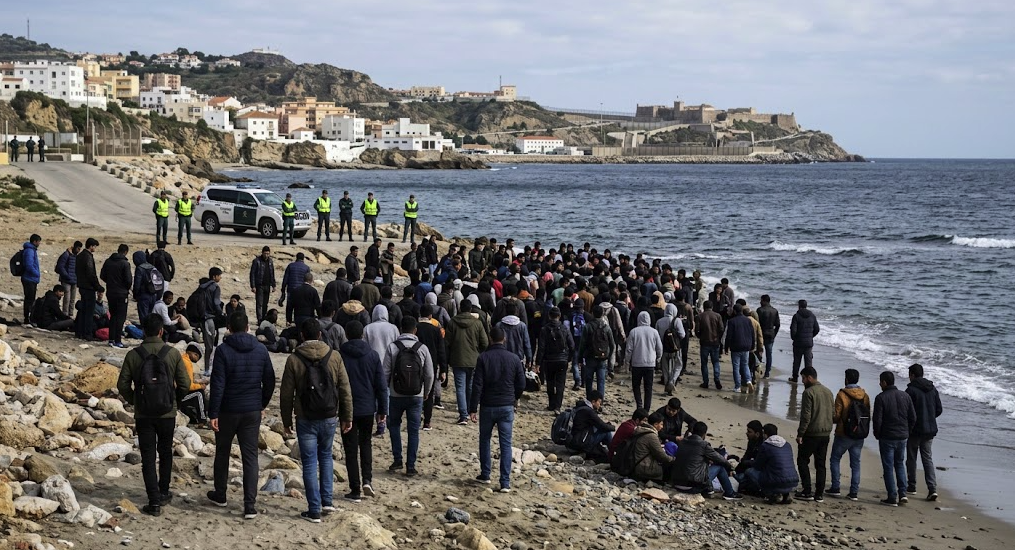
Most of the migrants returned to Morocco within hours of reaching Ceuta. However, thousands remained in the city, including a large number of children.
The continuing presence of migrants created pressure on local services and generated growing concern among residents and authorities.
Ceuta has a population of around 84,000 people. The arrival of such a large number of migrants in a very short period placed the local administration under exceptional pressure.
Many of those who remained lacked stable accommodation. Some slept on beaches or in streets while authorities worked to identify them and determine the appropriate administrative or protection procedures.
The Spanish government faced increasing criticism over its handling of the situation.
Local authorities argued that the scale of the emergency exceeded the city’s capacity to manage it alone. The political opposition also questioned whether the central government had reacted quickly enough.
Prime Minister Pedro Sánchez had already described the events as an attack on Spain’s territorial integrity and promised that state resources would be deployed to restore security and normality in Ceuta.
The government’s response has now moved into a new phase.
Madrid has declared the situation an issue of interest for national security and has placed the overall coordination of the response under Territorial Policy Minister Ángel Víctor Torres.
The decision gives the central government greater responsibility for coordinating the different institutions involved in the crisis.
Robles acknowledges residents’ concerns
Margarita Robles became the first of several ministers expected to address Parliament over the crisis.
During her appearance, she apologised to residents who felt abandoned or insufficiently protected.
Her remarks represented an acknowledgement that the emergency had affected not only migrants and public authorities but also the population of Ceuta.
Robles said she had personally witnessed feelings of anxiety, abandonment and a lack of security among residents.
The minister also defended the role of Spain’s security and intelligence services and insisted on the country’s position regarding Ceuta and Melilla.
The parliamentary appearance nevertheless produced further questions about the government’s preparation before the mass crossing.
Ceuta migration crisis raises questions over intelligence warnings
One of the most disputed issues concerns information available to Spanish authorities before the events of 30 July.
Robles said that the National Intelligence Centre, known as the CNI, had shared information with security forces about a possible imminent migrant crossing.
Interior Minister Fernando Grande-Marlaska subsequently gave a different account.
Grande-Marlaska said there had been no report indicating that the events that eventually occurred on 30 July were going to take place.
The difference between the ministers’ statements has become one of the most controversial aspects of the government’s handling of the crisis.
Robles later clarified that the information she referred to had not been transmitted through a formal written report.
The Government Delegation in Ceuta has also said it did not receive an advance warning that allowed officials to anticipate the scale of the mass arrival. The delegation said it had received information about a progressive increase in maritime arrivals, but not information indicating that an exceptional event of this magnitude was imminent.
The disagreement has fuelled criticism from opposition parties.
The People’s Party has questioned whether the government had sufficient information before the crossing and, if so, whether the available information reached the officials responsible for the response.
The controversy has also placed the CNI’s role under scrutiny.
Robles has defended the intelligence service and argued that intelligence information is not necessarily communicated through conventional written reports.
The dispute remains politically significant because the government is simultaneously attempting to demonstrate that it can improve its response to future migration emergencies.
The government’s explanation for the mass arrival
Prime Minister Pedro Sánchez has blamed human trafficking networks and the circulation of information through social media for contributing to the mass movement.
The government has also referred to the interpretation of a Spanish Supreme Court ruling as one of the factors behind the mobilisation.
According to the government’s explanation, trafficking networks used the interpretation of the court ruling to encourage people to attempt the crossing.
Sánchez also linked the situation to a sharp increase in irregular arrivals after the publication of information about the ruling.
The Spanish government has not publicly attributed the organisation of the mass crossing directly to the Moroccan government.
That distinction is important because relations with Morocco have become another sensitive part of the political debate.
Spain announces changes to immigration and asylum procedures
Alongside its response to the emergency in Ceuta, the Spanish government has announced changes to immigration and asylum legislation.
Interior Minister Fernando Grande-Marlaska said the reforms would bring Spain’s system into line with the European Union’s new migration and asylum framework.
The government says the objective is to create procedures that are orderly, efficient and provide legal guarantees.
One of the proposed changes concerns the initial assessment of undocumented migrants arriving in Spain.
The government plans to limit the medical, biometric and legal evaluation period to three days.
European rules allow this initial process to last for up to seven days.
The Spanish proposal therefore establishes a shorter period for completing the initial checks.
The reforms will also introduce a two-track system for asylum applications.
The intention is to accelerate cases considered urgent while maintaining separate procedures for other applications.
The government believes the changes will help authorities process cases more quickly and respond more effectively when large numbers of people arrive at the same time.
The Council of Ministers has approved a preliminary reform of the asylum and immigration laws as part of the measures linked to the Ceuta emergency.
The government has also approved an extraordinary allocation of €25 million to help address the situation involving unaccompanied minors in Ceuta.
The measures are designed to address both the immediate emergency and longer-term pressure on the city’s services.
The reforms come after weeks of political criticism over the government’s handling of the crisis.
For residents of Ceuta, however, the key issue remains whether the measures can translate into a faster and more coordinated response on the ground.
The humanitarian situation remains a central concern
The arrival of tens of thousands of migrants created an immediate humanitarian challenge.
Although most people returned to Morocco shortly after crossing, several thousand remained in Ceuta.
Among them were many children, creating additional responsibilities for Spanish authorities.
The situation of unaccompanied minors has become particularly sensitive because child protection rules require authorities to provide appropriate care while their legal status and future arrangements are assessed.
The central government has moved towards transferring some vulnerable minors from Ceuta to mainland Spain.
The decision followed weeks of uncertainty over how the children would be accommodated and managed.
For the local authorities, the issue is not simply the number of people involved.
Ceuta has limited territory and a population of around 84,000. A sudden increase in the number of people requiring accommodation, food, medical attention and administrative processing places significant demands on local resources.
The presence of migrants sleeping outdoors has also become one of the most visible signs of the continuing emergency.
Government measures therefore need to address two parallel concerns.
The first is the protection and processing of migrants who remain in the enclave.
The second is the impact of the emergency on Ceuta’s residents and public services.
This dual challenge has shaped much of the political discussion surrounding the crisis.
Robles’s apology was directed specifically at residents who felt that the state had not provided sufficient support during the most difficult stages of the emergency.
Morocco and the dispute over Ceuta and Melilla
The crisis has also revived longstanding tensions surrounding Spain’s relationship with Morocco.
Ceuta and Melilla are Spanish cities located in North Africa and share land borders with Morocco.
Their position makes them particularly sensitive points for migration management and bilateral relations.
Morocco has previously been accused by Spanish and European political figures of using migration pressure around the two cities to exert influence over Madrid or the European Union.
The Spanish government has not publicly established that Morocco organised the mass crossing in July.
Instead, Sánchez has focused his public accusations on trafficking networks and the role of social media.
However, statements from Moroccan officials have added a separate political dimension.
Moroccan Justice Minister Abdellatif Ouahbi recently referred to what he described as Morocco’s historical and geographical right to Ceuta and Melilla and proposed discussions with Spain about the issue.
The remarks prompted a firm response from Robles.
The Spanish defence minister said she would not allow a minister from another government to question the Spanish status of Ceuta and Melilla.
Her position reflects the Spanish government’s longstanding stance that both cities form part of Spain.
Sánchez had already described the July events as a violation of Spain’s territorial integrity during his visit to Ceuta. He also stressed that Spain would use its state resources to guarantee the city’s security.
The migration crisis has therefore developed beyond an immigration issue.
It now involves questions about border security, national security, relations with Morocco and the capacity of Spanish institutions to respond to sudden mass movements.
What happens next in Ceuta?
The immediate priority for Spanish authorities is to deal with the people who remain in Ceuta.
That includes identifying migrants, processing relevant legal cases, protecting vulnerable people and managing the situation of unaccompanied minors.
The government also needs to restore normal conditions for residents.
The declaration of a national security interest and the creation of a central coordination structure are intended to improve the management of the emergency.
Ángel Víctor Torres has been placed in charge of coordinating the government’s response.
The new arrangements are expected to bring together different ministries and public bodies that previously handled separate parts of the crisis.
The government has also increased the presence of security forces.
Sánchez said Spain would reinforce the National Police and Civil Guard presence and deploy the Armed Forces as part of the response.
The government has also discussed physical measures around the breakwater and faster procedures for the return of people who entered Spain irregularly.
At the same time, Spain is attempting to maintain cooperation with Morocco.
Sánchez has highlighted the importance of cooperation with the neighbouring country in fighting trafficking networks and facilitating returns.
That relationship will remain important because Morocco is the immediate neighbouring country on Ceuta’s border.
The Spanish government therefore faces a difficult balance.
It must protect the border and enforce immigration rules while maintaining diplomatic cooperation and meeting its legal responsibilities towards people seeking international protection.
Political pressure continues
The crisis has created significant pressure on Pedro Sánchez’s government.
Opposition parties have criticised the response and questioned whether the authorities acted quickly enough.
The disagreement between Robles and Grande-Marlaska over intelligence information has intensified the political debate.
At the same time, the government insists that it is taking responsibility and has introduced measures intended to prevent a repeat of the situation.
Robles’s apology was an important part of that message.
The minister acknowledged the distress experienced by Ceuta’s residents while defending the work of the security forces and the state’s commitment to the city.
The government must now demonstrate that its announcements can produce practical improvements.
For Ceuta, the central questions are immediate: how will the remaining migrants be managed, how will vulnerable children be protected, and how can authorities prevent another sudden border emergency?
For Spain, the crisis has exposed the complexity of managing migration at a border where humanitarian concerns, national security and relations with a neighbouring country intersect.
The reforms to immigration and asylum procedures are intended to provide a faster framework for future cases.
The new coordination structure is designed to ensure that responsibility does not fall disproportionately on the local government.
And the government’s continued cooperation with Morocco is intended to reduce the role of trafficking networks and facilitate returns where the law permits them.
The crisis has not disappeared simply because the largest wave of arrivals has ended.
Thousands of migrants remain in Ceuta, political disagreements continue in Madrid and questions remain about how much Spanish authorities knew before the mass crossing.
The coming weeks will show whether the government’s new measures can restore confidence among Ceuta’s residents while providing an effective legal and humanitarian response to those who remain.
For now, the apology from Margarita Robles marks a recognition of the pressure faced by the city, while the legislative and administrative measures announced by the government represent its attempt to regain control of a crisis that quickly became a national issue.
Official source:
Spanish Government – Presidency of the Government
Frequently Asked Questions
What caused the Ceuta migration crisis?
The Spanish government has attributed the mass arrival to trafficking networks, social media activity and the interpretation of a Spanish court ruling.
How many migrants crossed into Ceuta?
Figures cited by Ceuta’s president put the number at more than 72,000 people during 30 and 31 July.
What did Margarita Robles apologise for?
The Defence Minister apologised to residents who felt abandoned, anxious, unsafe or insufficiently supported during the crisis.
What immigration changes has Spain announced?
Spain plans to shorten initial migrant assessments to three days and introduce a two-track system for processing asylum applications…….MORE