
Nearly 900 Migrants Reach El Hierro in Five Boats as Canary Islands Face Record November Arrivals
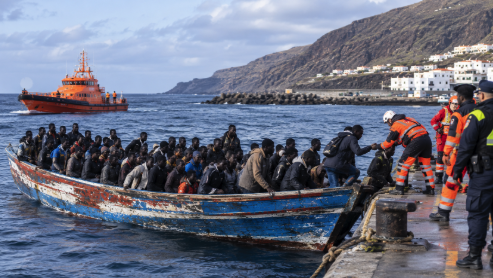
Nearly 900 migrants arrived on the Canary Island of El Hierro aboard five boats on Tuesday, November 24, intensifying pressure on local reception services as the Canary Islands approach 13,000 migrant arrivals in a single month. The latest landings came less than 24 hours after another 815 people reached El Hierro and Tenerife, prompting renewed calls for stronger government support and a permanent system to relocate unaccompanied minors to mainland Spain.

According to figures compiled by Spain’s EFE news agency from emergency and reception services, 888 people reached the port of La Restinga between midnight and approximately 10:30 a.m. on Tuesday. Among them were 82 women and 52 minors.
The latest arrivals underline the scale of the migration pressure facing El Hierro, a small island with a population of approximately 12,000 residents.

Five Boats Bring 888 Migrants to El Hierro
All five boats reached La Restinga, a fishing port on the southern coast of El Hierro. Spanish Maritime Rescue teams escorted the vessels to shore after locating them in Atlantic waters south of the Canary Islands.
The arrivals took place throughout the early morning, with the final boat reaching the harbour at approximately 8:45 a.m.
According to EFE’s tally, the five vessels carried:
- First boat: 217 people, including 13 women and 18 minors.
- Second boat: 190 people, including 20 women and eight minors.
- Third boat: 217 people, including 21 women and 12 minors.
- Fourth boat: 171 people, including 23 women and 18 minors.
- Fifth boat: 93 people, including five women and six minors.
The passengers came mainly from Gambia, Senegal and Guinea-Bissau. One passenger was reportedly a refugee from Yemen.
Several groups told reception workers that they had spent between six and seven days travelling across the Atlantic before reaching the Canary Islands.
One woman required hospital admission after suffering severe hypothermia. The incident highlights the physical dangers faced by people undertaking the long and often hazardous Atlantic crossing.
Canary Islands Approach 13,000 Migrant Arrivals in November
Tuesday’s arrivals followed another major day of rescue operations on Monday, when 815 people reached El Hierro and neighbouring Tenerife aboard eight boats.
According to figures reported by Spanish public broadcaster RTVE, six vessels arrived in El Hierro while two others were escorted to Los Cristianos in southern Tenerife.
By the end of Monday, approximately 12,960 people had reached the Canary Islands during November aboard 130 boats known locally as cayucos.
The latest arrivals on Tuesday pushed the monthly total beyond 13,000.
El Hierro has experienced particularly intense pressure, with approximately 11,000 people arriving on the island during November alone, according to figures reported by RTVE.
The scale of the arrivals is particularly significant given the island’s relatively small population and limited reception infrastructure.
Why So Many Boats Are Reaching the Canary Islands
The Canary Islands remain one of the main entry points into Europe for migrants travelling from West Africa.
The Atlantic route is particularly dangerous because of its distance, unpredictable weather and the limited safety equipment available on many of the boats used for the journey.
Gambia and Senegal are among the main departure countries identified in recent arrivals. Guinea-Bissau is also represented among the passengers rescued in the latest operations.
Spanish authorities have continued to deploy Maritime Rescue vessels to locate boats in distress and escort them safely to port.
After landing, migrants are taken through initial identification and reception procedures before being transferred to appropriate accommodation facilities.
Fernando Clavijo Demands Permanent Arrangements for Migrant Children
The latest arrivals have renewed political pressure on the Spanish government to improve the distribution of unaccompanied migrant children across the country.
Canary Islands president Fernando Clavijo travelled to Madrid on Tuesday for an interministerial meeting focused on the migration situation.
Clavijo has called on the central government to establish a permanent legal framework for transferring unaccompanied minors from the Canary Islands to other autonomous communities.
He argues that the current arrangements should not depend on agreements that require regular renewal, particularly when the islands are experiencing sustained increases in arrivals.
The regional president has warned that reception services are facing serious saturation and that the authorities are struggling to provide the level of care required under international protection commitments.
The issue is particularly sensitive because children arriving without parents or legal guardians require specialist accommodation, social services, education and long-term protection.
What Spanish Law Says About the Transfer of Unaccompanied Minors
Spain introduced legal changes in 2025 to establish a framework for dealing with extraordinary migration pressures and the distribution of unaccompanied foreign minors.
The reform of the Immigration Law, including Articles 35 bis, 35 ter and 35 quáter, provides mechanisms for responding to exceptional situations and organising transfers between autonomous communities.
These provisions are intended to improve coordination between regional administrations and ensure that the responsibility for protecting vulnerable children does not fall disproportionately on the territories receiving the largest numbers of arrivals.
Clavijo wants the arrangements to operate on a stable basis, rather than relying on temporary political agreements.
La Restinga’s Fishing and Diving Industries Face Growing Pressure
The migration situation is also affecting everyday life and economic activity in El Hierro.
La Restinga is an important fishing community and a recognised destination for diving tourism. Its harbour plays a central role in the local economy.
Residents have raised concerns that repeated rescue operations and the arrival of migrant boats are disrupting normal port activity.
Fishing vessels and diving businesses depend on access to harbour facilities, while the island’s tourism sector relies heavily on its coastal environment and maritime activities.
With thousands of people arriving within a relatively short period, local authorities face the challenge of managing humanitarian responsibilities without compromising essential services and the livelihoods of residents.
The situation has strengthened calls for additional national funding and a more coordinated distribution of reception responsibilities across Spain.
A Wider Challenge for Spain and the European Union
The increase in arrivals has once again placed migration at the centre of Spain’s political debate.
The Canary Islands have repeatedly asked Madrid and European institutions for greater assistance with maritime surveillance, reception facilities and the relocation of vulnerable people.
The Atlantic route requires cooperation between countries of departure, Spanish authorities and European agencies responsible for border management and asylum support.
However, rescue operations alone cannot address the wider pressures associated with irregular migration.
Long-term solutions require effective cooperation with countries of origin and transit, adequate humanitarian reception capacity, and clear procedures for protecting people who arrive in vulnerable circumstances.
HIGRH NEWS Editorial View: El Hierro Needs More Than Emergency Measures
The arrival of 888 people in five boats within a single morning illustrates the extraordinary pressure facing El Hierro.
An island with approximately 12,000 residents cannot be expected to manage repeated large-scale arrivals without sufficient support from national and European institutions.
Emergency funding, maritime rescue operations and temporary accommodation are essential, but they must form part of a wider and more sustainable strategy.
The protection of unaccompanied minors deserves particular attention. Children arriving without family support need secure accommodation and consistent protection, regardless of which Spanish region receives responsibility for their care.
At the same time, the interests of local residents must not be overlooked. Fishing, tourism, healthcare and other essential services require adequate resources to continue operating effectively.
In our view, the priority should be a permanent coordination system between the Spanish government, the Canary Islands and other autonomous communities, supported by European cooperation.
The humanitarian response must remain central, but it should be accompanied by realistic planning, fair distribution of responsibilities and sustained investment in the communities most affected by the Atlantic migration route.
Sources
- BOE — Organic Law 4/2000 on the rights and freedoms of foreigners in Spain, as amended: Read the legislation.
- BOE — Royal Decree-Law 2/2025 of 18 March: Read the official legislation.