
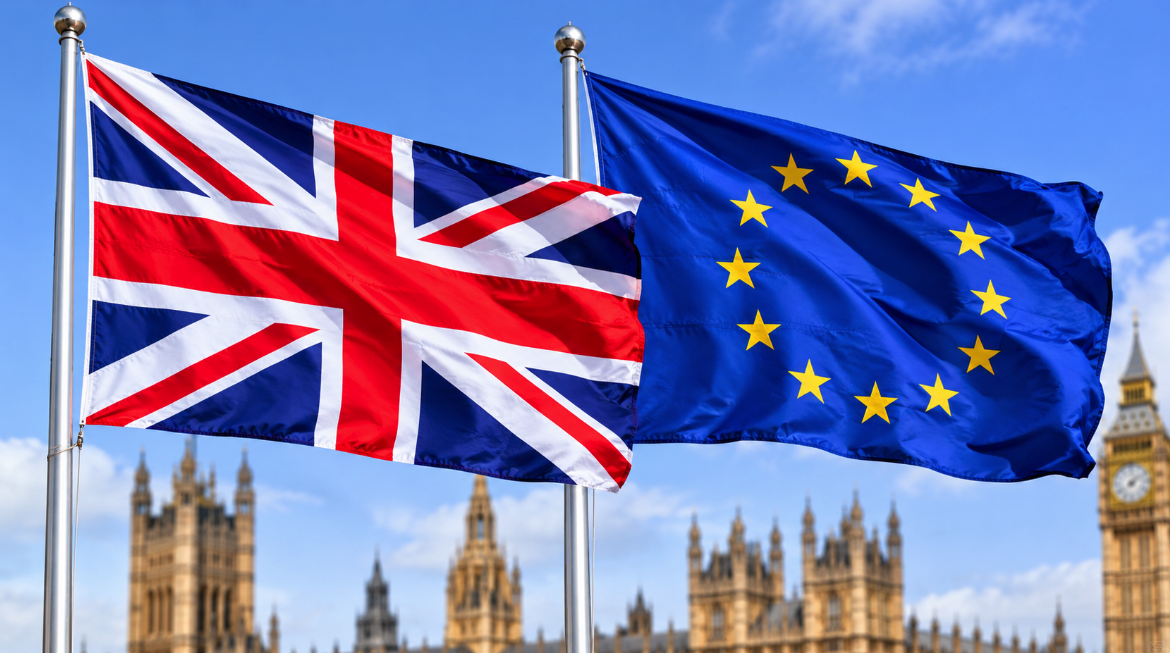

UK and EU Reach Major Post-Brexit Deal on Food Trade and Youth Mobility
The United Kingdom and the European Union have agreed on a major package of measures designed to reduce post-Brexit trade barriers, strengthen economic cooperation and create new opportunities for young people. Announced at a summit in Brussels on 20 November, the agreements include removing many food and agricultural checks, linking carbon emissions markets and introducing a new mobility scheme allowing up to 200,000 young people from both sides to live, work and study across the UK and EU.

The deal marks a significant step towards rebuilding relations between London and Brussels, nearly six years after Britain formally left the European Union. It could also have important consequences for businesses, students, workers and consumers on both sides of the Channel.
However, not all the changes will take effect immediately. Several agreements still require legal and administrative procedures, with some of the most significant measures scheduled for 2028 and beyond.

UK and EU Agree New Post-Brexit Cooperation Package
The agreements were announced following the second UK-EU summit since Britain’s departure from the European Union in 2020.
British Prime Minister Andy Burnham met European Commission President Ursula von der Leyen and European Council President António Costa in Brussels to discuss the future of relations between the two sides.
The meeting builds on the first UK-EU summit, held in London in May 2025, when both sides committed to developing a closer strategic partnership.
Von der Leyen described the new package as a turning point, while Burnham called it a historic moment for Britain and Europe.
According to the British government, the agreements could increase the size of the UK economy by 0.5% by 2040, equivalent to approximately £17 billion annually.
The package focuses on three major areas:
- Reducing trade barriers affecting food and agricultural products.
- Creating new opportunities for young people to live, work and study across the UK and EU.
- Linking British and European carbon emissions trading systems.
The agreement does not mean Britain is rejoining the European Union. The government has confirmed that the UK will remain outside the EU single market and customs union.
Food Trade: Fewer Checks and Lower Costs for Businesses
One of the most significant parts of the agreement concerns food, agriculture, animals and plant products.
Since Brexit, British businesses exporting agricultural products to the European Union have faced additional paperwork, health certificates and border inspections.
These requirements have increased costs and created delays for companies transporting goods between Britain and EU countries.
The new Sanitary and Phytosanitary (SPS) Agreement will establish a common regulatory area, allowing both sides to apply aligned rules to products covered by the agreement.
The planned changes include:
- Removing export health certificates for goods covered by the agreement.
- Eliminating certain phytosanitary certification requirements.
- Reducing time-consuming border inspections for meat, dairy and fish products.
- Simplifying procedures for organic products.
- Reopening the EU market to certain British products, including fresh sausages, burgers, seed potatoes and molluscs.
The agreement is also expected to make trade between Great Britain and Northern Ireland easier under the existing Windsor Framework.
Both sides are targeting 1 March 2028 for implementation, subject to the completion of the necessary legal procedures.
What Does This Mean for Consumers?
Reducing paperwork and inspections could help businesses transport food more efficiently and reduce some of the costs associated with international trade.
The British government believes the agreement could ease pressure on supermarket prices and contribute up to £5.1 billion annually to the UK economy by 2040.
However, lower food prices are not guaranteed. The final impact will depend on how businesses respond to the changes, as well as wider economic conditions.
For European exporters, including Spanish agricultural businesses, closer regulatory alignment could also simplify certain trading arrangements with British partners.
New Youth Mobility Scheme: 200,000 Opportunities Every Year
One of the most widely anticipated parts of the agreement is the new Youth Experience Scheme (YES).
The programme will allow young people from the United Kingdom and participating EU countries to spend up to three years living in the other territory.
The scheme will be open to:
- 100,000 young people from EU countries every year.
- 100,000 young people from the United Kingdom every year.
Applicants must be aged between 18 and 31 when their visa starts.
Participants will be able to undertake different activities during their stay, including:
- Working in the UK or an EU country.
- Studying at educational institutions.
- Travelling and experiencing different cultures.
- Volunteering.
- Working as au pairs.
The programme is intended to restore some of the opportunities that became more difficult for young people following Brexit.
For British citizens, it will create new possibilities to experience life in European countries without relying exclusively on conventional work or study visa routes.
European citizens will also gain a new route to spend an extended period in Britain.
When Will Young People Be Able to Apply?
Although negotiations have concluded, the scheme still needs to go through the necessary legal procedures.
The UK and EU aim to apply the agreement from 2028, with the first opportunities expected to be available no later than January 2030.
The programme will be subject to specific visa and residence requirements.
Importantly, it will not restore the previous freedom of movement between Britain and the EU.
The scheme will have annual participation limits, will not provide access to social benefits in the destination country and will not allow participants to bring dependants.
British participants will also be able to move between participating EU countries under the programme, subject to its conditions.
UK Rejoins Erasmus+ in 2027
Education is another important part of the renewed relationship.
The United Kingdom is due to participate in the European Union’s Erasmus+ programme from 2027, reopening opportunities for educational exchanges and cooperation between British and European institutions.
The programme supports several areas, including:
- University and higher education exchanges.
- Vocational training.
- School education.
- Adult learning.
- Youth programmes.
- Sport and educational cooperation.
The UK and EU have encouraged eligible institutions to apply for opportunities under the programme.
For students, teachers and educational organisations, the return to Erasmus+ represents an important development after years of reduced cooperation following Brexit.
However, the Erasmus+ agreement is separate from the new Youth Experience Scheme. The two programmes will operate under their respective rules and eligibility requirements.
University Tuition Fees Remain Under Negotiation
Despite the progress on educational cooperation, one important issue remains unresolved: university tuition fees.
The European Union and the United Kingdom have agreed to begin negotiations on a new arrangement covering the fees paid by British and European students studying in each other’s territories.
The objective is to improve access to higher education and create more opportunities for students on both sides.
The two parties have committed to concluding these negotiations within six months.
Until an agreement is reached, students should not assume that previous pre-Brexit tuition arrangements will automatically return.
The outcome could be particularly important for European students considering British universities, where international tuition fees can be significantly higher than domestic rates.
UK and EU to Link Carbon Markets by 2028
The new agreement also covers environmental policy and industrial competitiveness.
Britain and the European Union have agreed to link their respective emissions trading systems.
These systems place limits on greenhouse gas emissions and allow participating businesses to buy and sell emissions allowances.
Connecting the two markets should make it easier for companies operating across both territories to comply with carbon regulations.
The agreement is also intended to reduce exposure to certain carbon border charges under the respective Carbon Border Adjustment Mechanisms.
The UK government estimates that linking the markets could:
- Protect approximately £6.5 billion of British exports from relevant carbon border charges.
- Improve access to a larger carbon trading market.
- Reduce regulatory complications for aviation and maritime operators.
- Add nearly £3.8 billion annually to the UK economy by 2040.
Both sides are aiming to make the link operational by 1 January 2028.
The measure could be particularly relevant to energy-intensive industries, including steel and aluminium manufacturing.
What Happens Next? Key Dates for the UK-EU Agreement
Although the summit represents a significant political breakthrough, implementation will take place gradually.
Here are the main dates announced so far:
| Date | Expected development |
|---|---|
| 2027 | UK participation in Erasmus+ begins |
| 1 January 2028 | Target date for linking carbon emissions markets |
| 1 March 2028 | Planned start of the food and agricultural trade agreement |
| 2028 | Target for applying the Youth Experience Scheme agreement |
| January 2030 at the latest | First youth mobility opportunities expected to be available |
The tuition fee negotiations are expected to conclude within six months of the summit.
These dates remain subject to the relevant legal and administrative procedures.
Could Britain Eventually Rejoin the European Union?
The new agreements have also reopened the wider political debate about Britain’s long-term relationship with Europe.
Prime Minister Andy Burnham has maintained that the UK will remain outside the EU single market and customs union during the current parliamentary term.
However, he has left open the possibility of discussing closer economic relations in the future.
Potential options could range from maintaining the current arrangements to seeking a closer customs relationship or reconsidering EU membership.
The possibility of rejoining the European Union remains politically divisive in Britain.
Any application to return to the bloc would require unanimous approval from all 27 EU member states.
European Council President António Costa has indicated that the EU remains open to building the closest possible relationship with the UK, while stressing that closer integration also involves obligations.
Opposition figures, including Reform UK leader Nigel Farage, have criticised the new arrangements, arguing that closer alignment with European rules risks undermining the objectives of Brexit.
Security, Migration and Defence Cooperation Also on the Agenda
Beyond trade and youth mobility, the summit addressed wider European security challenges.
The UK and EU agreed to strengthen cooperation on defence, support for Ukraine, cybersecurity and efforts to tackle organised crime.
Migration was also discussed, particularly the networks responsible for dangerous crossings of the English Channel.
Both sides intend to improve information sharing between law enforcement agencies and coordinate efforts against people-smuggling networks.
A new structured dialogue on migration will help coordinate future cooperation.
The agreements reflect a shared recognition that security challenges increasingly require cooperation between neighbouring countries, even when they are no longer part of the same political union.
HIGRH NEWS Analysis: A Significant Step Towards Rebuilding UK-EU Relations
The new agreement represents one of the most substantial attempts to improve relations between Britain and the European Union since Brexit.
For businesses, reducing unnecessary border procedures could make trade more efficient and help restore commercial links that have been affected by additional administrative requirements.
For young people, the Youth Experience Scheme could be particularly important. The opportunity to live, work and study abroad for up to three years would provide access to professional experience, education and cultural exchanges that became more difficult after 2020.
The return of the UK to Erasmus+ also sends a positive signal about the future of educational cooperation.
However, expectations should remain realistic. The agreement does not restore freedom of movement, and many of its benefits will depend on implementation over the coming years.
Tuition fees remain unresolved, while the new mobility scheme will operate under specific limits and visa conditions.
In our view, the most important test will be whether these political commitments translate into practical benefits for ordinary citizens and businesses.
The UK and EU have taken an important step towards a more constructive relationship. Whether this develops into a lasting economic and political reset will depend on how effectively both sides deliver on their promises.
Official Sources
- UK Government — UK-EU Summit 2026 Explainer: https://www.gov.uk/government/publications/ukeu-summit-2026-key-documents/uk-eu-summit-2026-explainer-html
- UK Government — UK-EU Summit 2026 Joint Statement: https://www.gov.uk/government/publications/ukeu-summit-2026-key-documents/uk-eu-summit-2026-joint-statement-html
- UK Government — Prime Minister secures deal with EU to cut costs and create opportunities for young people: https://www.gov.uk/government/news/costs-cut-prime-minister-secures-deal-with-eu-to-cut-costs-keep-prices-down-and-create-opportunities-for-young-people-worth-up-to-17-billion-per-year
- European Council — EU-United Kingdom Summit, 20 November 2026: https://www.consilium.europa.eu/en/meetings/international-summit/2026/11/20/
- European Council — Joint Statement of the EU-United Kingdom Summit: https://www.consilium.europa.eu/en/press/press-releases/2026/11/20/joint-statement-eu-united-kingdom-summit-20-november-2026/