
Spain’s Supreme Court Upholds Suspension of Voting Rights for Some Citizens Under Grandchildren’s Law
The ruling raises concerns among Spanish citizens living abroad as eligibility checks affect access to the electoral register ahead of the November 29 elections.

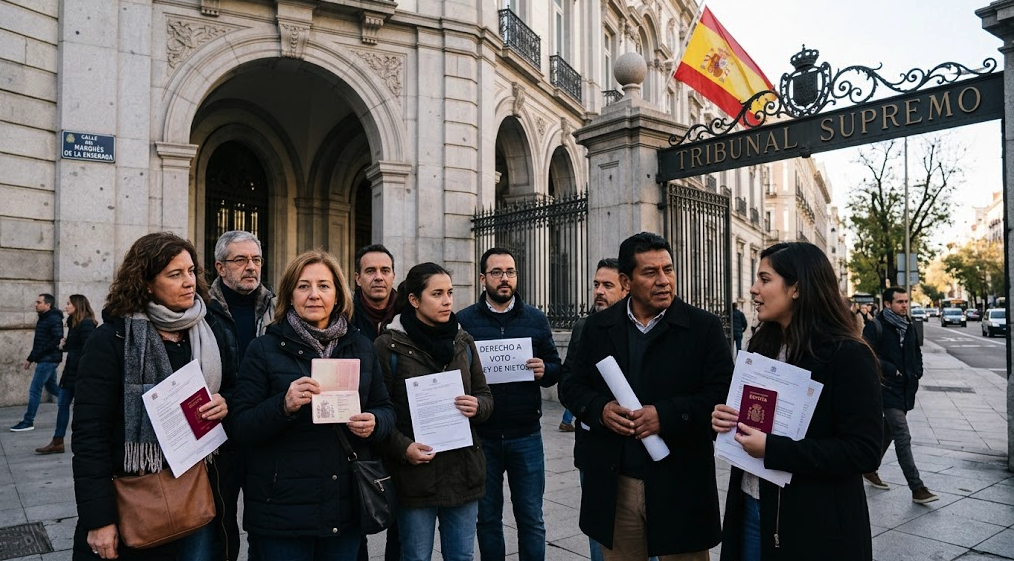
Spain’s Supreme Court has reportedly upheld a decision to suspend the voting rights of some people who acquired Spanish nationality under the country’s Grandchildren’s Law, adding to uncertainty for citizens abroad seeking to participate in upcoming elections.
The dispute concerns people who obtained nationality under Spain’s Law of Democratic Memory, commonly associated with the Ley de Nietos. The legislation expanded access to Spanish citizenship for certain descendants of Spaniards who were affected by exile and historical persecution.

However, acquiring Spanish nationality does not necessarily resolve every electoral registration requirement. For citizens living abroad, inclusion on the relevant electoral register and completion of the required administrative checks can determine whether they are able to vote in a particular election.
Electoral registration remains a key issue
The reported decision highlights the distinction between holding Spanish nationality and meeting the requirements to exercise voting rights in a specific election.
For Spaniards living overseas, the Censo Electoral de Residentes Ausentes (CERA) is the electoral register used for eligible Spanish citizens residing permanently abroad. Registration details and the applicable electoral procedures can affect participation in elections.
The central concern is whether citizens whose nationality applications were approved under the Grandchildren’s Law have completed the necessary consular and electoral formalities to be included in the relevant register.
Those affected should consult the Spanish consulate responsible for their place of residence and the competent electoral authorities to confirm their individual status and any applicable deadlines.
Why the Grandchildren’s Law matters
Spain’s Law 20/2022, known as the Law of Democratic Memory, introduced provisions allowing certain descendants of Spaniards to apply for nationality.
The legislation has been particularly significant for families whose relatives left Spain because of political persecution, exile, or other historical circumstances covered by the law.
For many applicants, obtaining Spanish citizenship represents a connection to family history and renewed access to rights associated with nationality. Electoral participation is one of the issues that can arise after citizenship is granted, particularly for those who live outside Spain.
The legal and administrative processes governing nationality and electoral registration are distinct. As a result, citizens should not assume that approval of a nationality application automatically resolves every requirement associated with voting.
What Spanish citizens abroad should do
Citizens who acquired nationality under the Grandchildren’s Law and intend to vote should verify their electoral status well before an election.
They can contact the relevant Spanish consulate, check the applicable electoral register, and ask the competent authorities whether any additional documentation or registration steps are required.
They should also confirm the election-specific timetable, since registration, claims, and voting procedures may be subject to strict deadlines.
A wider debate about political participation
The reported dispute raises broader questions about how Spain administers electoral rights for citizens living abroad, particularly those who have acquired nationality through historical-memory legislation.
For affected families, the issue goes beyond administrative procedure. It concerns their ability to participate in democratic life after obtaining Spanish citizenship.
The precise scope of the reported Supreme Court decision, including the categories of voters affected and the legal grounds for the suspension, should be confirmed against the published judgment and official electoral guidance before individual cases are assessed.
Official sources
- Law 20/2022 on Democratic Memory: https://www.boe.es/buscar/act.php?id=BOE-A-2022-17099
- Official instruction on nationality applications under the Law of Democratic Memory: https://www.boe.es/buscar/act.php?id=BOE-A-2022-17470
- Spain’s Organic Law 5/1985 on the General Electoral System: https://www.boe.es/buscar/act.php?id=BOE-A-1985-11672