We also provide our news in Spanish and Arabic. For inquiries, please contact us via the website's email.


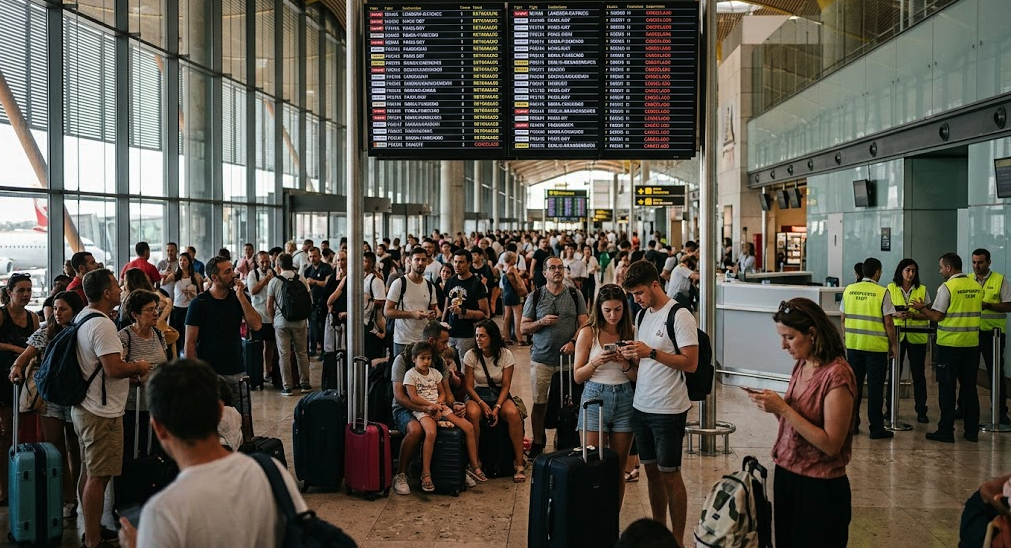
MADRID – HIGRH NEWS: flight delays and cancellations in Spain affected more than four in ten flights operating to and from the country during the peak summer travel period, according to figures from passenger-rights platform Flightright cited by The Olive Press. The figures show a significant number of delays across the Spanish aviation network, while Ryanair has separately criticised the country’s air traffic control system over delays affecting its flights. What do the latest figures reveal about disruption at Spanish airports?

Flight delays and cancellations in Spain reach 40.6% during peak summer
According to the Flightright figures cited by The Olive Press, 40.6% of flights landing in or departing from Spain during July and August did not operate according to their scheduled timetable.
The figure includes both delayed flights and cancellations. Flightright recorded 87,884 delayed flights, representing 39.98% of the total operations covered by the analysis.

The same figures recorded 1,346 cancellations, equivalent to 0.61% of all flights included in the study.
The figures therefore show that delays accounted for the overwhelming majority of the disrupted operations, while cancellations represented a considerably smaller proportion.
The summer period places particular pressure on Spain’s aviation network because of the large number of international visitors travelling to and from the country’s airports.
For passengers, a delay can affect connecting flights, hotel bookings, onward transport and other parts of a journey even when the flight eventually operates.
The figures cited by The Olive Press provide an overview of operations during the two peak summer months rather than an explanation for every individual disruption.
That distinction is important because flight delays can result from several operational factors, while cancellations can involve different circumstances and procedures.
The data also show considerable differences between airlines operating flights connected with Spain.
Jet2 recorded a delay rate of 54.1%, followed by easyJet at 52.19% and Ryanair at 48.93%, according to the figures reported by The Olive Press.
Airlines record sharply different delay rates
The figures provide a broad comparison of the proportion of flights that experienced disruption during the period studied.
Jet2 recorded the highest delay percentage among the airlines highlighted, with 54.1% of its flights affected by delays.
easyJet recorded 52.19%, while Ryanair registered 48.93%.
Other airlines recorded lower percentages. Binter Canarias had a reported delay rate of 27.53%, while Volotea recorded 28.51%.
Canary Fly registered 22.27%, the lowest percentage among the airlines specifically identified in the report.
These figures should be read as percentages of flights rather than percentages of passengers.
A flight with hundreds of passengers counts as one operation in the calculation, regardless of the number of people travelling on board.
The figures also distinguish delays from cancellations.
For cancellations, Lufthansa recorded 3.88%, followed by British Airways at 2.57%, Air France at 1.93%, easyJet at 1.34% and Iberia at 1.01%.
This difference matters when assessing the overall impact on travellers.
A delayed flight continues to operate, although later than planned. A cancelled flight does not operate as scheduled and requires the airline and passengers to make alternative arrangements.
The Flightright figures show that the number of delays was far greater than the number of cancellations during the period covered.
That means the 40.6% figure should not be interpreted as meaning that four in ten flights were cancelled. Most of the affected operations were delayed.
What the numbers show
The reported figures can be summarised as follows:
- 40.6% of flights were delayed or cancelled.
- 87,884 flights were delayed.
- 39.98% of flights were delayed.
- 1,346 flights were cancelled.
- 0.61% of flights were cancelled.
- 54.1% of Jet2 flights were delayed.
- 52.19% of easyJet flights were delayed.
- 48.93% of Ryanair flights were delayed.
The figures cover the peak summer period and therefore provide a snapshot of airline operations during a particularly busy part of the travel calendar.
Flight delays and cancellations in Spain put air traffic control under scrutiny
The latest figures come as Ryanair continues to criticise Spain’s air traffic control system.
The airline says around 10% of its flights operating through Spanish airspace experience delays caused by Spanish air traffic control problems.
Ryanair estimates that the issue affects almost six million passengers and says the number of these delays has increased by 28% compared with the previous year. These figures are claims made by the airline rather than an independent measurement presented in the Flightright study.
Ryanair has specifically criticised Spain’s state-run air navigation provider Enaire.
The airline’s chief operating officer, Neal McMahon, said the company’s analysis identified the area control centres serving Barcelona, Madrid and Seville among the weakest-performing centres in Europe.
Ryanair attributed the problems to what it described as staff shortages and insufficient capacity planning.
The airline also argued that the summer flight schedule was predictable and that Enaire should have planned staffing and controller deployment around the expected demand.
Those statements represent Ryanair’s position on the causes of its delays.
They should therefore be distinguished from the broader Flightright figures, which measure delays and cancellations across flights operating in Spain.
The two sets of information address related but different questions.
Flightright’s figures show how many flights experienced delays or cancellations, while Ryanair’s statements concern the airline’s assessment of air traffic control as a cause of some of its delays.
Ryanair says Spanish air traffic control delays affect millions
Ryanair has made air traffic control capacity a recurring issue in its criticism of Spain’s aviation infrastructure.
The airline says approximately one in ten of its flights operating in Spanish airspace is delayed because of problems attributed to air traffic control.
It estimates that almost six million passengers have been affected.
Ryanair also says the number of delays linked to Spanish air traffic control has risen by 28% compared with the previous year.
The airline has called for additional controllers, improved shift planning and increased staffing at major control centres and airports.
McMahon said Barcelona, Madrid and Seville area control centres were among those facing particularly significant capacity problems, according to The Olive Press.
However, the available figures do not establish that air traffic control was responsible for all of the delays recorded across Spain.
The Flightright analysis covers the overall disruption rate, while Ryanair’s statements focus specifically on delays it attributes to the Spanish air traffic control system.
For passengers, the distinction can be important when determining what caused a particular delay and what rights may apply.
The reason recorded for an individual flight disruption can affect the remedies available to travellers under applicable passenger-rights rules.
What passengers can do after a delayed or cancelled flight
Passengers affected by a delay or cancellation should first check the information provided by their airline and retain their travel documents.
Boarding passes, booking confirmations and communications from the carrier can be useful if a passenger later needs to make a complaint or establish what happened.
Passenger rights depend on the circumstances of the disruption, the route and the reason for the delay or cancellation.
Under European passenger-rights rules, certain disruptions can give travellers rights to assistance, rerouting or reimbursement, and in some circumstances financial compensation.
However, compensation is not automatic for every delay or cancellation.
For example, extraordinary circumstances can affect whether compensation is payable, even though other passenger protections may still apply.
Flightright’s passenger information also notes that compensation rules can depend on factors including the length of the delay, the distance of the flight and the circumstances that caused the disruption.
Passengers should therefore establish the specific cause and circumstances of their flight disruption rather than relying solely on the general statistics for the summer period.
Keeping receipts for reasonable expenses connected with a disruption can also help when a passenger needs to document a claim.
The airline remains the first point of contact for information about an individual flight and the measures being offered to affected passengers.
The summer figures reveal a wider punctuality problem
The figures reported by Flightright show that delays represented the main source of disruption during the period analysed.
The 87,884 delayed flights were vastly greater in number than the 1,346 cancellations recorded.
That distinction provides important context for the headline figure of 40.6%.
The data do not indicate that 40.6% of flights were cancelled. Instead, they combine delayed and cancelled operations into a single measure of flights that did not run according to schedule.
The differences between airlines were also substantial.
Jet2 recorded a delay rate of 54.1%, while easyJet recorded 52.19% and Ryanair 48.93%.
At the lower end of the figures highlighted in the report, Canary Fly recorded 22.27%, Binter Canarias 27.53% and Volotea 28.51%.
Cancellation rates followed a different pattern, with Lufthansa recording 3.88%, British Airways 2.57%, Air France 1.93%, easyJet 1.34% and Iberia 1.01%.
These figures underline why punctuality and cancellations should be considered separately when assessing airline operations.
A carrier can have a relatively high delay rate without having the same position in the cancellation figures.
The data also do not by themselves identify why every flight was delayed.
Weather, air traffic management, aircraft availability, airport capacity, operational planning and other factors can affect aviation schedules, but the figures cited in the report do not assign each individual delay to one specific cause.
For Ryanair, air traffic control remains a central part of its criticism of the Spanish aviation system.
The airline’s claims provide one explanation for part of its disruption, but they should not be treated as an explanation for the entire Spanish aviation network without additional evidence.
What the latest figures mean for travellers
For travellers using Spanish airports, the figures highlight the importance of checking flight information before departure and allowing additional time when travelling during periods of heavy demand.
The statistics also show why passengers should distinguish between a delay and a cancellation when seeking information about their rights.
A delay may require waiting for the original service, while a cancellation can require a replacement flight or refund.
The exact options depend on the individual circumstances and applicable passenger-rights rules.
The wider debate over Spanish air traffic control is likely to remain relevant as airlines, airports and authorities deal with high levels of demand.
Ryanair has publicly called for additional staffing and operational changes within the air traffic control system.
Meanwhile, the Flightright figures provide a broader picture of disruption across flights operating in Spain during July and August.
Taken together, the information shows a summer aviation period marked by a high number of delayed operations, alongside a much smaller number of cancellations.
For passengers, the most relevant information remains the status and cause of their own flight, the assistance offered by the airline and the rights that apply to their particular journey.
How many flights were delayed in Spain?
Flightright recorded 87,884 delayed flights during the period covered by its analysis.
What percentage of flights were delayed or cancelled?
The reported figure was 40.6% for flights operating to and from Spain during July and August.
What was Ryanair’s reported delay rate?
Ryanair recorded a 48.93% delay rate in the figures cited by The Olive Press.
Can passengers receive compensation after a flight delay?
In some circumstances, passengers may qualify for compensation or other assistance, depending on the cause, duration and circumstances of the disruption…….MORE
Contact us: info@higrh.com