We also provide our news in Spanish and Arabic. For inquiries, please contact us via the website's email.

ARGUINEGUÍN – HIGRH NEWS: migrants dead Canary Islands

More than 80 people are feared to have died during a 27-day Atlantic crossing after a migrant boat was found adrift southwest of Gran Canaria, with 44 survivors and five bodies aboard. The vessel had reportedly departed The Gambia carrying more than 120 people before spending almost four weeks at sea, so what happened during the journey?
Migrants dead Canary Islands: a boat found after 27 days at sea
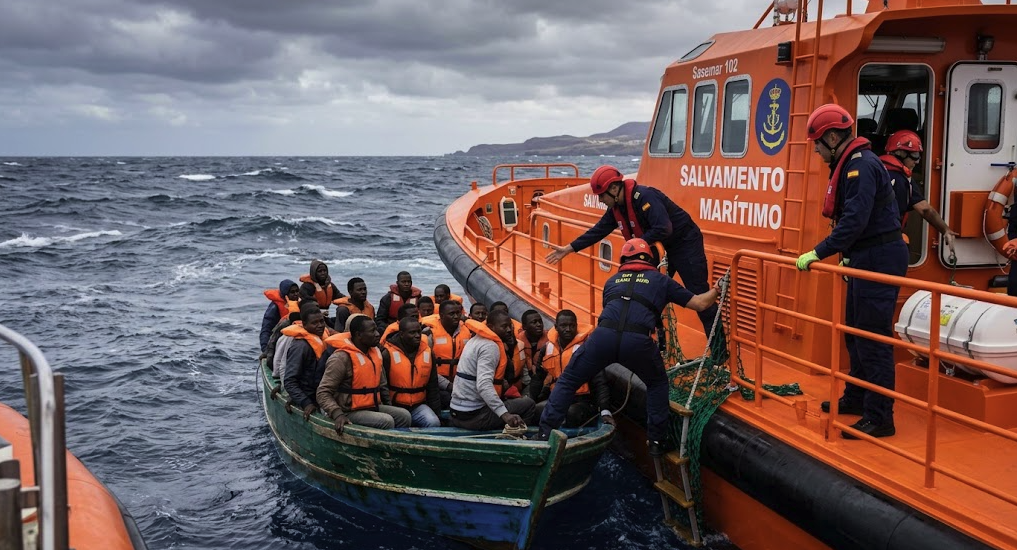
Spanish maritime rescue teams located the boat approximately 65 nautical miles southwest of Arguineguín, a coastal town in Gran Canaria, after it had spent 27 days adrift in the Atlantic.

The discovery triggered a rescue operation involving Spain’s maritime emergency services. When rescuers reached the vessel, they found 44 people still alive and five dead bodies aboard.
The survivors were all men from sub-Saharan Africa, according to Salvamento Marítimo. Three of them were in critical condition and required emergency evacuation by helicopter after the rescue.
The remaining survivors travelled by sea to Gran Canaria, arriving at the port of Arguineguín during the early hours of Thursday.
The operation unfolded in difficult maritime conditions. Winds in the area reached around 20 knots, while waves measured approximately 2.5 metres.
Those conditions prevented rescuers from recovering the five bodies found inside the boat.
Salvamento Marítimo said the weather made it impossible to retrieve the bodies safely once the rescue of the living passengers had been completed.
The operation also left unanswered questions about the total number of people who had originally travelled on the boat.
Maritime rescue authorities said they could not independently establish how many occupants had initially boarded the vessel.
That uncertainty has become central to the emerging account of the tragedy because an organisation assisting migrant families has reported a substantially higher death toll.
The five bodies constitute the number of deceased people directly found by the maritime rescue service. The figure of 83 represents an estimate communicated by Caminando Fronteras based on information provided by survivors and contacts linked to the missing passengers.
The reported death toll from the Atlantic crossing
Helena Maleno Garzón, founder of the migrant-rights organisation Caminando Fronteras, said survivors reported that 83 people had died during the journey.
According to Maleno, the reported victims included three women and a baby.
Reuters reported that it could not independently verify the figure of 83 deaths. Salvamento Marítimo, meanwhile, confirmed five bodies aboard the boat when rescuers arrived.
That distinction is important when reporting the tragedy.
The five bodies constitute the number of deceased people directly found by the maritime rescue service. The figure of 83 represents the estimate communicated by Caminando Fronteras based on information provided by survivors and contacts linked to the missing passengers.
The two figures therefore describe different levels of confirmation.
Caminando Fronteras has worked for years with relatives of people attempting to cross the Atlantic from West Africa to the Canary Islands. The organisation often receives information from families when boats lose contact during the journey.
In this case, the organisation connected the rescued boat with a departure from The Gambia and reported that many passengers had died before the vessel reached the area where Spanish rescuers found it.
The reported presence of women and a baby among the original passengers adds another dimension to the tragedy. Salvamento Marítimo confirmed that the people rescued alive were men.
The information available about those who died comes from different sources, which means the complete identity and final number of victims remained unclear at the time of the rescue.
The contrast between the 44 survivors, the five bodies found aboard and the much larger figure reported by Caminando Fronteras illustrates the difficulties involved in documenting deaths during long Atlantic crossings.
People who die during such journeys can disappear at sea, leaving relatives dependent on accounts from survivors and humanitarian organisations to establish what happened.
A departure from The Gambia
The boat reportedly left The Gambia in West Africa in early August.
Caminando Fronteras said the vessel carried around 127 people when it began its journey. Other reports placed the original number at 128.
The difference of one person reflects the uncertainty surrounding the passenger count and the difficulty of establishing a definitive manifest for an irregular sea crossing.
What is clear from the available information is that the vessel began the journey with substantially more people than the 44 men rescued alive.
The reported departure date was 7 August, meaning the passengers spent almost four weeks at sea before the rescue operation brought the survivors to Gran Canaria.
The Atlantic crossing from West Africa to the Canary Islands involves a long stretch of open ocean. Boats making the journey can face strong winds, powerful currents and changing sea conditions.
The length of this particular journey made the situation especially severe.
A boat remaining at sea for 27 days must contend not only with the physical risks created by waves and weather but also with the consequences of an extended voyage without the resources normally available on a commercial or rescue vessel.
By the time Spanish rescuers located the boat, dozens of passengers were reportedly no longer alive.
The information provided by survivors will be important in reconstructing the final days of the journey and determining how many people died before the vessel reached the waters south of Gran Canaria.
For families in The Gambia and elsewhere in West Africa, the rescue also leaves a difficult process of identifying survivors and determining the fate of relatives who travelled aboard the boat.
The reported death toll cannot be treated as fully confirmed until the relevant authorities establish more information. However, the five bodies found aboard provide direct evidence that people died during the crossing.
The accounts from survivors provide additional information about deaths that may have occurred earlier, although those accounts require verification.
Migrants dead Canary Islands: the rescue off Gran Canaria
A rescue aircraft first located the boat in the Atlantic, around 65 nautical miles southwest of Arguineguín.
The distance placed the vessel far from the Gran Canaria coastline and required maritime rescue crews to reach it at sea.
Once the vessel was located, Spanish rescue services moved to evacuate those who remained alive.
The rescue operation took place against difficult weather conditions, with winds of around 20 knots and waves measuring approximately 2.5 metres.
Those conditions affected more than the speed of the operation. They also prevented rescuers from bringing the five bodies back from the boat.
The 44 survivors were eventually taken toward Gran Canaria.
Three people required urgent medical attention and were transported by helicopter because of their critical condition.
The remaining survivors travelled by sea and reached Arguineguín in the early hours of Thursday.
Their arrival marked the end of a journey that had begun in West Africa and lasted 27 days.
For official information about Spain’s maritime rescue operations, Salvamento Marítimo provides information through its official website.
Medical teams then assessed the condition of the survivors after their prolonged time at sea.
The rescue demonstrated the importance of aerial surveillance in identifying boats on the Atlantic route. Without the aircraft locating the vessel, the passengers could have remained adrift farther from the Canary Islands.
The operation also demonstrated the limits faced by rescue crews once they reach boats in distress.
Even after the vessel was located and the living passengers were evacuated, rough sea conditions prevented the recovery of the five bodies.
The incident therefore ended with both a successful rescue and an unresolved humanitarian loss.
Forty-four people reached safety, while the number of people who died during the crossing remained subject to further investigation and verification.
The Canary Islands and one of the world’s most dangerous migration routes
The Atlantic route linking West Africa with the Canary Islands is widely regarded as one of the world’s deadliest migration crossings.
Thousands of people attempt the journey in boats each year in the hope of reaching Spanish territory.
The route presents particular dangers because of its length and exposure to the open Atlantic.
Strong currents, rough seas and long distances can turn a journey that might initially appear manageable into a prolonged emergency.
The boat found south of Gran Canaria illustrates those risks.
Instead of reaching the islands within a short period, the vessel remained at sea for 27 days.
The crossing ended with 44 survivors, five confirmed bodies aboard and an estimate from Caminando Fronteras that 83 people had died.
The incident also demonstrates why the number of deaths along the Atlantic route can be difficult to establish.
When boats disappear, there may be no survivors to provide information. When a vessel eventually reaches the Canary Islands, it may contain far fewer people than when it departed.
In those situations, humanitarian organisations often rely on relatives, survivors and other contacts to reconstruct the journey.
Authorities must then distinguish between confirmed deaths, reported deaths and people who remain missing.
That process can take time.
For the people who survive, the arrival in Gran Canaria is only one stage of the aftermath. They may also become important witnesses to what happened during the crossing.
Their accounts can help investigators understand how long the boat remained at sea, how many people were aboard and what happened to those who disappeared.
The tragedy off Gran Canaria therefore extends beyond the five bodies discovered by rescue crews.
It includes the fate of people whose deaths were reported by survivors but whose remains were not recovered.
It also includes families who may still be waiting for definitive information about relatives who left West Africa aboard the vessel.
The reaction from the Canary Islands government
Fernando Clavijo, president of the Canary Islands government, responded publicly to the tragedy.
In a message published on X, he described the continued loss of life as intolerable and said the Canary Islands could not become accustomed to the Atlantic being a place of death.
Clavijo’s statement followed the discovery of the boat and the rescue of its surviving passengers.
His comments placed the latest incident within the broader debate over migration policy and the dangers associated with the Atlantic route.
The Canary Islands have become one of the principal destinations for people travelling from West Africa toward Spain by sea.
The route has continued to generate humanitarian emergencies involving overcrowded or poorly equipped vessels.
The latest rescue adds another case in which the people aboard a boat faced a prolonged and dangerous journey before Spanish authorities could locate them.
For the survivors, reaching Gran Canaria ended the immediate danger of being lost at sea.
For the families of those who died, however, the process of establishing identities and confirming what happened remains separate from the rescue itself.
What is confirmed about the tragedy
Several facts about the incident are established by the rescue operation.
Spanish maritime authorities located the vessel around 65 nautical miles southwest of Arguineguín.
They rescued 44 living passengers, all men from sub-Saharan Africa.
Three survivors were in critical condition and were taken to hospital by helicopter.
Five dead bodies were found aboard the boat.
Rough weather prevented rescuers from recovering those bodies.
The vessel had spent 27 days at sea after reportedly leaving The Gambia.
The original number of passengers remains uncertain in official terms, although Caminando Fronteras said around 127 people had been aboard.
The organisation’s founder, Helena Maleno, reported that 83 people had died during the crossing, including three women and a baby.
Reuters could not independently verify that higher death toll.
Those distinctions should remain clear as authorities and humanitarian organisations continue to establish what happened.
The confirmed facts already reveal a severe loss of life.
The fate of the people who did not reach Gran Canaria may become clearer through survivor testimony and information from their families.
Until then, the tragedy remains a stark reminder of the risks faced by people attempting to cross the Atlantic toward the Canary Islands.
The 44 survivors reached safety, but their journey ended with the loss of dozens of lives, according to the account provided by Caminando Fronteras.
The five bodies found aboard the vessel offered direct evidence of those deaths, while the reported figure of 83 victims points to a potentially much larger toll.
For the Canary Islands, the incident once again brings the human cost of the Atlantic migration route into focus.
Frequently Asked Questions
How many migrants survived the boat crossing?
Spanish Maritime Rescue rescued 44 survivors from the vessel. All were men from sub-Saharan Africa.
How many bodies were found?
Five bodies were found aboard the boat. Rescue teams could not recover them because of rough sea conditions.
Where did the boat come from?
The vessel reportedly departed from The Gambia in West Africa in early August.
How many people are believed to have died?
Caminando Fronteras reported that 83 people died during the crossing, including three women and a baby. Reuters could not independently verify that figure, while Spanish maritime authorities confirmed five bodies aboard the boat…….MORE
Contact us: info@higrh.com