We also provide our news in Spanish and Arabic. For inquiries, please contact us via the website's email.


CEUTA – HIGRH NEWS: Ceuta migrant crisis

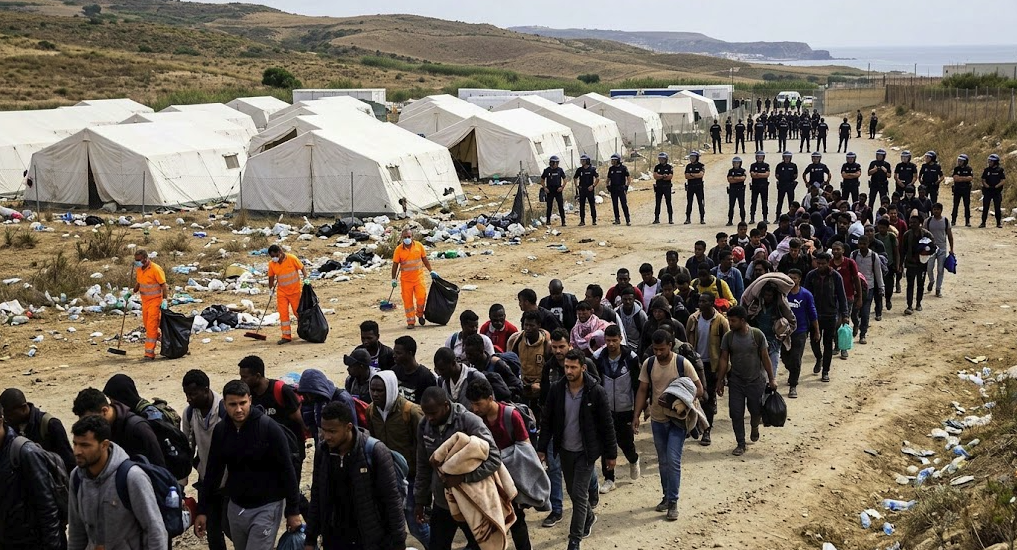
The Ceuta migrant crisis escalated at Loma Colmenar after Spanish National Police moved to disperse hundreds of migrants who had gathered outside a temporary reception site. Officers fired warning shots into the air as tensions rose around access to the facility, while the area was later cleared and cleaned. How did a queue that had lasted for days turn into a confrontation involving riot police?
A long wait outside the Loma Colmenar facility
More than a thousand migrants had been waiting for days near a large parking area on the outskirts of Ceuta, according to the material provided for this report.

The group had gathered outside temporary facilities established at Loma Colmenar. The site included large white tents equipped with beds, with the aim of providing migrants with somewhere to sleep, eat and maintain basic hygiene.
The first occupants entered the facilities around ten days before the police operation. At that point, 25 large tents with bunk beds had been installed.
The available places quickly proved insufficient for the number of people seeking access. As a result, a long queue developed around the site, with migrants waiting for an opportunity to enter.
The situation became particularly tense as people outside watched work being carried out to expand the facilities. Many continued to wait in the hope that additional places would become available.
The area had previously served another purpose. Vehicles waiting to cross into Morocco used the open space so that queues would not block the road around the border.
The Government later adapted the site to provide temporary accommodation for migrants who had otherwise been sleeping outdoors. The facilities were intended to provide access to food, water, hygiene and overnight shelter.
A false rumour also circulated among some migrants. According to the supplied account, some believed that entering the facility could provide them with a fast route to obtaining documents allowing them to remain in Europe.
That information was false, but it added to the expectations surrounding access to the tents.
Current reporting also confirms that hundreds of migrants had been camping outside the Loma Colmenar reception area while waiting to enter.
Police intervention brings the situation to a head
The situation changed when some migrants gained access to the facility and others waiting outside attempted to move forward at the same time.
Europa Press reported that the simultaneous movement created an overcrowded surge in which migrants pushed one another and confronted each other. Police then intervened to separate people and contain the situation.
National Police deployed riot-control units around the site. Officers carried out charges to prevent the gathering from advancing further.
They also fired warning shots into the air as a deterrent while trying to restore control.
The police subsequently began clearing the area outside the reception facilities. Officers blocked access roads and maintained a security presence around Loma Colmenar.
Many migrants left the area carrying their belongings after the police operation.
The intervention followed several days in which people had remained outside the facility, with some spending the night at the site.
According to the supplied account, police sources described the use of warning shots as part of the effort to control the situation and said the incident was ultimately brought under control.
The operation also involved cleaning teams. Once the area had been cleared, workers began removing the rubbish accumulated during the days of occupation.
The immediate confrontation therefore ended with the dispersal of the crowd, but the underlying shortage of accommodation remained.
Limited accommodation adds to the pressure
The central difficulty at Loma Colmenar was the gap between the number of migrants seeking accommodation and the number of available places.
The tents were quickly filled, particularly by people who had previously been sleeping in makeshift shelters at Trampolín beach.
Moving into the facility offered a significant change in living conditions. The tents provided beds as well as access to food, water and basic hygiene facilities.
But there were not enough spaces for everyone waiting outside.
That shortage led to the formation of increasingly large queues around the facility. Some migrants remained nearby for days in the hope of gaining entry.
The supplied account states that several hundred migrants were able to enter after the Army opened an additional large white tent. Many others remained outside.
The situation also affected the surrounding neighbourhood.
A senior Local Police officer cited in the source material said that residents had complained about disturbances during the night. The officer referred to fights, thefts and alleged sexual assaults.
The same police official estimated that around 5,000 migrants had at one point been present in the neighbourhood. That figure is presented as the official’s estimate rather than as an independently verified count.
The accumulation of people also produced visible environmental problems. Hundreds of kilograms of rubbish had built up around the area during the period of waiting.
Cleaning crews moved in after the police operation to clear the waste.
The combination of limited accommodation, a large number of people outside the facility and tensions with the surrounding community created a difficult situation for both migrants and residents.
Ahmed voices frustration after the evacuation
The police operation left many migrants looking for another place to stay.
Among those expressing frustration was Ahmed, a 29-year-old migrant described in the supplied material as one of the informal leaders of the group.
He questioned where migrants were expected to go after being removed from the area.
“They throw us out of the beach, they throw us out of here, where do they want us to go?” Ahmed said.
His comment reflected the uncertainty facing people who had already moved from one location to another.
Some migrants had previously stayed at Trampolín beach before being moved towards the Loma Colmenar facilities.
The temporary site had therefore become an important point for people seeking somewhere to sleep and access basic services.
After the police cleared the area, Ahmed and other migrants were reported to have moved around Ceuta while looking for another place to settle.
The episode also highlighted the difficult relationship between the migrant population and some residents living close to the site.
According to the supplied material, some local residents, many of them Arabic-speaking Muslims, provided migrants with food and hygiene products.
At the same time, some residents also wanted the migrants to leave the area.
That contrast reflects the competing pressures surrounding the temporary settlement: humanitarian assistance on one side and concerns about the impact of a large informal gathering on the surrounding neighbourhood on the other.
The temporary settlement and its impact on Ceuta
The open area at Loma Colmenar gradually became a temporary settlement despite the fact that the reception facilities had limited capacity.
Migrants who could not enter the tents remained outside, sometimes spending the night in the area while waiting for vacancies.
The presence of beds, food, water and hygiene facilities inside the site made access highly sought after.
The expectation of additional capacity also encouraged people to remain nearby as construction and expansion work continued.
However, the available information does not establish that the expansion was sufficient to accommodate everyone who was waiting.
The shortage of places remained at the centre of the dispute.
The concentration also created practical problems around the site. Police had to reinforce the area and manage access routes while preventing the gathering from becoming larger.
Current reporting confirms that the police operation included measures to disperse migrants who had gathered outside and that access roads around Loma Colmenar were affected by the security deployment.
The clean-up operation provided a visible sign of how long the concentration had lasted.
Workers removed accumulated waste after the migrants were dispersed.
The episode therefore involved several overlapping issues: limited temporary accommodation, a large number of people waiting outside, pressure on local services, tensions in the surrounding neighbourhood and a police operation to clear the area.
What happened after the Loma Colmenar evacuation?
After the police cleared the site, migrants who had not obtained accommodation had to leave the area.
Some began moving through Ceuta in search of another place to stay.
For those who had been sleeping outdoors, the immediate problem remained unchanged: finding somewhere to spend the night.
The evacuation removed the large queue from Loma Colmenar, but it did not remove the demand for accommodation.
The facilities had been established precisely because large numbers of migrants were already living outside in difficult conditions.
The information supplied for this report does not establish that migrants who entered the facility automatically received permission to remain in Europe.
Instead, it identifies that claim as a false rumour circulating among some people waiting to enter.
The events at Loma Colmenar consequently centred on access to a limited temporary reception system.
The Government had adapted the site to provide basic shelter, but demand exceeded the available capacity.
The immediate police operation ended the gathering outside the facility. Cleaning teams then worked to restore the area.
The situation of migrants who remained without accommodation, however, continued beyond the evacuation.
For official information and administrative services, readers can consult the Official Electronic Headquarters of the Autonomous City of Ceuta.
Ceuta migrant crisis leaves questions over accommodation
The Ceuta migrant crisis at Loma Colmenar illustrates the pressure created when temporary accommodation cannot meet the number of people seeking access.
For days, migrants waited outside the facility hoping to obtain a place inside.
The situation became increasingly tense when some people entered and others tried to follow. Police intervened, deployed riot-control units and fired warning shots into the air.
The operation eventually cleared the area.
For the migrants who remained outside, however, the evacuation created another immediate challenge: finding somewhere else to stay.
Ahmed’s question — “where do they want us to go?” — captured the uncertainty expressed by people who had already moved from Trampolín beach to the Loma Colmenar area.
The episode also exposed the pressure placed on the surrounding neighbourhood.
Residents had provided food and hygiene products to migrants, while some also called for the group to leave.
Police officials cited concerns over nighttime disturbances, including fights, thefts and alleged sexual assaults. Those claims are attributed to the police official quoted in the supplied material.
The situation at Loma Colmenar ultimately combined a humanitarian need for shelter with a security and public-order challenge.
The temporary facilities provided basic services to those who managed to enter, but the number of people seeking access was greater than the available capacity.
Once the police cleared the site, the physical settlement disappeared from the area, but the accommodation problem remained.
The events at Loma Colmenar therefore marked another significant moment in the continuing Ceuta migrant crisis, with hundreds of people left to look for alternatives after the evacuation.
Frequently Asked Questions
What happened at Loma Colmenar?
Police dispersed a large gathering of migrants outside a temporary reception facility after tensions developed around access to the site.
Why did police fire warning shots?
Police used warning shots into the air as a deterrent while attempting to control the crowd and prevent the situation from escalating.
How many migrants were waiting outside?
The supplied material says more than 1,000 migrants had been waiting in the area, while a senior Local Police officer estimated that the wider concentration had reached around 5,000 people.
What happened to migrants who could not enter?
They were dispersed from the Loma Colmenar area and some began looking for other places to stay in Ceuta…….MORE
Contact us: info@higrh.com