We also provide our news in Spanish and Arabic. For inquiries, please contact us via the website's email.


MADRID – HIGRH NEWS: Ceuta migrant crisis has entered a new and increasingly tense phase, with Spain requesting additional European assistance to process migrants who remain in the Spanish North African enclave after the mass border crossing in July. At the same time, Ceuta’s authorities have warned that the pressure on the city is reaching a critical point, while demonstrations and clashes have increased concerns about public order. What measures is Spain now taking to prevent the situation from deteriorating further?

Ceuta migrant crisis pushes Spain to seek wider European support
The Spanish government has asked the European Commission for assistance from Frontex, Europol and the European Union Agency for Asylum (EUAA) to help manage migrants who remain irregularly in Ceuta.
Interior Minister Fernando Grande-Marlaska made the request as authorities continue identifying and processing people who entered the city during the mass crossing from Morocco at the end of July.

The Spanish government wants additional European resources to strengthen the system used to identify migrants, assess their circumstances and determine the appropriate legal procedure for each case.
According to information released after the request, Spain is also seeking additional Frontex personnel. Reuters reported that Madrid asked for 10 more officers to assist with migrant screening.
The request comes nearly a month after tens of thousands of people crossed into Ceuta. Spanish authorities have said that at least 72,000 people entered during the mass movement, while most subsequently returned to Morocco.
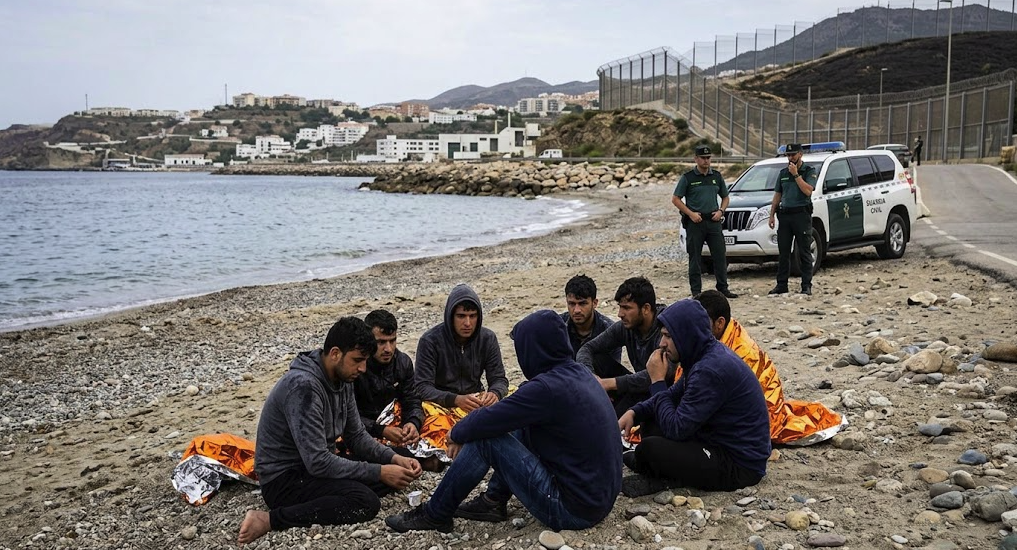
Thousands, however, remain in the city. Estimates reported by Reuters put the number still in Ceuta between 5,000 and 8,000 people.
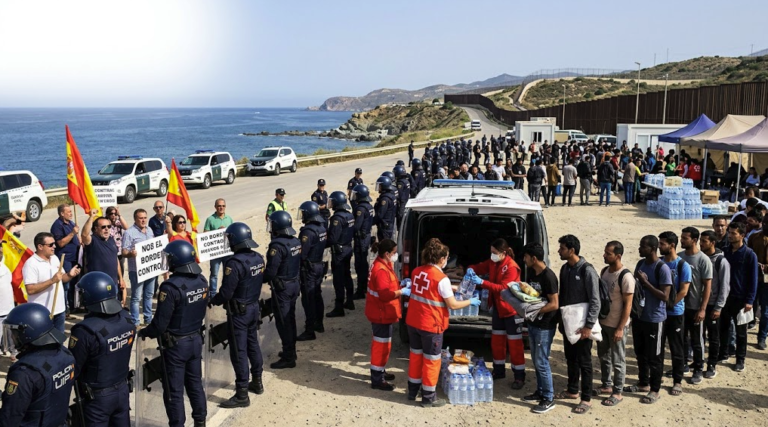
The situation has placed significant pressure on local services and accommodation facilities. Some migrants have been staying in temporary settlements and sleeping in coastal areas, prompting repeated interventions by Spanish authorities.
Madrid has also asked the EU asylum agency to provide assistance with interviews and interpretation. Because of the limited space available in Ceuta, part of that work is expected to take place electronically.
The role of Frontex and Europol
Frontex is being asked to contribute to the identification and screening process, while Spain wants greater cooperation with Europol in the fight against migrant-smuggling networks.
The European assistance is intended to support Spanish authorities rather than replace their responsibility for managing the situation.
The government has also requested an extension of Operation Minerva, a joint border-control operation involving Spanish police and Frontex. Madrid wants the operation to continue until the beginning of September while the authorities deal with the consequences of the mass arrival.
The request for European assistance reflects the scale of the administrative challenge facing Ceuta. The city has limited territory and reception capacity, while thousands of individual cases require identification and assessment.
Spain is therefore seeking to increase the number of personnel and organisations involved in the process.
Official source: Spanish Ministry of the Interior
Ceuta authorities warn that pressure is reaching a critical level
The political pressure inside Ceuta has also intensified.
The Assembly of Ceuta unanimously approved an institutional declaration calling on the central government to adopt urgent measures. Local representatives described the situation as extreme and warned that the city was approaching a point where normal life could be seriously affected.
President Juan Vivas said Ceuta had lost much of its usual calm and argued that authorities had little time to prevent a more serious deterioration.
The declaration also called for people who entered during the mass crossing and who remain in Ceuta to return to their countries in accordance with Spanish law.
At the same time, the local authorities defended the right of residents to demonstrate, provided protests remain peaceful and orderly.
That distinction has become particularly important as tensions have risen in recent days.
Local authorities have condemned violence and stressed that neither residents nor migrants should take the law into their own hands.
The statement from the Ceuta Assembly came after several incidents involving protesters, migrants and security forces.
The developments have increased pressure on the central government to accelerate the processing of migrants who remain in the city while also maintaining public order.
A city under pressure after the mass crossing
Ceuta is a small Spanish autonomous city on the North African coast, surrounded by Morocco and the Mediterranean Sea.
Its geographical position makes it one of the most sensitive points on Spain’s external border.
The scale of the July crossing placed immediate pressure on police, reception services and local authorities.
Although most of those who crossed subsequently returned to Morocco, thousands remained behind. The continued presence of migrants has become a major issue for residents and local politicians.
The limited size of the territory has made the situation particularly difficult to manage.
Authorities have had to move migrants from beaches and temporary settlements to other facilities while continuing the identification process.
The government has also faced demands to clarify how quickly people who do not have the legal right to remain in Spain can be returned.
Interior Minister Grande-Marlaska has insisted that the government will act according to the law and has called for calm.
The minister’s position comes as political opposition parties demand tougher action over the migration situation.
Spain prepares additional measures along the Ceuta border
Alongside the request for European assistance, the Spanish Interior Ministry has announced a package of measures aimed at strengthening Ceuta’s border security.
The proposals include changes to maritime surveillance and physical infrastructure around important areas of the city’s coastline.
Among the measures are plans to extend the Tarajal and Benzú breakwaters. Authorities also intend to establish a permanent system of maritime containment buoys.
The security package includes additional aerial surveillance using drones, light intervention vessels and remotely operated underwater equipment.
The objective is to improve monitoring of the coastline and provide security forces with more tools to respond to possible attempts to cross the border.
The measures come after the large-scale movement from Morocco demonstrated how quickly pressure could build along Ceuta’s coastal approaches.
The government is therefore combining several approaches: stronger border surveillance, European cooperation, migrant identification and the processing of individual cases.
The authorities are also continuing cooperation with Morocco.
The management of the border remains closely connected to relations between Madrid and Rabat because Morocco controls the territory immediately surrounding Ceuta.
Processing migrants remains a central challenge
One of the most immediate problems is determining the legal situation of the people who remain in the city.
Spanish authorities need to identify individuals, record their biometric information, assess possible vulnerabilities and determine whether they should enter an asylum procedure, return under the applicable rules or follow another legal route.
The involvement of the EU asylum agency is intended to provide additional expertise during this process.
Spain has requested assistance with interviews and interpretation because many migrants require communication support during their assessment.
The use of electronic procedures is also being considered because the physical capacity available in Ceuta is limited.
The government hopes that additional European personnel will allow the process to move more quickly while maintaining the necessary legal safeguards.
The scale of the operation, however, means that authorities face a considerable administrative workload.
Thousands of individual cases have to be handled while local authorities continue providing basic assistance to people who remain in the city.
Tensions rise as protests and clashes continue
The humanitarian and administrative pressure has been accompanied by a rise in tensions on the streets.
Residents have held demonstrations demanding stronger action over the migrants who remain in Ceuta.
Some of the protests have led to confrontations with police.
At one beach where migrants had been staying, protesters and police clashed. Some migrant belongings and temporary structures were burned during the unrest.
Authorities have responded by increasing police presence around areas where migrants are staying and where demonstrations have taken place.
Grande-Marlaska has repeatedly called for calm and rejected violence as a response to the crisis.
The minister’s message came after separate incidents involving migrants and security personnel.
A soldier was injured after migrants threw stones at troops, while several migrants were arrested in connection with the incident.
Police also made arrests following an alleged attack on an officer.
The incidents have added another layer to an already complicated situation.
Authorities now face the task of protecting migrants, residents, aid workers and security personnel while trying to prevent demonstrations from turning violent.
Calls for order from the Spanish government
The Interior Ministry has stressed that violence cannot provide a solution to the problems facing Ceuta.
Government officials have urged residents to express their concerns peacefully and have warned against actions that could endanger people or interfere with emergency and humanitarian operations.
The same principle applies to migrants, according to the authorities.
The government says the response must remain within the legal framework and that individual cases must be processed through the appropriate procedures.
This position has become increasingly important as political pressure grows.
Right-wing and far-right parties have called for the migrants to be removed from Ceuta and returned to their countries of origin.
The government, meanwhile, is trying to combine returns where legally possible with asylum procedures and other forms of individual assessment.
That process requires coordination between Spanish authorities and European agencies.
What happens next in the Ceuta migrant crisis?
The immediate priority for Madrid is to increase the capacity available to identify and process the people who remain in Ceuta.
The requested support from Frontex, Europol and the EUAA could provide additional personnel and expertise.
The extension of Operation Minerva would also give Spanish and European border authorities more time to reinforce their work in and around the enclave.
At the same time, Spain plans to strengthen surveillance along the coastline.
The government will have to manage two connected challenges: the migration cases themselves and the growing tension among parts of the local population.
The Ceuta Assembly has made clear that it wants faster action from Madrid.
For local authorities, the continued presence of thousands of migrants represents a strain on a city with limited space and resources.
For the central government, the priority is to restore order while ensuring that migrants are dealt with according to Spanish and European law.
The situation also remains closely linked to Spain’s cooperation with Morocco.
The mass crossing demonstrated how quickly the border can become overwhelmed when large numbers of people attempt to enter at the same time.
Madrid will therefore face pressure to improve both immediate management and longer-term border preparedness.
The coming days will show whether the additional European assistance, stronger surveillance and new processing arrangements can reduce the pressure on Ceuta.
For residents, migrants and the authorities responsible for the response, the central question is whether these measures will be enough to restore calm without creating further confrontation.
Frequently Asked Questions
Why is Spain asking Frontex for help in Ceuta?
Spain wants additional European personnel to assist with identifying and screening migrants who remain irregularly in Ceuta.
What role could Europol play?
Spain is seeking greater cooperation with Europol, particularly in relation to the fight against migrant-smuggling networks.
How many migrants remain in Ceuta?
Recent estimates reported by Reuters put the number between 5,000 and 8,000 people.
What new security measures are planned?
Spain has announced measures including stronger maritime surveillance, drones, intervention vessels, underwater equipment and changes to coastal infrastructure.
…….MORE
Contact us: info@higrh.com