We also provide our news in Spanish and Arabic. For inquiries, please contact us via the website's email.


VILLENA – HIGRH NEWS: Villena treasure theft

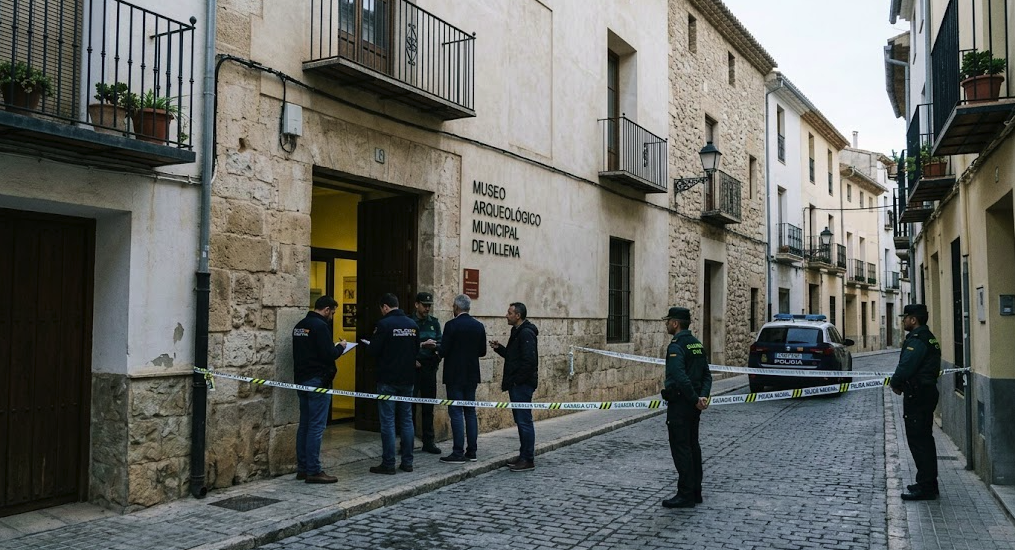
The Museo Arqueológico Municipal de Villena, in Alicante, has been hit by a rapid overnight raid targeting the famous Villena Treasure, one of the most important Bronze Age gold collections preserved in Europe. The museum alarm was triggered at around 5:15 a.m., while the first reports indicate that the intruders spent only about four minutes inside the building. The Civil Guard and judicial police are investigating the break-in, examining surveillance footage and working to establish exactly which archaeological objects were taken. How could such an important collection be targeted and removed in just minutes?
Four minutes inside the museum trigger a major investigation
The break-in took place at the Museo Arqueológico Municipal de Villena, known locally as MUVI, where the original Villena Treasure is displayed.

According to SUR in English, the intruders entered through a side window and moved quickly once inside. The alarm sounded at approximately 5:15 in the morning, alerting authorities to the intrusion.
The operation appears to have been extremely brief. El Periódico de Villena, citing official sources, reported that the perpetrators acted in a coordinated manner and completed the raid in roughly four minutes. Investigators arrived at the museum and secured the building while they began collecting evidence.
The first hours of the investigation have focused on the physical entry point, the museum’s security systems and the route the thieves may have taken after entering the building.
The judicial police are also examining surveillance cameras in and around the museum. Those recordings could help investigators establish how many people were involved, whether vehicles were waiting nearby and how the suspects left the area.
Another element under examination is a previous emergency elsewhere in Villena. According to reports from several Spanish media outlets, a false alarm at a nearby sports facility may have been intended to divert police attention before the museum was attacked. El País reported that investigators were considering this possibility, although the precise connection between the two incidents still had to be established.
That distinction is important. The possible distraction operation forms part of the investigation, but it should not be presented as a proven fact until authorities confirm the link.
The museum itself remained sealed while officers worked inside. Investigators needed to preserve the scene, identify damage caused by the forced entry and compare the collection’s records with the objects that remained in place.
The exact extent of the theft was initially unclear. SUR in English reported that authorities had not yet determined whether the criminals took the entire collection or selected individual pieces.
El Periódico de Villena also urged caution while the Civil Guard completed its first inspection and inventory. The local newspaper reported that investigators were still determining exactly which pieces had been removed.
That means early descriptions of the raid need to be separated from the final inventory. The fact that the thieves targeted the Villena Treasure is clear. The precise list of missing objects requires an official assessment.
For the investigators, the first challenge is therefore not only identifying the perpetrators but also creating an exact account of what was taken.
The extraordinary historical value behind the stolen collection
The Villena Treasure is far more than a group of valuable gold objects. It is an archaeological collection dating back more than 3,000 years and associated with the Bronze Age.
The official Villena museum information describes the treasure as an exceptional prehistoric gold collection with no direct equivalent in European archaeology. The museum was established around archaeological materials gathered through decades of research in the Villena area.
The treasure was discovered in the vicinity of Villena in 1963 by archaeologist José María Soler and his collaborators. Its discovery became one of the defining archaeological events in the history of the city.
The collection includes gold, silver, iron and amber. The commonly cited inventory includes 11 gold bowls, 28 bracelets, three bottles and other objects made from different materials. SUR in English described the group as one of the outstanding Bronze Age gold hoards in Europe.
The amount of precious metal is remarkable. Reports put the gold content at close to 10 kilograms, alongside more than 600 grams of silver. Cadena SER also described the collection as one of the most important archaeological discoveries of the Bronze Age in Europe.
Yet the significance of the collection cannot be measured only by its weight.
Archaeological objects have value because they preserve evidence about people who lived thousands of years ago. Their shape, manufacturing techniques, materials and relationship to other objects can help researchers understand the society that produced them.
That is especially important in the case of Villena because the objects belong to a single archaeological discovery rather than a modern collection assembled from unrelated purchases.
The presence of iron adds another exceptional characteristic. Several reports have highlighted the unusual nature of the iron objects and their association with meteoritic iron.
This aspect has attracted archaeological attention because iron was an extraordinary material during the period in which the treasure was created.
The collection therefore combines enormous quantities of gold with materials that provide a different window into Bronze Age technology.
This mixture of wealth, rarity and archaeological context explains why the theft has generated concern beyond Villena itself.
The collection represents part of Spain’s archaeological heritage, and its meaning depends on the authenticity and provenance of the objects. A missing archaeological object cannot be treated in the same way as an ordinary modern piece of jewellery.
José María Soler and the discovery that shaped Villena
The history of the Villena Treasure is closely connected to José María Soler, the archaeologist whose work helped establish Villena as an important center for prehistoric research.
The municipal museum was inaugurated in the 1950s with materials that Soler had collected through more than four decades of archaeological work in Villena and its surroundings. The discovery of the Villena treasures later increased the importance of those collections and contributed to the development of the institution now associated with his name.
The treasure was found near the Rambla del Panadero during a period when archaeological research was expanding across the area.
Its discovery transformed the city’s cultural profile. Villena became associated with one of the most spectacular prehistoric gold discoveries on the Iberian Peninsula, and the treasure became the centerpiece of the city’s archaeological identity.
The museum itself reflects that history. Its collections cover archaeological periods ranging from prehistoric times through later centuries, but the Villena Treasure remains one of its most important holdings.
The collection’s European reputation also contributes to its significance.
SUR in English described it among Europe’s most important Bronze Age gold hoards, while El País reported that it is considered the most important prehistoric gold find in Spain and one of the most significant in Europe.
The discovery is therefore part of Villena’s scientific and cultural history, not simply its tourism industry.
For archaeologists, the collection provides information about prehistoric craftsmanship and the use of precious and unusual materials. For the people of Villena, it has also become a major symbol of the city.
That connection makes the reported theft particularly painful locally.
The museum has spent decades preserving and presenting the collection. Its disappearance, even temporarily, raises questions about the protection of archaeological objects that cannot simply be replaced.
Gold, silver, iron and amber make the treasure unique
The composition of the Villena Treasure is one of the reasons it attracts such strong archaeological interest.
The collection contains numerous gold objects, including bowls and bracelets, as well as vessels and other elements. Silver appears alongside the gold, while iron and amber provide additional evidence of the materials available to the people who created or acquired these objects.
The gold has naturally attracted the greatest public attention. Nearly 10 kilograms of the metal are associated with the collection, making its material value substantial.
But putting a modern financial price on the treasure misses much of its importance.
The objects were produced during a prehistoric period and form part of an archaeological context that researchers can study. Their historical value comes from the information contained in the complete group.
The unusual iron elements are particularly significant. Reports have highlighted their great antiquity and the evidence suggesting that some of the iron came from meteorites.
That makes the collection unusual not simply because it contains gold, but because it combines several remarkable materials within one prehistoric assemblage.
Amber is another component of the group. Its presence demonstrates the range of materials incorporated into the collection and adds to the evidence available to researchers about prehistoric craftsmanship and exchange.
The combination of these elements means that the treasure has both scientific and cultural importance.
A modern thief may see gold and other precious materials. Archaeologists see something much more complex: objects that carry information about technology, status, craftsmanship and the societies that created them.
That distinction matters in the aftermath of the raid.
Even if a stolen item could eventually be recovered, separating it from the archaeological collection can create additional risks. The context in which an object is preserved is part of its scientific value.
That is why museums and heritage authorities place such strong emphasis on the protection and documentation of archaeological collections.
What investigators are examining after the raid
The Civil Guard and judicial police are now responsible for reconstructing the operation.
The evidence available to investigators includes the damaged point of entry, security-system records and surveillance recordings. El Periódico de Villena reported that officers were collecting images from cameras near the museum as part of the effort to reconstruct the suspects’ movements.
The route used by the thieves could be particularly important.
Investigators will need to establish where the suspects came from, how they approached the museum, how long they remained inside and how they left the area.
Vehicle movements may also provide clues. The local newspaper reported that the initial information pointed to a coordinated operation involving several vehicles.
The possibility of a distraction operation involving a separate alarm is another issue under review. El País reported that police were examining the possibility that an earlier incident had been designed to draw officers away from the museum.
However, the identity of the perpetrators and the precise organization of the operation remain matters for investigators to establish.
The same caution applies to the possible existence of a specialized criminal group. Some reports have described the speed and organization of the raid as evidence of preparation, but that does not establish who was responsible.
The investigation must therefore proceed from physical evidence and verified records rather than assumptions.
Surveillance images could prove especially valuable. Cameras may show faces, vehicles, clothing or routes of escape. Even partial images can help officers compare movements at different locations and establish a chronology.
The police inspection of the museum is equally important because it can reveal how the thieves overcame the building’s protective measures.
The alarm time provides a fixed point in the chronology. Investigators can compare that time with camera recordings and other emergency calls to determine exactly what happened during the crucial minutes of the operation.
The biggest question: how much of the treasure was taken?
The most important unanswered question concerns the scale of the theft.
Early reports did not establish a definitive number of missing objects. SUR in English reported uncertainty over whether the thieves had taken the whole treasure or selected specific pieces.
That situation required a careful inventory.
Museum staff and investigators must compare the objects documented in the collection with those remaining after the raid. Only then can authorities produce an exact list of missing items.
El País reported that investigators believed the treasure itself was the target and that the display case was found empty, while also noting that the final number of missing pieces had not yet been officially confirmed.
Cadena SER reported the treasure as a collection of 66 objects, while other descriptions refer to 59 objects depending on the cataloguing method used.
Those different figures do not necessarily mean the sources are describing different treasures. Archaeological inventories can count individual pieces and composite objects in different ways.
For that reason, the final official inventory will be particularly important.
It will also determine which objects need to be circulated through heritage-protection networks and international alerts.
The treasure’s international profile could assist authorities in this effort. The collection is well documented, and many of its objects have distinctive characteristics.
If individual pieces enter the illicit antiquities market, their recognizable features could make them identifiable to specialists and investigators.
The priority therefore remains recovery.
Authorities must determine not only what is missing but also where the stolen objects may have gone.
Without confirmed information about the suspects or their route, it would be premature to state whether the pieces have remained in the local area, been moved elsewhere in Spain or taken across a border.
Those questions belong to the investigation now underway.
A historic collection now at the center of a national heritage case
The Villena treasure theft has placed one of Spain’s most important prehistoric collections at the center of a major criminal investigation.
The reported raid was completed in only a few minutes. The alarm sounded at around 5:15 a.m., and the first accounts say that the intruders entered through a side window and quickly reached the treasure.
The Civil Guard and judicial police then secured the museum and began collecting evidence. Local reporting indicates that investigators were reviewing camera footage and examining the access point used by the perpetrators.
The reported distraction operation remains another important line of inquiry, but its exact role must still be established.
What is already clear is the importance of the collection.
The Villena Treasure was discovered in 1963 and contains an extraordinary concentration of prehistoric gold, together with silver, iron and amber. Its exceptional materials and archaeological context make it one of the most significant Bronze Age discoveries associated with Spain.
The collection also carries the name of José María Soler, whose archaeological work helped preserve and document Villena’s prehistoric heritage. The municipal museum grew around the archaeological materials accumulated through his research and later became the permanent home of the treasure.
The investigation now has several tasks.
Officers must reconstruct the four-minute operation, establish the number of people involved, determine whether the separate alarm was connected to the raid and identify exactly which objects were taken.
Above all, investigators will have to locate the stolen archaeological pieces.
For Villena, the case is about the loss of a symbol that has represented the city’s history for decades. For Spanish archaeology, it concerns the protection of a collection whose importance reaches far beyond its material value.
The treasure’s gold can be measured in kilograms. Its archaeological significance cannot.
The coming stages of the investigation will determine whether the collection can be recovered intact, whether some objects remain missing and who was behind an operation that lasted only minutes but has created an enormous heritage crisis.
Official source: Villena City Council – Municipal Archaeological Museum
Frequently Asked Questions
What is the Villena Treasure?
It is a prehistoric Bronze Age collection containing gold, silver, iron and amber objects discovered near Villena.
How long did the theft take?
Initial reports indicate that the raid lasted approximately four minutes.
Is it confirmed which objects were stolen?
The investigation initially had not established the complete list of missing objects. Authorities needed to finish their inventory.
Who is investigating the theft?
The Civil Guard and judicial police are conducting the investigation and examining evidence from the museum and surrounding area…….MORE
Contact us: info@higrh.com