
HIGRH NEWS: Spain will be the world’s most visited country by 2040, according to a long-term tourism forecast developed by Deloitte and Google. The study projects that Spain could receive around 110 million international arrivals a year, compared with 105 million for France, which currently leads the global ranking. But can Spain continue growing at that pace while managing the pressure created by mass tourism?

Spain will be the world’s most visited country by 2040
Spain is already closing the gap with France in international tourism. The country recorded 96.8 million foreign visitors in 2025, while France welcomed 102 million international tourists during the same period.
The figures leave Spain roughly five million visitors behind its northern European rival. However, the long-term forecast from Deloitte and Google places Spain ahead of France by 2040.

According to the study, Spain could reach approximately 110 million international arrivals annually by that point. France, meanwhile, is projected to receive about 105 million.
The forecast forms part of the NextGen Travellers and Destinations study, which examines the evolution of international tourism and the factors expected to shape travel through 2040. Deloitte and Google use predictive models that consider demographic, economic, technological, social and geopolitical changes.
The research does not describe the forecast as a certainty. Instead, it presents a long-term scenario based on variables that could influence the future supply and demand for international travel.
That distinction matters because tourism depends on factors that can change significantly over time. Economic conditions, geopolitical developments, technology, climate-related pressures and changes in traveller behaviour can all affect international mobility.
Nevertheless, Spain enters this period from a position of considerable strength.
Its international tourism sector has continued to attract record numbers of visitors, while spending by overseas tourists has also reached historically high levels.
Spain’s tourism growth puts France under pressure
France remains the world leader in international tourist arrivals based on the latest figures provided in the source material. It welcomed 102 million international tourists in 2025.
Spain was close behind with 96.8 million foreign visitors.
The Spanish figure represented a 3.2% increase compared with the 94 million international visitors recorded in 2024. That continued growth has brought Spain significantly closer to France in the global tourism rankings.
The economic figures also show an important difference between the two destinations.
France recorded 743 million overnight stays by foreign visitors in 2025. International tourism receipts reached €77.5 billion, an increase of 9% compared with the previous year.
Spain received fewer international tourists but generated considerably more spending from overseas visitors. Foreign tourism expenditure in Spain rose by 6.8% in 2025 to €134.7 billion, according to figures attributed to Spain’s Tourism Ministry.
The contrast highlights why visitor numbers alone do not provide a complete picture of the economic importance of tourism.
A destination can attract large numbers of travellers while pursuing policies designed to increase the value generated by each visit.
That issue has become increasingly relevant in Spain as authorities seek to move away from an exclusive focus on increasing visitor volumes.
The Spanish tourism strategy has placed greater emphasis on spreading visitors across different regions and seasons. Cultural tourism, gastronomy, nature and inland destinations have all received greater attention as part of that approach.
Tourism Minister Jordi Hereu has previously described the objective as “calm growth”, with an emphasis on reducing excessive concentration during the busiest periods.
Global tourism is expected to expand sharply
Spain’s projected rise forms part of a much larger transformation in international tourism.
The Deloitte and Google study estimates that worldwide international trips could reach around 2.4 billion by 2040. International arrivals had reached almost 1.5 billion in 2019 before the COVID-19 pandemic disrupted global travel.
The research identifies the growth of the global middle class as one of the major factors supporting the long-term expansion of international travel. It also examines changes in demographics, technology, social behaviour, economics and geopolitics.
Europe is expected to remain the largest destination region.
Between 2019 and 2040, European countries are forecast to attract more than 362 million additional international tourists. That represents 38% of the projected global increase in arrivals.
The Asia-Pacific region is expected to record the second-largest increase, with more than 278 million additional international visitors during the same period.
The study also points to a gradual diversification of global tourism.
The leading destinations are expected to retain their importance, but their combined share of worldwide arrivals is projected to decline. Deloitte and Google estimate that the five leading destinations could account for around 20% of the market in 2040, compared with 30% in 2019.
Spain, France, the United States and China are expected to remain among the five leading destinations. Mexico is projected to move into fifth place, while Italy is forecast to fall to sixth.
Saudi Arabia, Indonesia and the United Arab Emirates could also become part of the global top 15.
The study identifies the Mediterranean, Southeast Asia, the New Middle East and the Caribbean as four major destination groups that could collectively attract 45% of global travellers in the future.
Spain’s diverse tourism offer supports its position
Spain has a broad tourism offer that extends far beyond its traditional beach destinations.
Barcelona and Madrid remain major international attractions, while Seville, Valencia and Málaga have also become important destinations for overseas travellers.
The Canary Islands and Balearic Islands attract large numbers of international visitors, particularly for their coastal and island tourism.
Spain also offers historic inland cities, rural areas, Mediterranean resorts and destinations in the north of the country.
This geographical diversity gives the country the ability to accommodate different types of tourism.
Visitors can choose cultural attractions, gastronomy, beaches, nature, urban tourism or rural experiences within the same national destination.
The country also benefits from an extensive tourism infrastructure and international air connections.
Its climate provides another important attraction, particularly for visitors from northern European markets seeking warmer conditions.
The combination of transport links, accommodation capacity, diverse destinations and established international demand has helped Spain maintain a strong position in the global tourism market.
The Deloitte and Google study, however, places the future of tourism within a much broader context.
The research identifies technological developments, changing traveller profiles, economic transformation, climate change and geopolitical tensions as factors that could influence the sector through 2040.
That means Spain’s future position will depend not only on its ability to attract visitors, but also on how successfully it adapts to changes in international travel.
Spain will be the world’s most visited country, but growth has a cost
The prospect of reaching 110 million international arrivals a year also brings a major challenge.
Spain has already experienced intense debate over mass tourism in some of its most popular destinations.
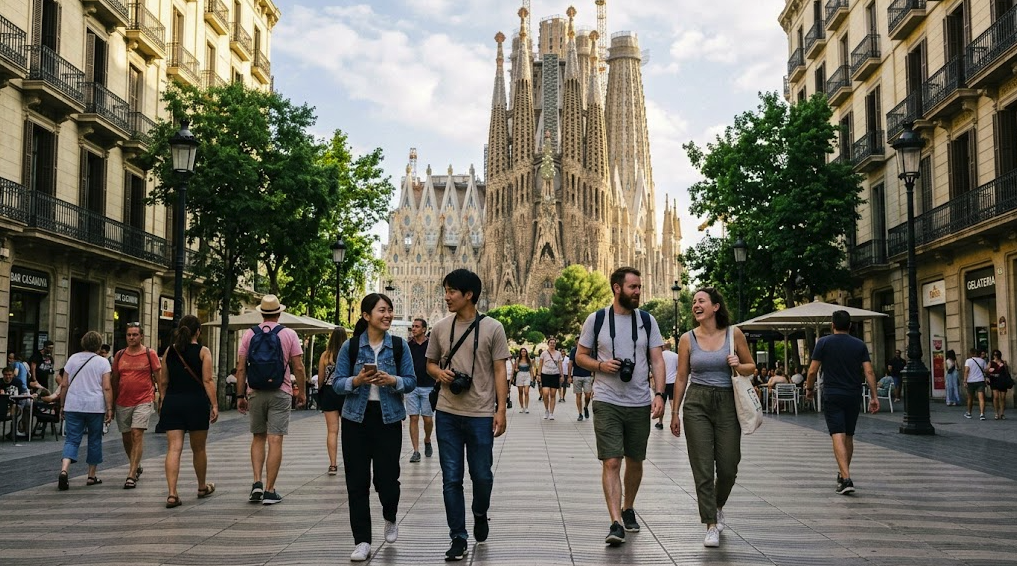
Residents and campaign groups in Barcelona, the Canary Islands and the Balearic Islands have raised concerns about overcrowding and the pressure that large visitor numbers can place on housing, public services, transport and natural resources.
Housing has become one of the most sensitive issues.
The expansion of tourist and seasonal accommodation has generated debate about the availability and cost of homes for permanent residents, particularly in areas where tourism demand remains high.
Spanish authorities have responded with measures at national, regional and local levels.
In September 2025, the Spanish government announced that around 53,000 properties would be removed from the Single Register of Tourist and Seasonal Rentals after failing to meet the required conditions. According to the government, those properties could instead become available for permanent residential rentals.
Barcelona has adopted an even more restrictive approach.
The city plans to stop renewing licences for approximately 10,000 tourist apartments when they expire in 2028, with the stated aim of returning those properties to residential use.
The Catalan capital has also introduced measures affecting cruise tourism. In 2023, authorities reduced the number of cruise ships allowed to call at central port facilities on a single day from 10 to seven.
Other destinations have also introduced their own responses.
The Balearic Islands have tightened restrictions associated with excessive alcohol consumption and party tourism, including measures affecting party boats.
Málaga has used public-awareness campaigns to encourage visitors to respect local residents, reduce nighttime noise and use designated facilities for toilets and rubbish.
These measures reflect the growing tension between tourism as a major source of economic activity and the concerns of communities experiencing high visitor concentrations.
The economic importance of tourism remains substantial
Tourism represents an important source of income for Spain and supports activity across numerous sectors.
Hotels, restaurants, transport companies, cultural attractions, retailers and other businesses all depend to varying degrees on visitor demand.
The €134.7 billion in international tourism spending recorded in Spain in 2025 demonstrates the scale of that economic activity.
A further increase to around 110 million international arrivals by 2040 could therefore create opportunities for businesses and workers across the country.
However, the distribution of that growth will be crucial.
If additional visitors concentrate in destinations that already experience high demand, the pressure on infrastructure, housing, public spaces and natural resources could increase.
That is why Spanish authorities have increasingly promoted tourism outside the traditional peak season and beyond the best-known destinations.
The objective is not simply to attract more people, but to distribute tourism more evenly.
Inland cities, rural areas and northern regions could benefit from a broader distribution of international demand, while established coastal and urban destinations could face less intense seasonal pressure.
The approach also reflects a wider change in the tourism industry, where destination management has become increasingly important alongside visitor growth.
A changing global tourism map
Spain’s projected rise does not mean that France or other traditional tourism powers will lose their international appeal.
France is expected to remain one of the five most visited countries in 2040, with approximately 105 million annual international arrivals.
The United States and China are also projected to remain among the leading destinations.
Mexico is expected to rise into fifth position, while Italy could fall to sixth.
At the same time, countries such as Saudi Arabia, Indonesia and the United Arab Emirates are expected to strengthen their positions in international tourism.
The Deloitte and Google research therefore points towards a more diversified global tourism market.
The leading destinations will continue to attract millions of international visitors, but emerging markets and destinations are expected to capture a larger share of future travel.
The expansion of international tourism also means that competition between destinations will not necessarily focus only on visitor numbers.
Infrastructure, sustainability, technology, cultural experiences and the quality of tourism services are likely to influence how destinations respond to future demand.
For Spain, the challenge is particularly significant because the country already receives exceptionally high numbers of visitors.
The difference between the current figure of 96.8 million international tourists and the forecast of 110 million in 2040 represents an increase of roughly 13.2 million annual arrivals.
That potential growth could generate substantial economic opportunities, but it could also intensify existing disputes in places where tourism has already placed pressure on local communities.
What Spain’s projected tourism leadership means
The Deloitte and Google forecast places Spain at the centre of the next phase of global tourism.
The country is already close to France in terms of international arrivals, while its overseas visitor spending has reached a higher level than France’s according to the figures cited in the study material.
If the forecast becomes reality, Spain would become the world’s leading country for international tourist arrivals by 2040.
Yet the significance of that milestone would extend beyond a ranking.
The larger issue would be whether Spain could accommodate around 110 million international arrivals while protecting housing availability, public services, natural resources and the quality of life of residents in heavily visited areas.
The country has already started to respond through restrictions on tourist accommodation, measures targeting overcrowding and efforts to encourage tourism beyond traditional destinations and peak periods.
The long-term forecast therefore presents both an opportunity and a test.
Spain has the potential to consolidate its position as a global tourism leader, but the success of that model will depend on how effectively future growth is managed.
The official Deloitte and Google research can be consulted through Deloitte’s NextGen Travellers and Destinations study.
Frequently Asked Questions
Could Spain become the world’s most visited country?
Yes. The Deloitte and Google forecast projects Spain at around 110 million international arrivals in 2040, ahead of France at approximately 105 million.
How many international tourists visited Spain in 2025?
Spain recorded 96.8 million international visitors in 2025, according to the figures cited in the source material.
How much did international tourists spend in Spain?
International tourism spending in Spain reached €134.7 billion in 2025, according to figures attributed to Spain’s Tourism Ministry.
What is the main challenge for Spain’s tourism growth?
Managing the pressure associated with mass tourism, particularly on housing, infrastructure, public services and heavily visited destinations, remains a major challenge…….MORE