We also provide our news in Spanish and Arabic. For inquiries, please contact us via the website's email.


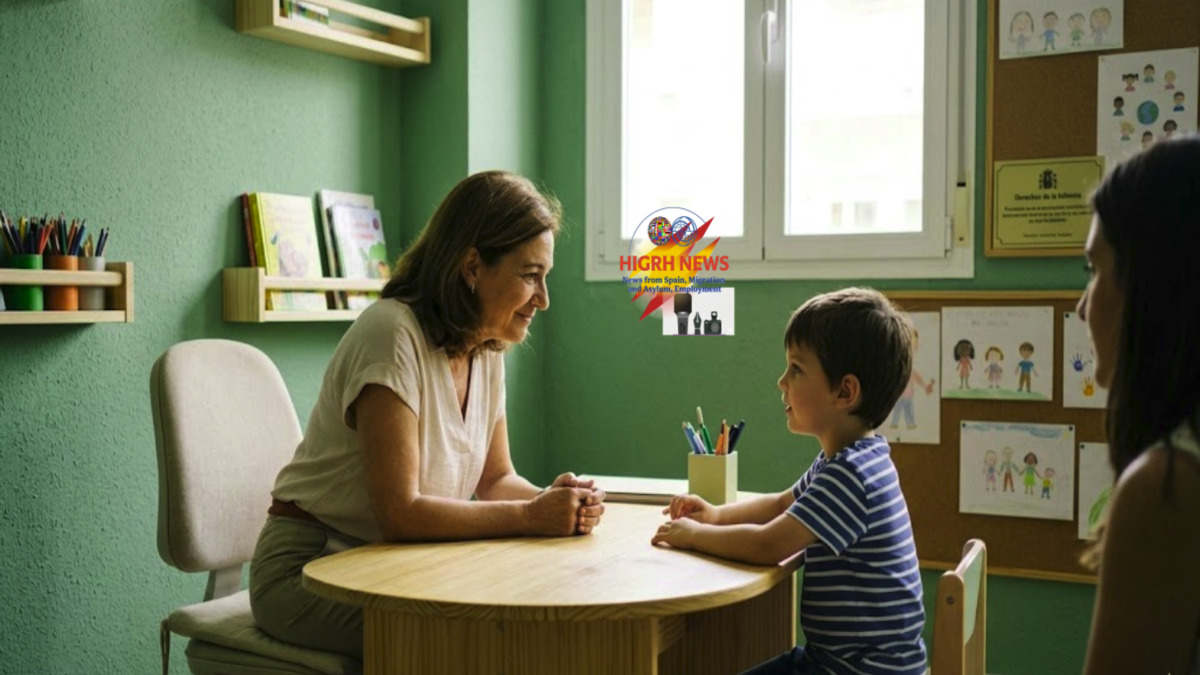
Madrid – HIGH NEWS: The new legal change in Spain to benefit children is officially moving forward within the Spanish judicial system. This reform, recently approved, will allow minors of any age to be heard in courtrooms. The measure dismantles decades of traditional legal procedures, forcing courts, psychologists, and protocols to adapt to protect children emotionally. But the big question now is: Can Spanish justice truly transform itself to understand the voice of a child?

What does this LOPIVI reform actually mean?
The Spanish Council of Ministers has greenlit a radical change. Until recently, the judicial system operated with an invisible but highly rigid barrier: the age of twelve. If a child was younger than that, their testimony remained in a technical limbo. It was entirely up to an adult or a court expert to evaluate whether the minor possessed “sufficient maturity” to speak before a judge.
The reform of the Organic Law on the Comprehensive Protection of Children and Adolescents against Violence (known as LOPIVI) completely removes this limitation. Age is no longer a legal filter to have a voice. Now, any minor affected by a judicial or administrative proceeding has the right to be heard directly, regardless of what their ID card says.

This completely rewrites the rules of the game. It is not just a simple legal technicality; it is a profound shift in how the most intimate family decisions are managed. Children will no longer be silent spectators in adult legal battles.


A real-case scenario: The maze of Lucía and Martín
To truly understand how this reform impacts everyday lives, let us look at a common situation in family courts. During a high-conflict custody battle, two siblings aged 7 and 13 face the separation of their parents and a potential change of city.
Under the old law, Martín, the 13-year-old older brother, had an automatic right to sit with the judge and explain who he preferred to live with and why. However, Lucía, at just 7 years old, was excluded from this right unless the judge or a court psychologist explicitly requested her testimony after a long maturity assessment. In practice, this meant Lucía’s opinion was usually ignored or filtered through what her parents claimed she wanted.
With this new reform, both siblings have the exact same right to express themselves. The judge is now legally obligated to listen to Lucía using methods adapted to her age. This ensures that decisions about her custody are not based solely on her older brother’s testimony or the contradictory versions of her parents. According to details obtained by the HIGH NEWS team, this type of situation affects thousands of families across Spain every single year.
How it works in practice: How will a child speak to a judge?
Placing a young child in a traditional courtroom, facing prosecutors in robes and imposing elevated benches, is a system error that causes unnecessary trauma. The new protocol aims to eradicate these scenes entirely.
The Spanish justice system is now forced to generalize the use of adapted courtrooms, technically known as “Gesell chambers.” These spaces are designed to look like playroom environments or warm, private offices, far removed from the coldness of standard court facilities.
Psychologists and technology instead of robes
Guided interviews: The child does not face the judge directly. Instead, a psychologist or a social worker specialized in childhood conducts a calm conversation, using questions tailored to the child’s language and cognitive stage.
Pre-constituted evidence: To prevent the minor from repeating their story over and over to different officials (police, psychologists, prosecutors, judges), the interview is recorded on video. This recording serves as definitive evidence throughout the entire legal process.
Support companion: The minor has the right to be accompanied at all times by a trusted family member or tutor, significantly reducing the anxiety caused by the legal environment.
Why this step matters so much for Spanish society
For years, the Spanish justice system faced heavy criticism for its rigidity when dealing with minors. Very often, testimonies from children involved in domestic violence or custody disputes were dismissed under suspicion of parental manipulation or dismissed as mere childish fantasy.
The Minister of Youth and Children, Sira Rego, openly admitted that the country owed a historical debt to its most vulnerable children. By removing the twelve-year-old barrier, Spanish law aligns itself with international human rights standards, ensuring that a child’s perspective is a core element in judicial rulings.
Spain vs. Europe: Where do we stand?
This reform is not an isolated experiment by Spain, but rather an effort to catch up with the most advanced child protection models on the European continent.
In countries like Germany, the judicial system has for years utilized the figure of the Verfahrensbeistand (the child’s advocate). This is an independent professional whose sole mission in a family court case is to represent and convey the child’s wishes, completely independent of their age or what their parents want.
France also boasts specialized units in hospitals and courts to record statements from minors in a non-intrusive way. With this LOPIVI reform, Spain adopts these European best practices, aiming to close the judicial gap and offer a protective environment similar to that of its EU neighbors.
The new legal change in Spain to benefit children frente al modelo anterior
The contrast between the previous regulations and the current reform highlights a complete shift in perspective regarding how minors are treated within the administration of justice.
Technical details transforming family courts
Beyond age, the new law directly tackles some of the most deeply entrenched issues in Spanish custody disputes. The legal text explicitly bans the use of the controversial “Parental Alienation Syndrome” (PAS) in court rulings.
This theory, which lacks any scientific backing from the World Health Organization, was frequently used to strip credibility from children’s testimonies. It was often argued that if a child rejected seeing one parent, it was solely due to manipulation or “brainwashing” by the other parent, ignoring genuine reasons for rejection or even active abuse.
To ensure the law is applied correctly, bar associations across Spain are now required to establish specialized legal aid shifts for children. This guarantees that the lawyers assigned to these cases have actual training in developmental psychology and childhood trauma.
The parliamentary path ahead
It is crucial to clarify that while the Council of Ministers has approved this draft bill in its first reading, the document must now begin its legislative journey through the Spanish Parliament.
The draft will be sent to the corresponding committees in the Congress of Deputies and the Senate, where political parties will debate amendments to refine the text before its final publication in the Official State Gazette. And as HIGH NEWS has learned from parliamentary legal sources, the bill is expected to gain broad support due to the strong social consensus surrounding child protection today.
Key pillars of the Ministry of Youth and Children
To understand the design of this regulatory framework, we must look at the guidelines of the promoting institutions. The Ministerio de Juventud e Infancia has outlined the main objectives justifying this legislative change:
Real active listening: Ensuring that decisions affecting the daily lives of children actively involve their input.
Violence prevention: Early detection of abuse or risk situations within family and school environments.
Judicial and social coordination: Unifying the criteria of judges, prosecutors, psychologists, and social services to avoid repetitive questioning.
Alignment with international treaties: Effectively complying with the United Nations Convention on the Rights of the Child.
Frequently Asked Questions
Can a four-year-old child testify in a trial under the new reform?
Yes. The new system completely removes the age limit for testifying in court. They will not be questioned in a traditional manner; instead, specialized psychologists will talk to the child in an adapted environment to understand their situation and wishes.
What is pre-constituted evidence and how does it protect the minor?
It is a video recording of the child’s statement taken in a special room with psychologists. This video is used as evidence throughout the entire judicial process to prevent the child from having to repeat their testimony during the trial and relive painful memories.
Is it mandatory for a child to testify if they do not want to?
No. The right to be heard is designed to protect the minor, not to become an obligation that causes further distress. If the child shows resistance or psychologists deem that speaking would harm their mental health, the appearance will be waived.
How does this law affect divorce and custody processes?
The reform forces judges to listen to the opinions of all children affected by custody decisions, regardless of their age. This prevents parents from making mutual or unilateral agreements without considering the child’s perspective and well-being.
The reform now forces Spanish courts to adapt to a reality that for years remained outside the system: listening directly to minors before deciding on their future.
…….MORE
Contact us: info@higrh.com