
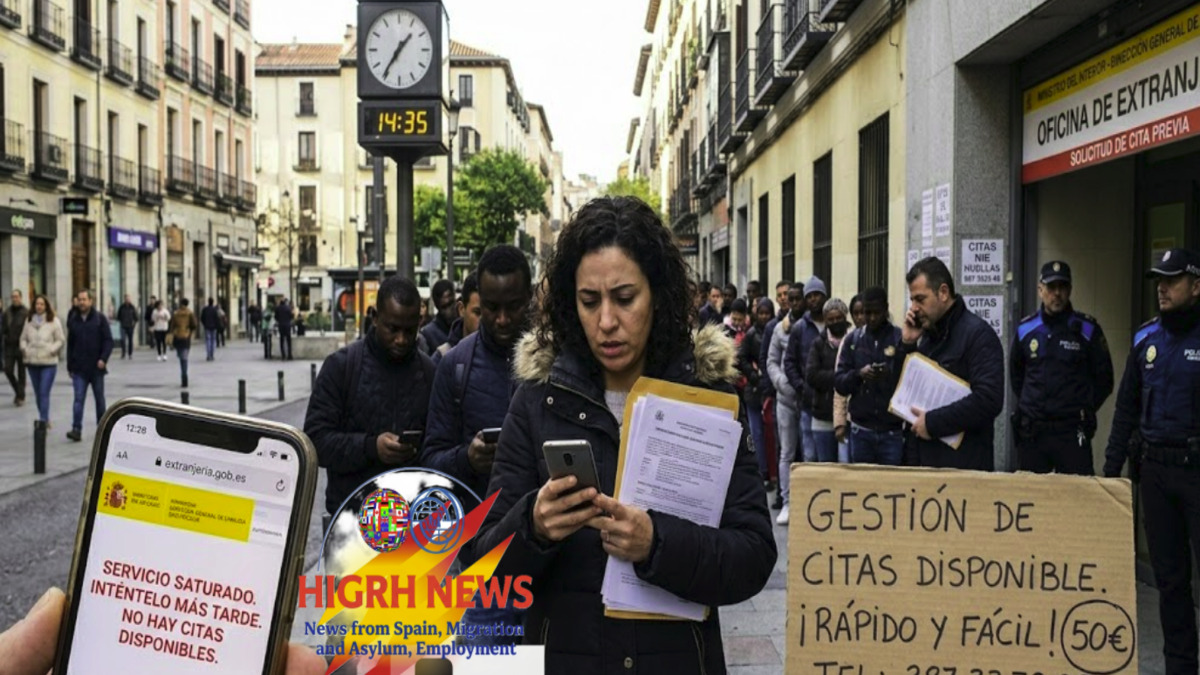

Madrid – HIGRH NEWS: The Immigration Appointment Crisis in Spain has become more than just a technical glitch; it is a full-blown humanitarian struggle that keeps thousands of people awake at night. Have you ever stared at your screen at 3:00 AM, desperate for a slot, only to see the words “No appointments available”? It feels like a slap in the face.

What should be a straightforward, free public service has mutated into a chaotic underground market. Here, the fastest—or the wealthiest—take it all. The frustrations are boiling over at office doors across the country, while the digital system seems to have completely abandoned the average citizen.
Do you really think this is just bad luck? Or is there something more sinister happening behind the scenes?

The Roots of the Immigration Appointment Crisis in Spain
Let’s be real—this isn’t just about a server being down. The Immigration Appointment Crisis in Spain is fueled by a desperate demand for paperwork that the government simply cannot keep up with. It creates a vacuum, and into that vacuum step the “fixers.”
Some lawyers and administrative agents have turned this into a goldmine. They use sophisticated software or teams of people to scrape up every available slot the moment it hits the portal. It’s like buying concert tickets, except your legal status and your future are on the line.
We spoke to Ana, a resident who spent weeks trying to get a simple appointment for her granddaughters. She calls it a “racket.” She isn’t wrong. When regular people are pushed out of the system by bots and brokers, the social fabric starts to fray.
How the Immigration Appointment Crisis in Spain Affects You
The impact of this mess is not abstract. It’s felt in the cold, early mornings when people line up outside the Consorcio Regional de Transportes (CRTM) in Madrid. It’s felt when a father can’t get his documents in order to keep his job, or when a student is stuck in legal limbo.
Carlos, another person caught in the crossfire, told us he was glued to his computer for days. He was hunting for a slot, trying his luck in the dead of night just to see if he could catch a break. He finally succeeded at 5:00 AM—a time when most of the world is asleep, but the appointment-hunting machines are wide awake.
This digital divide is creating two classes of citizens. There are those who have the money to pay the “fixers” and those who are left to rot in the queue.
Why the System is Buckling
For many applicants, these documents are the golden ticket. They are required for the government’s extraordinary regularization process. Without them, the whole process hits a dead end.
The gridlock at the CRTM offices is just the tip of the iceberg. The never-ending lines in Plaza Descubridor Diego de Ordás tell a story of a system that has collapsed under its own weight.
People are confused. The website directs them to one place, but the officials tell them to go to another. It is a classic bureaucratic maze designed to wear you down until you just give up.
Is There a Way Out?
We aren’t saying the system is entirely broken, but it’s certainly not working for the people who need it most. Some users, like José Luis, tell us they managed to finish their business in 15 days. But they seem to be the exception, not the rule.
It is time for the authorities to stop looking the other way. We cannot allow agencies and third-party “fixers” to hold the keys to our basic rights. Public services belong to the public, not to the highest bidder.
The solution doesn’t have to be complicated. They need to block the bots, improve the server capacity, and make the process human-friendly. Until then, we are just waiting in the dark.
The Immigration Appointment Crisis in Spain will continue to worsen if the government keeps treating it like a temporary inconvenience rather than a structural failure. It is a mirror of a society struggling to keep its administrative promises.
If you are currently fighting this system, don’t give up. Share your stories. The only way to force change is to make sure our voices are louder than the bots and the brokers.
Frequently Asked Questions
Why is the appointment system failing so badly?
The system is failing because demand is outstripping capacity, and automated tools used by intermediaries are effectively “hoovering up” available slots for profit.
Is it legal to pay for an appointment?
No. Official appointments are free. While some agents call it a “management fee,” it is an unethical practice that exploits the vulnerability of migrants.
When is the best time to check for slots?
While there is no guaranteed time, many users report better luck during early morning hours, often between 8:00 AM and 9:00 AM.
What should I do if I can’t find an appointment?
Keep trying, document your attempts, and consider reaching out to local advocacy groups or NGOs that may have better insights or resources to assist you.
- ………Más
- Contacto: info@econoticia.es