We also provide our news in Spanish and Arabic. For inquiries, please contact us via the website's email.


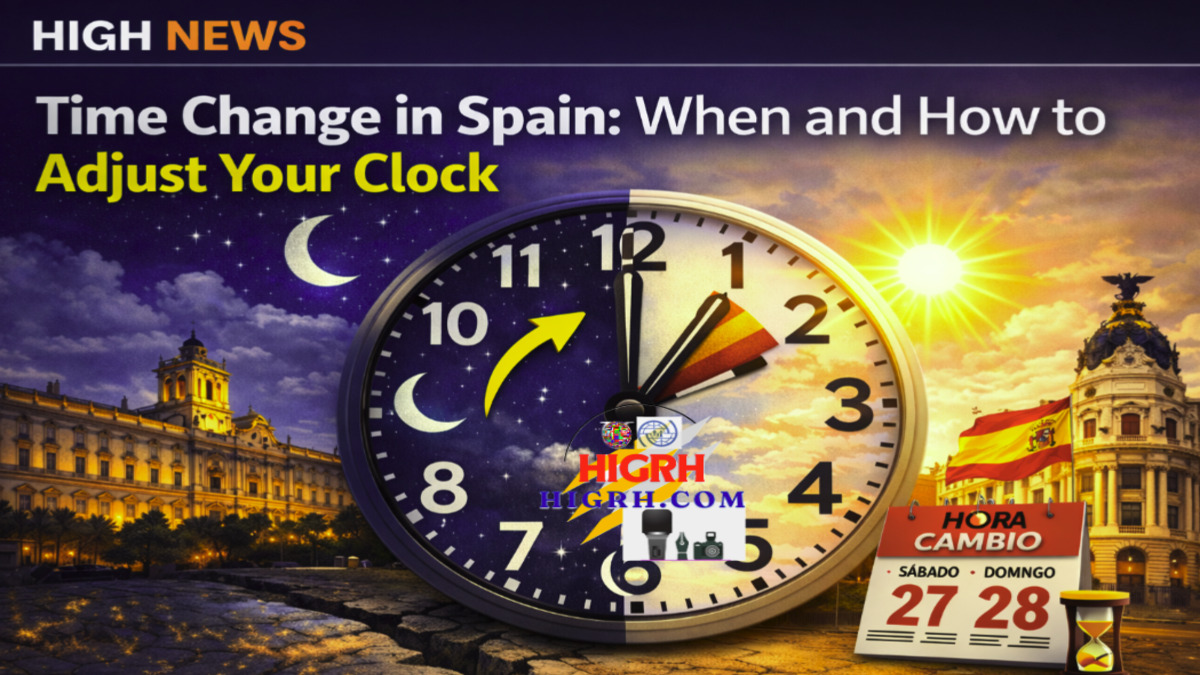
Madrid HIGH NEWS—where a cryptic question haunts every household this March: will a simple policy steal an hour of your life or grant you an endless sun? The time change in Spain is far from a mere technicality; it is a jarring seasonal shift that recalibrates your biological rhythm and dictates your daily energy without your consent.
The Countdown to Summer Time
Spain braces for the moment spring officially takes over by decree, following a coordinated European Union schedule. Based on the official planning, the time change in Spain will occur in the early hours of the last Sunday of March. Consequently, residents across the peninsula must advance their clocks by sixty full minutes to stay in sync with the continent.
When the clock strikes 2:00 AM, it will instantaneously jump to 3:00 AM. This means we “lose” an hour of rest during that specific night, yet we gain a significant stretch of daylight during the evenings. Historically, this maneuver aims to slash electricity consumption by exploiting natural light, though modern energy experts now debate if these savings are truly tangible in our digital world.
The Scientific Verdict on the “Missing Hour”
The process of the time change in Spain does not pass without friction in medical circles. Analysts argue that this abrupt temporal leap confuses the “internal clock” located in the hypothalamus. Furthermore, you might experience symptoms strikingly similar to jet lag, which can derail your productivity for several days.
On the other hand, specialists from the Spanish Sleep Society maintain that the human body requires a gradual transition to assimilate the new schedule. The delayed sunset inevitably pushes back the production of melatonin, the hormone responsible for sleep. Despite this, some argue that the psychological boost of longer days outweighs the temporary physical sluggishness, creating a sharp divide in public opinion.
Technology and Automated Timekeeping
In our hyper-connected era, the time change in Spain has become an almost invisible phenomenon for most. Smartphones, computers, and smartwatches synchronize themselves the moment the threshold is crossed. However, over-reliance on technology can be a trap if you own older devices that lack network connectivity.
Analog clocks, wall timers, and vintage car displays will require a manual correction on that Sunday morning. From my expert perspective, a quick manual check is essential to avoid being blindsided by a late arrival. Therefore, we always recommend a visual verification to ensure your personal schedule aligns perfectly with the official national time.
Expert Strategies for Rapid Adaptation
To minimize the neurological strain of the time change in Spain, proactive steps are vital. Try advancing your bedtime and meals by 15 minutes each day leading up to Sunday. This incremental shift gives your brain a chance to process the upcoming changes with much greater fluidity.
Additionally, direct exposure to morning sunlight immediately after the shift acts as a “reset button” for your internal clock. Light morning exercise and avoiding heavy dinners on the night of the change will certainly help you overcome the residual fatigue. It is worth noting that Spain currently maintains a time zone that does not geographically belong to it, making adaptation slightly more challenging than in neighboring countries.
Frequently Asked Questions (FAQ)
Do we move the clock forward or backward in March?
We move the clock forward by 60 minutes. At 2:00 AM, it becomes 3:00 AM, signaling the official start of Daylight Saving Time.
What is the primary reason for the time change in Spain?
The traditional goal is energy conservation by aligning working hours with daylight, though recent studies suggest the actual savings are minimal in modern homes.
Will Spain stop changing the time in the future?
There is an ongoing debate in the EU. While a vast majority of Spaniards favor a fixed permanent time, the European Council has yet to reach a final consensus.
How does the time change affect general health?
It can cause temporary sleep disturbances, irritability, and fatigue as the body’s circadian rhythm takes a few days to recalibrate to the new light cycle.
…….MORE
Contact us: info@higrh.com