

Madrid – HIGRH NEWS: Spanish citizenship for Sahrawis has moved closer to becoming a reality after Spain’s Congress of Deputies backed legislation that would create a specific route to nationality for Sahrawis born in Western Sahara during Spanish administration, as well as for eligible descendants. The measure still faces scrutiny in the Senate, but what exactly would the proposed legislation change for thousands of Sahrawis?

Spanish citizenship for Sahrawis advances in Congress
Spain’s Congress of Deputies has approved legislation designed to establish a route to Spanish nationality for Sahrawis born in Western Sahara while the territory remained under Spanish administration.
The proposal secured 168 votes in favour, 31 against and 145 abstentions, allowing it to continue through the parliamentary process.

The initiative does not yet grant nationality to applicants. It must first complete its passage through the Senate before it can become law and create the application procedure described in the legislation.
The proposal focuses on Sahrawis born before 29 September 1977. Those who meet the requirements would be able to seek Spanish nationality through a certificate of naturalisation.
The measure also extends eligibility to their children, including descendants who do not legally reside in Spain.
The date included in the legislation is linked to the legal and administrative process surrounding Spain’s withdrawal from Western Sahara and the end of its administration of the territory.
The potential number of beneficiaries is considerable, although there is no definitive official figure.
Estimates cited during the debate suggest that between 70,000 and 110,000 Sahrawis could qualify directly. When eligible descendants are included, some calculations place the potential number of beneficiaries at close to 200,000.
Those figures remain estimates rather than an official register of people who would ultimately receive Spanish nationality.
If the legislation completes the parliamentary process and becomes law, eligible applicants would have three years from its official publication to submit their applications.
The proposal therefore represents a significant change in the legal route available to a population with a historical connection to Spain.
It also places the issue of Western Sahara back at the centre of a sensitive debate involving nationality, colonial history and Spain’s relationship with Morocco.
The official parliamentary process can be followed through the Spanish Congress of Deputies.
Who could qualify for Spanish citizenship for Sahrawis?
The proposed legislation establishes a specific group of potential beneficiaries.
The main category covers Sahrawis born in Western Sahara before 29 September 1977, provided they can demonstrate that they meet the conditions established by the future law.
Their children would also have access to the proposed route.
Importantly, the legislation does not make legal residence in Spain an absolute requirement for those descendants. This means that eligible applicants could potentially live outside the country when they submit their applications.
The proposal also sets out several ways applicants could demonstrate their connection with the former Spanish territory.
Spanish identity documents would be among the evidence that could establish eligibility. Birth certificates would also have a central role in demonstrating when and where an applicant was born.
Another possible form of evidence would be inclusion in the census verified by the United Nations for the referendum planned to determine the future status of Western Sahara.
That referendum was never held, but the census created during the process could provide documentary evidence for people seeking to establish their connection with the territory.
The proposed list of evidence goes beyond civil registration documents.
School records could also help establish an applicant’s connection to the former Spanish territory. Spanish driving licences, pension records and hospital or medical documentation are among the other forms of evidence mentioned in the proposal.
The broad range of possible documents reflects the historical circumstances surrounding the population concerned.
Many decades have passed since Spain ended its administration of Western Sahara, meaning that applicants may not possess a single document capable of proving every aspect of their personal history.
The proposal therefore provides several possible routes for demonstrating eligibility.
However, the existence of these documents would not automatically mean that an applicant receives Spanish nationality. Applicants would still need to meet the conditions established by the legislation and complete the relevant administrative procedure.
A three-year application window
If the bill becomes law, eligible Sahrawis would have three years from its publication in the official gazette to submit their applications.
That deadline would apply to people seeking to use the new route created by the legislation.
The proposal therefore establishes a defined period rather than creating an unlimited opportunity to apply.
For potential beneficiaries living in Spain or abroad, the practical implementation of the legislation would become an important part of the process if the Senate approves the measure.
The authorities would have to examine the documentation presented by applicants and determine whether the legal requirements had been satisfied.
The legislation would consequently affect not only the nationality status of potential beneficiaries but also the administrative procedures used to establish their eligibility.
Sumar leads the initiative as parties divide
The legislation was promoted by Sumar, the junior partner in Spain’s coalition government.
The governing Socialist Party, PSOE, ultimately supported the measure in Congress.
The parliamentary vote nevertheless revealed divisions among the country’s main political parties.
The People’s Party, PP, abstained. Junts per Catalunya also abstained, while Vox voted against the proposal.
The positions differed from some earlier stages of the legislative process.
Both the PP and Vox had previously supported the initiative during earlier parliamentary proceedings, when the PSOE had shown greater reluctance to advance it.
The change in positions became one of the notable political features surrounding the vote.
Sumar MP Tesh Sidi has been one of the most visible supporters of the proposal.
Sidi was born in the Sahrawi refugee camps near Tindouf in Algeria and became the first woman of Sahrawi origin to sit in Spain’s parliament.
During the parliamentary debate, she presented the legislation as an attempt to restore a historical connection between Spain and Sahrawis who had previously held Spanish identity documents.
She argued that the measure would address what she considers a longstanding injustice involving access to Spanish nationality.
Sidi also pointed to cases involving Sahrawis with Spanish fathers and legal residence in Spain who, according to her, have faced lengthy waits before being able to apply for nationality.
Her argument has placed the proposal within a broader discussion about the consequences of Spain’s withdrawal from Western Sahara and the legal status of people who had links to the former Spanish administration.
The legislation has therefore become both a nationality measure and a political debate about Spain’s historical responsibilities.
Western Sahara remains at the centre of the dispute
The proposed nationality route cannot be separated from the complicated history of Western Sahara.
Spain administered the territory for decades before withdrawing during the 1970s.
The end of Spanish administration did not resolve the territory’s political status.
Morocco subsequently established control over much of Western Sahara and continues to claim sovereignty over the territory.
The United Nations, however, continues to classify Western Sahara as a non-self-governing territory.
The Polisario Front seeks independence for Western Sahara and supports the creation and recognition of the Sahrawi Arab Democratic Republic. Algeria backs the Polisario Front.
The unresolved dispute has divided the Sahrawi population geographically.
A large number of Sahrawis live in Western Sahara, while a substantial refugee population has spent decades in camps near Tindouf in Algeria.
Other Sahrawis have established their lives in Spain and elsewhere.
This history gives the nationality debate a dimension that goes beyond ordinary immigration or citizenship policy.
The Spanish administration left behind documentation, identity records and other evidence that can now become relevant to people seeking to establish their historical connection with Spain.
For years, Madrid supported a United Nations-backed process involving a referendum on the territory’s future.
The Spanish government later changed its position and endorsed Morocco’s proposal for Western Sahara to operate as an autonomous territory under Moroccan sovereignty.
Madrid described Morocco’s proposal as serious, credible and realistic.
That decision helped repair relations with Rabat after a period of significant diplomatic tension.
The nationality legislation now introduces another sensitive issue into those relations.
Spanish citizenship for Sahrawis arrives amid tensions with Morocco
The parliamentary vote comes against a difficult diplomatic background.
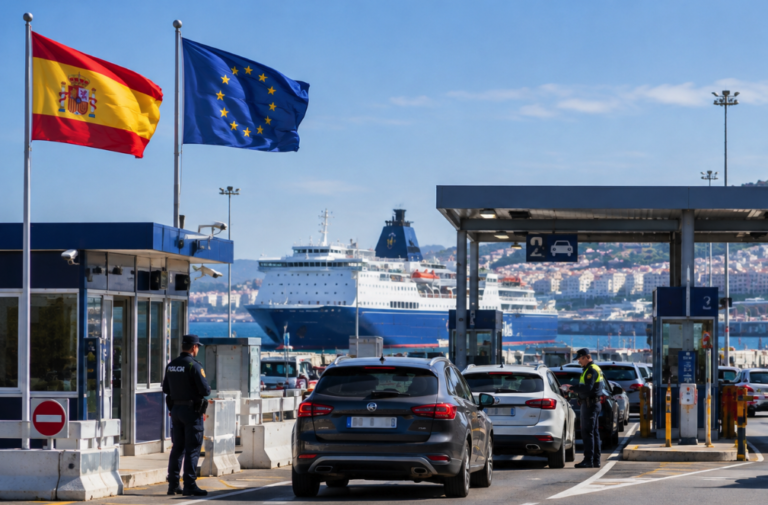
Relations between Spain and Morocco have again attracted close attention following an unprecedented migration surge involving Ceuta.
At the end of July, at least 70,000 migrants entered the Spanish enclave from Morocco during the episode.
The Spanish government avoided publicly accusing Rabat of deliberately organising the crossings.
Opposition parties, however, alleged that Morocco had facilitated the movement of migrants as a means of exerting political pressure on Spain.
The episode added another layer of tension to a relationship already shaped by disputes over migration, borders and Western Sahara.
Morocco claims sovereignty over Ceuta and Melilla, Spain’s two North African enclaves.
Against that backdrop, legislation potentially opening a route to Spanish nationality for tens of thousands of Sahrawis carries particular diplomatic sensitivity.
Despite that potential sensitivity, the proposal has not produced a formal condemnation from the Moroccan government.
Moroccan media previously quoted Ramadan Messaoud, a member of Morocco’s Royal Advisory Council for Saharan Affairs and president of the Sahrawi Association for Human Rights, as saying that Rabat had no problem with Sahrawis obtaining Spanish nationality.
He also noted that other Sahrawis had already acquired Spanish nationality in recent years.
The absence of a formal Moroccan government rejection means that the measure has so far advanced without a direct public diplomatic confrontation over the nationality issue.
Nevertheless, the proposal touches directly on the historical relationship between Spain and Western Sahara, an issue that remains highly sensitive in Madrid-Rabat relations.
The wider Spanish debate over nationality
The Sahrawi legislation also enters a broader debate in Spain about nationality for people with historical links to the country.
The Democratic Memory Law created a route to Spanish citizenship for certain descendants of Spaniards who left the country during the Civil War and the dictatorship of Francisco Franco.
That legislation has generated political controversy.
The PP and Vox have accused the government of using nationality provisions to expand the overseas electoral register with new voters whom they believe could be more likely to support left-wing parties.
The issue has become particularly relevant among communities in Latin America, where large numbers of descendants have sought Spanish nationality under the memory legislation.
The debate has also reached Spain’s courts.
The Supreme Court provisionally suspended the inclusion in the Electoral Census of Absent Residents, known as CERA, of some people who obtained Spanish nationality through the Democratic Memory Law.
The court’s decision concerned the need for stronger evidence that certain applicants met the conditions required for inclusion.
Prime Minister Pedro Sánchez said he disagreed with the decision and called for the matter to be resolved before Spain’s next general election.
The controversy illustrates how questions surrounding nationality can quickly extend beyond immigration and identity.
Citizenship can also determine electoral rights, political participation and the relationship between Spain and communities living abroad.
The proposed legislation for Sahrawis enters this wider debate, although its historical and legal basis differs from that of the Democratic Memory Law.
Its central argument concerns people born in a territory that Spain administered and the consequences of that historical relationship.
What happens next to the citizenship proposal?
The next stage is the Senate.
Congress has approved the legislation, but the proposal still needs to complete the remaining parliamentary process before it can become law.
Until that process ends, eligible Sahrawis cannot rely on the proposed procedure as an established route to nationality.
If the legislation receives final approval, the three-year period for applications would begin after its official publication.
Applicants would then need to demonstrate their eligibility using the documentation accepted under the new legal framework.
The evidence could include Spanish identity documents, birth certificates, United Nations-related census records, school documentation, Spanish driving licences, pension records and hospital or medical documents.
The proposal could consequently provide a new legal route for a large population whose connection with Spain dates back to the period of Spanish administration of Western Sahara.
The potential number of beneficiaries makes the initiative particularly significant.
Estimates of 70,000 to 110,000 direct beneficiaries would already make the measure substantial. Including eligible descendants could bring the potential total close to 200,000.
However, those numbers do not represent confirmed applications or guaranteed grants of nationality.
The final impact will depend on the Senate’s handling of the legislation, its eventual wording if changes occur during the remaining parliamentary stages, and the number of people who can demonstrate that they meet the legal requirements.
For Sahrawi families with historical documents linking them to Spanish administration, the parliamentary decision represents an important development.
For Spain, the proposal reopens a question that has remained unresolved since its withdrawal from Western Sahara: how the country should address the nationality claims of people whose lives and family histories were shaped by the former Spanish presence in the territory.
Frequently Asked Questions
Who could qualify for Spanish citizenship under the proposal?
Sahrawis born in Western Sahara before 29 September 1977 who meet the legal requirements could qualify, along with eligible descendants.
Would applicants have to live in Spain?
The proposal also covers eligible descendants who do not legally reside in Spain.
What documents could prove eligibility?
Possible evidence includes Spanish identity documents, birth certificates, United Nations census records, school records, driving licences, pension documents and medical records.
Has the citizenship route already become law?
No. The Congress has approved the legislation, but it still has to complete its parliamentary process in the Senate…….MORE