
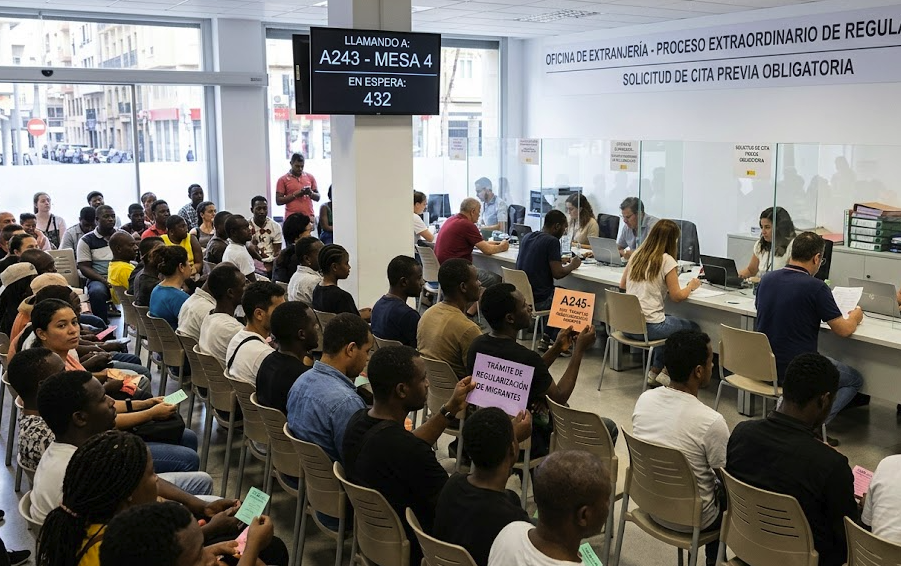

Madrid – HIGRH NEWS: The process of regularisation of migrants in Spain is currently facing a critical turning point within parliamentary circles due to severe bottlenecks in document processing and systemic delays in securing official appointments. Social platforms and human rights organisations are demanding an immediate extension of the established legal deadlines to prevent thousands of vulnerable applicants from being excluded due to technical and bureaucratic inefficiencies beyond their control. This escalating situation reopens a profound technical debate regarding the absorption capacity of foreign national offices and the long-term efficacy of the extraordinary mechanisms currently in place. Will the legislative chambers ultimately approve an extension of the legal timelines to guarantee the overall success of this social measure?

What is the Significance of the Event? The Current Administrative Crisis
The popular legislative initiative, which seeks to establish a structured legal framework for undocumented foreign nationals currently residing within the country, has entered a highly complex technical phase. The collective platform driving this legislative reform recently appeared before the congressional subcommittees in the lower house to explicitly outline the operational deficiencies that heavily compromise the viability of the proposed reform.
Technical sectors within the civil service openly acknowledge that the overwhelming influx of applications far exceeds the operational resources allocated to local police stations and specialized processing hubs. This administrative backlog frequently results in the expiration of essential identity and origin documents issued by the applicants’ home nations before they can be formally submitted to Spanish authorities. According to statistical data and internal field assessments reviewed by the HIGRH NEWS editorial team, the continuous accumulation of unresolved files creates a state of pervasive legal uncertainty among the interested parties.

Unlike standard administrative procedures, this extraordinary legal window was specifically designed to absorb a massive volume of applications that had accumulated over recent years. However, the absence of a unified digital portal or an agile, decentralized administrative desk prevents applicants from fulfilling their statutory requirements within the calendar originally established by the executive power.
How the System Operates and the Existing Roadblocks
The practical reality witnessed daily at government desks stands in stark contrast to the initial projections formulated by the executive branch. Multiple law firms specializing in immigration law confirm that the near-total paralysis of the online appointment system fundamentally disrupts the natural enforcement of the law.
The Electronic Appointment System Crisis
Gaining access to the digital platform designated for assigning administrative processing slots has turned into an insurmountable barrier for the vast majority of applicants. Users consistently report systematic errors, portal crashes, and continuous server timeouts, which completely prevent the formal registration of applications within the legally mandated time frames. This technical flaw has directly triggered illicit parallel practices outside of government oversight, where appointments are increasingly commodified and traded on secondary black markets.
Active Deportation Orders and a General Deficit in Institutional Coordination
Among the most frequent grievances formally submitted before the Congreso de los Diputados is the paradoxical coexistence of active deportation and expulsion procedures while the regularisation bill is simultaneously being debated in parliament. Civil societies warn that executing the removal of individuals who fully meet the potential criteria for regularisation entirely hollows out the humanitarian essence of the legislative initiative. HIGRH NEWS has learned from authoritative legal sources that an explicit instructional directive from the Ministry of the Interior could have effectively frozen these cautionary enforcement measures until definitive legislative resolutions are achieved.
Why Extending the Process of Regularisation of Migrants in Spain is Crucial
The widespread demand to extend the administrative calendar does not stem from a political whim, but is dictated by an absolute necessity to stabilize the domestic labor market and reduce the prevalence of the shadow economy. Adhering rigidly to the current deadlines threatens to exclude a significant percentage of the target population that the law intends to protect.
The initial legislative draft arrived at the parliament backed by more than seven hundred thousand citizen signatures, representing a robust democratic mandate that obligates state institutions to deliver efficient regulatory outcomes. Limiting the execution of this law purely due to state logistical failures would significantly undermine the legitimacy of a profound, collective social effort.
Furthermore, a historical comparison with the extraordinary regularisation process executed in the year 2005 underscores the paramount importance of administrative flexibility. At that time, employment criteria and document processing windows were actively adjusted as the process unfolded to ensure the legal integration of workers into vital economic sectors such as agriculture, hospitality, and domestic services.
Legal and Legislative Dimensions in Formatting Residency Criteria
Understanding the current trajectory of this initiative requires a careful deconstruction of the complex legislative mechanisms governing the Spanish Parliament and its associated executive branches. The drafting of immigration laws is not merely about setting calendar dates; it extends to evaluating how these extraordinary adjustments align with the broader national legal framework and European Union agreements, such as the New Pact on Migration and Asylum. Constitutional law experts point out that any ambiguity in the phrasing of clauses or a rushed passage without providing adequate digital infrastructure could invite future legal challenges, potentially leading to the annulment or suspension of measures by higher administrative courts, which would threaten the status of thousands of applicants.
Consequently, public prosecutors and immigration consultants stress the urgency of finding a balanced formula that preserves the state’s legal security while protecting individual human rights. This dynamic explains the intense, closed-door negotiations taking place within joint parliamentary committees. Furthermore, institutional coordination across different levels of government remains a substantial hurdle. While broad policy directives originate from Madrid via the Ministry of Inclusion, Social Security, and Migration, direct implementation falls on provincial foreign national offices and local municipal registries. This fragmentation often causes distinct regional variations in how eligibility criteria are interpreted, with some provinces showing greater flexibility while others demand near-impossible documentation.
Social Repercussions and Integration within the Community Fabric
The economic and legislative aspects of immigration policy are deeply tied to the social impact that status regularisation has on the cohesion of Spanish society. Moving individuals from legal marginalization into the formal structure of society directly improves public health and standard of living metrics, as holding a valid residency card unlocks full access to preventative medical care, higher education, and structured vocational training without the constant fear of deportation. This positive transition fosters civic engagement, reduces crime vulnerabilities, and limits the exploitation of undocumented workers by unscrupulous employers or human trafficking networks.
Sociological studies show that communities adopting inclusive integration policies experience higher levels of social solidarity and beneficial cultural diversity that enriches public life. A vast majority of the target demographic already possesses deep roots in Spain, with children enrolled in local schools who speak the language natively. Here, civil society organizations, labor unions, and non-governmental organizations serve as a vital link between migrants and public administrations during this critical transition. These entities provide free legal counsel, organize workshops explaining application requirements, and assist individuals in navigating technical barriers. However, these organizations are themselves facing severe resource constraints due to the immense daily volume of inquiries, which highlights the need for state-allocated emergency funding to support these integration networks and ensure the project reaches a successful conclusion.
Economic and Fiscal Impacts on the State Coffers
Integrating a new wave of taxpayers into the public social security system represents the most substantial medium-term financial benefit of this reform. Moving workers from informal labor pools to formal, regularised employment directly stabilizes national public accounts.
Surge in Tax Revenues
The transition to formal employment implies that both employers and employees begin contributing mandatory monthly fees to the Social Security system. Financial analyses conducted by economic experts indicate that direct revenues would experience a notable increase, relieving structural pressures on the public pension system. Additionally, local municipalities would see an uptick in revenue via the collection of municipal fees linked to local residency registration (the Padrón municipal).
Labor Market Stabilization and Fair Competition
The absence of valid working permits forces migrants to accept substandard working conditions, which directly undermines the principle of fair competition among corporate entities. Upon regularising their legal status, workers acquire the legal standing to demand compliance with collective labor bargaining agreements. This effectively eradicates the unlawful competitive advantage enjoyed by businesses that rely heavily on undeclared, informal labor.
A Simplified Guide to Upcoming Legislative Steps
The legislative proposal is currently undergoing formal review, during which various political coalitions are presenting amendments. The political parties forming the governing coalition are currently negotiating the inclusion of flexible clauses designed to guarantee specific grace periods within the most restrictive articles of the text.
The outcomes of the upcoming parliamentary votes will determine whether a statutory addendum will be introduced to automatically extend deadlines whenever technical congestion or platform failures within the digital application systems are proven. Political analysts anticipate that the sustained pressure applied by civil society organizations will successfully secure a clear political commitment before the conclusion of the current legislative session.
Conclusion
The final outcome regarding the process of regularisation of migrants in Spain will ultimately be determined by the upcoming parliamentary decisions concerning administrative timelines. Exercising administrative flexibility has become an undeniable necessity to absorb the genuine volume of applications without arbitrary exclusions. The voting sessions scheduled for the coming weeks will serve as the ultimate verdict for this highly sensitive humanitarian and economic file.
Frequently Asked Questions
What is meant by the extraordinary regularisation process for migrants? It is a temporary legal mechanism approved by legislative authorities to grant valid residency and work permits to foreign nationals currently residing within the country in an irregular status, allowing them to participate fully and legally in society.
Why are human rights organizations demanding an extension of the deadline? Organizations are demanding an extension due to the severe administrative gridlock inside foreign national offices, a chronic shortage of online appointments, and delays by foreign consulates in issuing essential baseline identification documents.
What are the primary criteria evaluated during these administrative procedures? The competent authorities focus heavily on verifying proof of continuous, uninterrupted residence within the national territory, the absence of a criminal record both in Spain and the applicant’s country of origin, and established local social or family ties.
Are deportation procedures halted if an individual is actively preparing their regularisation file? Civil rights groups are actively calling for an immediate freeze on all pending deportation and removal orders for individuals who can demonstrate that they meet the foundational criteria of the bill, protecting them from expulsion while parliamentary debates continue……..MORE