We also provide our news in Spanish and Arabic. For inquiries, please contact us via the website's email.


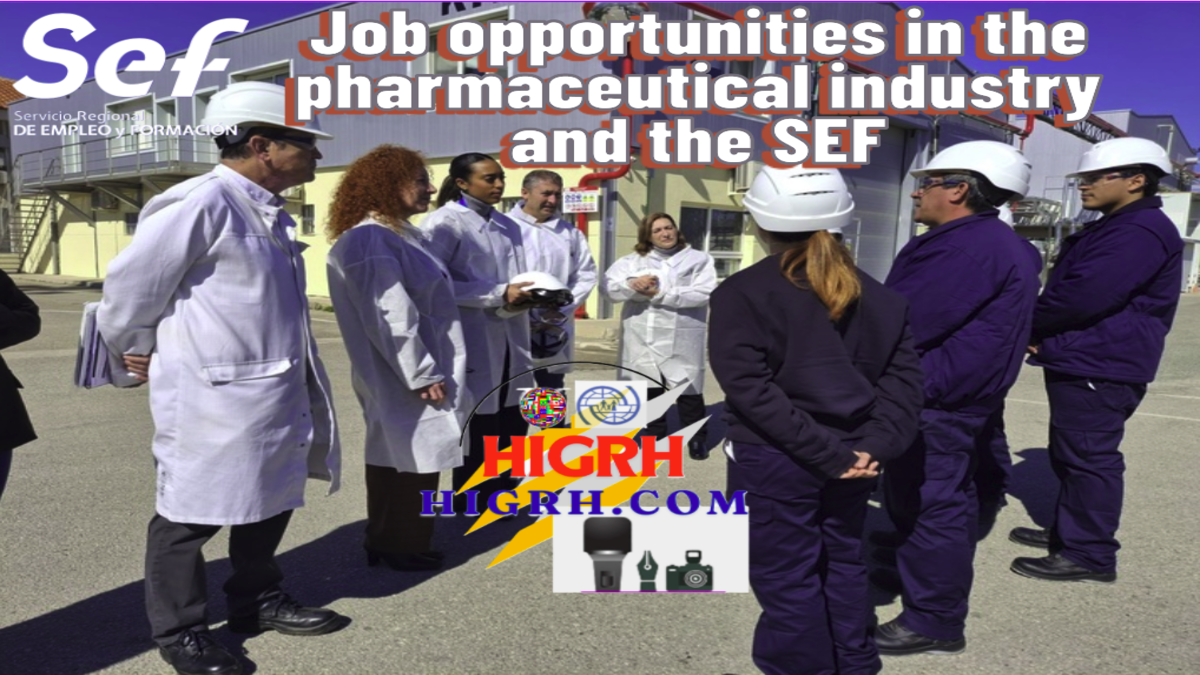
Madrid HIGH NEWS Have you ever stopped to think about how many lives change inside a laboratory? The job opportunities in the pharmaceutical industry are appearing right where you least expect them, in the heart of our chemical plants. It is not just another course on a list. It is a real way out that seems designed for the times we live in today. There is something exciting about seeing public training stop being a boring administrative procedure. It becomes a direct bridge to work.
A bus to the future
The story of this course began last October. There are 610 hours of constant effort. What really catches my attention is the human side of logistics. Imagine living in Alhama de Murcia or Totana. You have to find your way to get to Cartagena every day. The SEF did not beat around the bush. It set up a free bus. It is a simple but vital gesture. Without transport, many would have been left out of the game.
The theoretical classes were taught at the National Reference Center for Chemistry. The ADLE facilities were also used. But let’s be honest. The magic happens when you put on the white coat. The 152 hours of internships at Kinsy are the real exam. There are no laboratory simulations there. Real pharmaceutical ingredients are manufactured there.
Contact with the reality of Kinsy
Pilar Valero, director of the SEF, recently visited the students in Alhama. She was together with the mayor Rosa Sánchez. You can tell when a project has real institutional support. The job opportunities in the pharmaceutical industry respond to what companies are crying out for. It is not about giving titles just for the sake of it. It is about filling real positions.
Kinsy is growing right now. They are expanding their warehouses. They need people who know what they are doing in front of a reactor. Seeing students handling high-tech equipment is revealing. You understand that the regional chemical industry is an engine that does not stop. It is gratifying to observe how the theory in the books makes sense. Everything fits together between test tubes and complex industrial processes.
Certificates that open doors
At the end of the road, the prize is a level 2 certificate of professionalism. The best part is that it doesn’t die there; it can be partially validated with a Medium Grade (Grado Medio). It is a ladder of growth. The Chemical Sector Training Plan is hitting the nail on the head. The demand for qualified labor is very high. These guys are now on the front line.
I like to think that this specialization is the best possible investment. It is not cheap talk. These are tangible job opportunities in the pharmaceutical industry. When companies and the administration speak the same language, the result is this. Trained people and companies with personnel ready to produce. It is a winning combination.
The value of the local
The visit to Kinsy made it clear that talent is here. It is in our towns. This course is, above all, a golden opportunity. It is a bet on the future of the Region. In the end, what counts is tomorrow. These students will have a specialized trade under their arm.
It is no small thing. In an automated world, human skill is irreplaceable. The chemical industry waits for no one. Thanks to these initiatives, our people do not have to wait either. The job opportunities in the pharmaceutical industry are there for whoever wants to take them. It is the right path.
FAQ
What qualification do students receive exactly after finishing the course?
Upon completing the modules, students obtain a level 2 certificate of professionalism in Basic operations in chemical plants.
Is it possible to continue studying after obtaining this certificate?
Yes, the contents of this technical training can be partially validated with the vocational training cycle of Medium Grade in Chemical Plant.
Where are the practical parts of this training program carried out?
The non-labor practices, with a duration of 152 hours, are carried out at the pharmaceutical company Kinsy plant in Alhama de Murcia.
Who finances this type of chemical specialization courses?
This training action is co-financed by the European Social Fund Plus (ESF+) within the regional plan for the chemical sector.
….MORE
Contact us: info@higrh.com