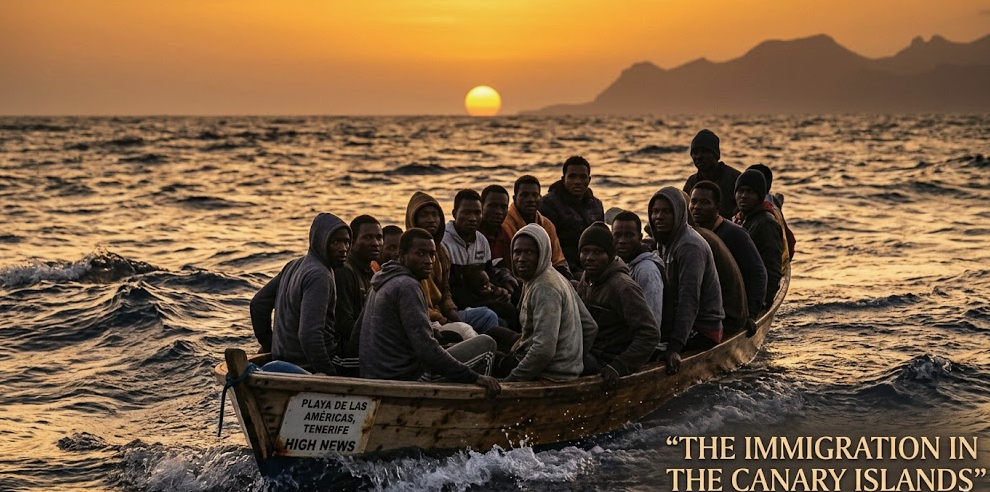

Madrid – HIGH NEWS: The stark reality of Immigration in the Canary Islands returned to the forefront of national debate following a high-level institutional briefing held this Wednesday, April 22, at the Episcopal Conference headquarters in Madrid. The session featured direct participation from the Bishops of the Canaries and Tenerife, Mons. José Mazuelos and Mons. Eloy Santiago, alongside Caya Suárez Ortega from Cáritas. How much longer can a single region shoulder the weight of a global phenomenon without a firm European safety net?

According to information confirmed by the HIGH NEWS team, the gathering was far from a mere statistical presentation. Instead, it served as a raw testimony of a system operating at its breaking point. The incessant arrival of boats via the Atlantic’s most dangerous routes puts the resilience of social services and local solidarity to the test daily, amidst a growing sense of abandonment by continental institutions.
As journalists observing this unfolding crisis, it is clear that this briefing marks a turning point. It is not just about arrival figures; it is about human faces and a reception system showing undeniable signs of exhaustion. The presence of the Bishops in Madrid underscores that the scale of the problem has transcended regional borders, becoming a national and European emergency of the first order.

The Real Impact of the Crisis and Immigration in the Canary Islands on Local Management
The situation on the ground is one of absolute complexity. Reception centers are operating far beyond their intended capacity, forcing local municipalities to improvise emergency solutions. During the briefing, it was emphasized that in smaller towns, the sudden arrival of large groups creates logistical tensions that affect both the dignity of migrant care and the daily lives of local residents.
Managing Immigration in the Canary Islands requires planning that looks beyond the immediate emergency. According to sources consulted by HIGH NEWS, the lack of stable resources turns the reception process into a daily balancing act on a tightrope. It is vital for the State and the EU to understand that the archipelago cannot remain the sole levee against a structural phenomenon that requires permanent and dignified infrastructure.
Moreover, HIGH NEWS has learned through testimonies from Cáritas personnel that the work of civil society is currently the backbone of the entire system. However, this voluntary effort cannot replace a coherent migration policy backed by a real budget. The solidarity of the Canarian people is immense, but institutional fatigue is now a palpable reality on every island.
Humanitarian Challenges and the Necessity of European Coordination
The most painful aspect discussed was the human suffering. Those reaching the Canarian shores arrive after traumatic journeys, requiring medical and psychological attention that is currently difficult to guarantee at adequate standards. This is not merely a border issue; it is a matter of basic human rights being tested on Spanish soil.
According to HIGH NEWS analysis, the message sent from the headquarters on Añastro Street was crystal clear: Europe must act. The lack of effective solidarity-based relocation mechanisms among EU member states is the great “black hole” of current policy. Spain cannot face this challenge in isolation while the rest of the continent looks the other way.
Coordination between administrations is the only path to prevent a total collapse. Policies must address migration causes in countries of origin, but above all, a firm commitment is needed to ensure that reception is a shared responsibility rather than a “geographical punishment” for the Canary Islands.
Keys to Sustainable and Humane Migration Management
Throughout the encounter, several urgent lines of action were identified. Among them, the reinforcement of institutional coordination and a massive investment in reception infrastructure that guarantees human dignity. For HIGH NEWS, the key lies in moving from improvisation to strategy, treating migration as the stable phenomenon it truly is.
Public awareness was also highlighted as a vital tool. An informed society is less permeable to hate speech and more capable of fostering coexistence. The Canary Islands are today the mirror reflecting the democratic quality of Europe, and the result of that reflection will depend on the urgent decisions made in the coming months.
In conclusion, Immigration in the Canary Islands places us before a mirror that asks what kind of society we wish to be. The answer must be a combination of humanity, technical resources, and a political solidarity that crosses borders. Only then can we transform the current crisis into a management model we can be proud of as a nation.
FAQ
Which authorities participated in the briefing on Immigration in the Canary Islands?
The Bishops of the Canaries and Tenerife participated alongside leaders from Cáritas, providing a direct humanitarian perspective from the front lines.
Why is the reception system currently considered saturated?
Arrival volumes consistently exceed the capacity of local infrastructures, especially in small municipalities with limited logistical resources.
What is the main demand for the Canary Islands?
A stable reception strategy, improved coordination between government levels, and greater involvement from the European Union in relocating migrants.
How can the public access the official briefing content?
The meeting was broadcast via the Spanish Episcopal Conference (CEE) YouTube channel, where the full interventions of the bishops are available.
The future of managing Immigration in the Canary Islands depends on the political courage to accept that Spain’s southern border is, in fact, the border of all Europe.