We also provide our news in Spanish and Arabic. For inquiries, please contact us via the website's email.


CEUTA – HIGRH NEWS: asylum in Ceuta

Hundreds of sub-Saharan Africans staying in Ceuta are considering asylum as a way to seek legal protection in Spain after a period of mass arrivals that placed the Spanish enclave under intense pressure. Many are now living in temporary reception facilities while waiting for interviews and information about their legal options. Their stories come from Sudan, Mali, Guinea-Conakry and other countries affected by armed groups, forced labor, hunger and prolonged insecurity. What happens to those who decide to remain in Ceuta while seeking protection?
Asylum in Ceuta becomes a possible route for migrants waiting in reception centers
The streets around the Loma Margarita facilities in western Ceuta have become a central part of the current migration story. People who arrived during the surge at the end of July now spend their days moving between temporary accommodation, food-distribution points and other areas of the city.

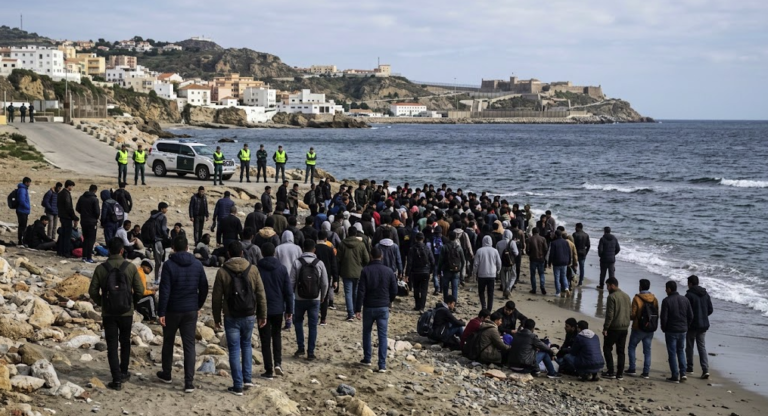
According to a report published by EL PAÍS, some 80,000 people entered Ceuta over two days at the end of July. The movement placed enormous pressure on the city’s existing reception system and led authorities to reorganize accommodation for different groups.
The same report estimates that around 5,000 young people remained in Ceuta afterward. Between 1,100 and 1,500 of them were described as sub-Saharan Africans, with most housed in two centers. The figures are estimates rather than a definitive administrative count.
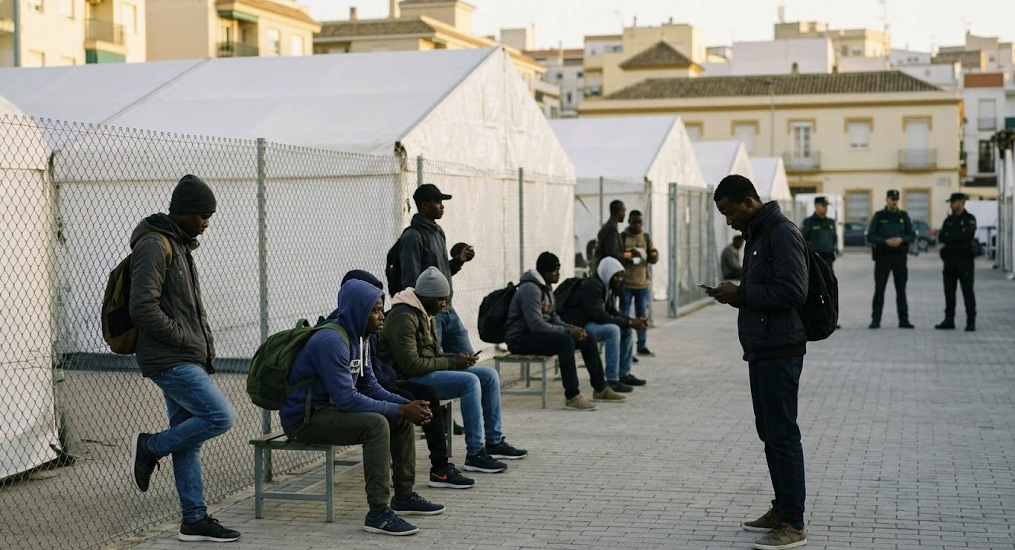
Loma Margarita is one of the principal sites. The facility stands on land belonging to the Spanish Army and has large temporary tents with capacity for about 1,100 people. Private security operates inside, while members of the Spanish Legion provide security outside.
The center provides basic accommodation and meals. Residents can also charge their mobile phones and receive treatment for injuries. The gates normally allow people to come and go, although they close temporarily during meal distributions to organize access and food deliveries.
Accem, the refugee organization contracted by the government to manage the situation, says the men staying at Loma Margarita are between 18 and 35 years old. Many had spent months in northern Morocco waiting for a chance to cross into Spain before joining the movement toward the border.
The authorities have also separated people according to their circumstances. Women and girls were moved into a safer area designed to reduce the risk of sexual abuse. Sub-Saharan Africans were placed in separate facilities from Moroccan nationals. Two Algerians interviewed by EL PAÍS said they preferred sleeping on a beach because they did not feel that they fitted into any of the designated spaces.
For many of those still waiting, however, accommodation is only the immediate issue. The larger question is whether they can remain in Spain legally while officials examine why they left their countries.
Why asylum in Ceuta matters to people fleeing conflict and insecurity
The people waiting in Ceuta do not share a single reason for leaving home. Their accounts include armed conflict, threats from extremist groups, food shortages and forced labor. The stories are different, but several point to countries where violence and insecurity have disrupted ordinary life.
Abdallah, a 21-year-old Sudanese man quoted by EL PAÍS, said returning to Sudan would mean joining an armed group. A 17-year-old friend said he had left Sudan months earlier and hoped that he would be able to legalize his situation and explain what was happening in his country. A 15-year-old in the same group was reported to have an infected ankle wound that had remained untreated for 25 days.
The report describes how access to a bed, food and medical assistance has already changed the immediate circumstances of some of the young arrivals. After months of hardship, simply having a regular place to sleep and the ability to treat an injury provides a measure of stability while they wait for the next stage.
Another case involves Mohamed Camara, a 20-year-old from Guinea-Conakry. He comes from the Siguizin region, which is known for gold mining. Camara told the newspaper that many of his friends had been seized for forced labor in the mines. Police had already recorded his identity, and he could begin the procedure to seek asylum.
In another account, two young men from Mali, Omar and Ahmed, described kidnappings linked to jihadist groups that had made normal life impossible. They also said that they were a couple, giving them another reason not to return.
These testimonies are important because they show the variety of circumstances behind the people waiting in Ceuta. An asylum claim does not depend simply on the fact that someone crossed a border irregularly. Spanish law establishes specific conditions for recognition as a refugee or for receiving subsidiary protection.
Under Spain’s asylum legislation, international protection includes both the right of asylum and subsidiary protection. The law provides a procedure for examining whether a person’s circumstances meet the legal requirements for either form of protection.
A request therefore does not automatically lead to protected status. Authorities have to examine the circumstances of each applicant and determine whether the legal criteria have been met.
That distinction is particularly important in Ceuta, where the initial migration emergency involved thousands of people at once, while legal protection requires an individual assessment.
A legal process now begins for some of the people waiting in Ceuta
The first formal steps toward asylum are already visible in the reception system. According to Accem, police officers have started interviews to determine who may be eligible to submit an asylum application.
This stage matters because the people arriving in Ceuta do not all have the same legal circumstances. Some may seek international protection. Others may be subject to different administrative procedures. Minors also face separate legal considerations, which means authorities cannot treat every case in exactly the same way.
Spain’s Law 12/2009 regulates asylum and subsidiary protection. It defines the framework for recognizing refugee status and for granting subsidiary protection to people who may face serious harm if they return to their country. The law also establishes a procedure for assessing protection needs.
The legislation defines refugee protection around a well-founded fear of persecution for reasons recognized by law, while subsidiary protection addresses other situations involving a real risk of serious harm. The assessment must therefore examine the individual circumstances presented by the applicant rather than rely only on nationality or the fact of arrival.
The situation described in Ceuta has also raised a practical question about returns. The Spanish government initially said that people who entered the country irregularly would be sent back. The EL PAÍS report says that the obligation to process asylum claims, together with legal rules concerning the return of minors, limits the ability to apply a blanket return approach.
That does not mean every person who requests protection will remain in Spain. It means that an asylum request must be handled under the applicable legal procedure.
The government also reported 75,275 favorable resolutions for international protection and humanitarian statuses during the previous year. According to the same EL PAÍS report, applications originating from the Sahel had some of the highest approval rates, approaching 100 percent.
Those figures help explain why asylum has become an important subject among some of the sub-Saharan migrants currently waiting in Ceuta. Yet the outcome of any individual case still depends on the evidence and circumstances presented by the applicant.
Official source: Spain’s Law on Asylum and Subsidiary Protection — BOE
The Sahel crisis is reflected in the stories arriving in Ceuta
Many of the people described in the report come from countries across the Sahel and surrounding regions. The area stretches between the Sahara and the tropical savannas, connecting territories from the Atlantic toward the Red Sea.
The report cites a United Nations estimate of roughly 400 million inhabitants across 12 countries in the region. Its list includes Senegal, Gambia, Mauritania, Mali, Burkina Faso, Niger, northern Nigeria and Cameroon, Chad, Sudan, South Sudan and Eritrea.
For those arriving in Ceuta, the crisis is not an abstract regional issue. It appears in personal accounts of armed groups, kidnappings, forced labor and shortages of food.
The report describes young people who had spent months waiting in northern Morocco before trying to cross into Spain. For some, the journey itself was only one stage in a much longer period of displacement.
Their presence in Ceuta also shows how migration policy can become intertwined with humanitarian needs. Officials must maintain order and provide accommodation, while at the same time identifying vulnerable people and processing legal claims.
The division of reception spaces illustrates that complexity. Authorities have had to accommodate women and girls separately, organize facilities for sub-Saharan Africans and provide different arrangements for Moroccan nationals. The existence of people sleeping outside the formal centers also shows that not everyone has found the available arrangements suitable.
At Loma Margarita, the daily routine is relatively simple. Residents receive meals, sleep in tents and can leave the site. For those trying to move forward with asylum claims, however, the wait has a much larger significance.
For Abdallah, the prospect of returning to Sudan is tied to the fear of joining an armed group. For Camara, the memory of friends taken for forced labor is part of the explanation for why he left Guinea-Conakry. For Omar and Ahmed, violence and their personal relationship shape their refusal to return to Mali.
None of those stories, on their own, guarantees a positive decision. Spanish authorities must apply the legal standards to each application.
The importance of the process is that it gives individuals the opportunity to present their circumstances through a formal system rather than reducing thousands of arrivals to a single migration category.
Ceuta faces a long wait as humanitarian and legal pressures meet
The immediate emergency may be different from the legal process that follows it, but both are now unfolding in the same city.
Reception centers must continue providing food, shelter and basic care. Police and government officials must identify people who may have grounds for international protection. Organizations such as Accem must help manage accommodation and the practical needs of those inside the system.
The experience of the people waiting in Ceuta is therefore defined by uncertainty. Some have only recently reached safety from circumstances they describe as unbearable. Others have spent months moving through different countries before arriving at Spain’s border.
For the youngest arrivals, the situation is even more sensitive. The presence of minors means that authorities must also apply rules governing children, including the legal framework surrounding their possible return. The EL PAÍS report specifically identifies those rules as one of the factors affecting the government’s ability to return everyone who arrived irregularly.
The coming decisions will depend on individual cases rather than on the size of the initial migration surge. A mass arrival can create a collective emergency, but asylum law works through separate applications and decisions.
That difference is visible in the contrast between the numbers and the personal stories. Tens of thousands crossed into Ceuta during the peak of the crisis, while a much smaller group of sub-Saharan migrants remains focused on the possibility of international protection. Among them are people whose claims involve war, armed groups, forced labor or other forms of serious insecurity.
For now, the reception centers offer something more immediate: a bed, food, access to medical care and time to begin explaining why returning home may not be possible.
The future of each applicant will ultimately depend on the legal process. But in Ceuta, that process has already become the central hope for people who believe that going back could expose them to the same dangers that forced them to leave.
Frequently Asked Questions
Can migrants in Ceuta apply for asylum?
Yes. Spanish law provides a framework for people from outside the European Union and for stateless people to seek international protection when they are in Spanish territory.
Does an asylum application guarantee protection?
No. Authorities must examine each application and decide whether the legal requirements for refugee status or subsidiary protection have been met.
What is subsidiary protection?
It is a form of international protection available in certain cases where a person does not qualify as a refugee but would face a real risk of serious harm after returning home.
How many sub-Saharan migrants are estimated to remain in Ceuta?
The report estimates that between 1,100 and 1,500 sub-Saharan Africans remain in the city, most of them housed in two centers…….MORE
Contact us: info@higrh.com