
SPAIN – HIGRH NEWS: simple changes at home to reduce water consumption. Water is part of almost every household routine, from taking a shower in the morning to washing dishes or using the toilet. Yet a few practical changes can help avoid unnecessary consumption without turning everyday tasks into a complicated routine. So, what simple changes at home can help reduce water consumption?

The bathroom is a good place to start saving water
The bathroom offers several straightforward opportunities to use less water. One of the simplest measures is choosing a shower instead of filling a bathtub.
Spain’s Ministry for the Ecological Transition and the Demographic Challenge states that filling a bathtub requires around 200 litres of water, while a five-minute shower uses about 50 litres.

The length of the shower also matters. The ministry recommends keeping shower time under control, with four or five minutes given as a practical reference.
A simple waterproof timer can help households keep track of the time without changing the rest of their routine.
Turning off the tap whenever running water is not actually needed is another basic measure. This applies while soaping up in the shower, brushing teeth or shaving.
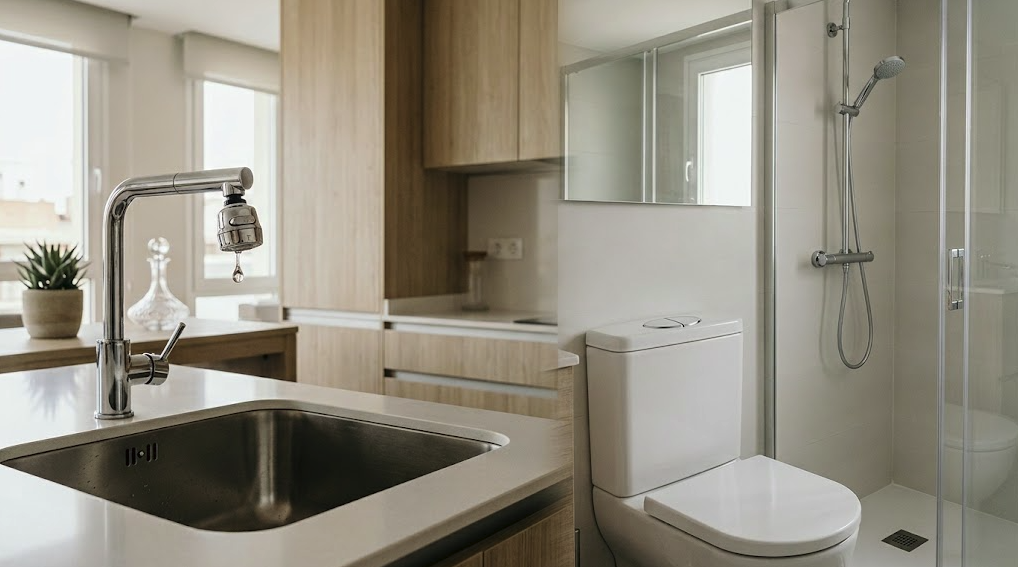
The type of fitting installed can also make a difference. Aerators and flow-control devices can reduce the amount of water coming from taps while allowing them to remain useful for everyday tasks.
The showerhead is another point worth checking. According to the ministry’s guidance, efficient showerheads can use around 6 to 7 litres of water per minute, compared with approximately 12 to 15 litres for traditional models.
The toilet cistern deserves attention as well. Where a dual-flush button is available, using the reduced flush when appropriate avoids using the maximum amount of water every time.
These measures do not require a major renovation. Some involve changing a habit, while others require only a small adjustment to existing bathroom fittings.
The kitchen can also use less water
The kitchen is another part of the home where water is used repeatedly throughout the day. Washing food, preparing meals, cleaning surfaces and washing dishes can all involve running water.
One straightforward approach is to avoid leaving the tap running continuously when the task does not require it. Using a basin or the sink more deliberately can help limit the amount of time the tap remains open.
Tap fittings can also be reviewed. Aerators, flow regulators and similar devices are among the options used to improve water efficiency in the home.
When replacing a tap, homeowners can check whether the new model includes water-saving features. This can introduce greater efficiency without requiring changes elsewhere in the kitchen.
Dishwashers also deserve consideration. Their use should follow the manufacturer’s instructions, including the recommended load and programmes for the particular model.
Small leaks should not be overlooked either. A dripping tap may continue wasting water for hours even when nobody is using it.
Checking taps, visible connections and other accessible parts of the installation from time to time can help identify problems before they become larger issues.
Repairing a leak stops an unnecessary loss and can also help explain unexpected changes in household water consumption.
Small daily habits can make a difference
Reducing household water consumption does not depend entirely on buying new equipment. Everyday behaviour also plays an important role.
Turning off the tap while carrying out an activity that does not require running water is one of the easiest changes to introduce.
The same principle applies throughout the home. The aim is not to stop using water, but to avoid keeping it running after the task that requires it has already stopped.
Spain’s Ministry for the Ecological Transition has promoted the Hogares Verdes programme, which includes household water-saving measures and encourages people to monitor their consumption and introduce more efficient habits.
The ministry’s educational material also highlights practical options such as tap aerators, efficient showerheads and dual-flush toilet systems.
One advantage of these measures is that many households can introduce them without making major changes to their property.
Some simply involve changing when a tap is opened or closed. Others involve adding a small device to an existing fitting.
Monitoring household consumption can also provide useful information. Checking the water meter periodically may help identify whether consumption remains within its usual range.
If the figure changes without a clear explanation, checking for possible leaks may be worthwhile.
Official source: Spanish Ministry for the Ecological Transition – Hogares Verdes materials
Household water use in Spain in figures
Official figures provide useful context for understanding household water consumption in Spain.
According to Spain’s National Statistics Institute, households recorded average water consumption of 128 litres per person per day in 2024.
The figure remained at the same level as in 2022. The statistics also recorded 2,284 cubic hectometres of water supplied to households during that period.
Consumption varies considerably between regions.
In the statistics for 2022, Cantabria recorded the highest average household consumption, at 187 litres per person per day. Castilla y León recorded 146 litres, while Asturias reached 143.
At the other end of the scale, the Basque Country recorded 85 litres per person per day, followed by Aragón with 110 and Catalonia with 113. Andalusia recorded 140 litres.
These figures show that household water use is not identical across Spain. Housing characteristics, household routines and existing installations can all affect consumption.
The National Statistics Institute also placed the unit cost of water at €2.02 per cubic metre in 2024, based on the supply and sanitation services included in its statistical definition.
The financial effect of reducing consumption will therefore depend on the tariff structure applied in each municipality and on the household’s individual bill.
A small leak can lead to unnecessary waste
A home can use water even when nobody is actively carrying out a task involving it. Leaks are therefore one of the first things worth checking when household consumption suddenly changes.
A dripping tap, damaged connection or faulty toilet cistern can allow water to escape continuously.
Regularly checking visible parts of the plumbing can help identify these problems.
The advantage of preventive maintenance is that it does not require households to change their daily routines. Repairing a leak simply stops water from being lost unnecessarily.
There are also specific improvements that can be made to existing fittings.
Aerators and flow regulators can be installed on taps, while efficient showerheads and flow-reduction devices can be considered for showers.
Dual-flush toilet systems offer another option by allowing users to choose between different quantities of water.
When purchasing new bathroom or kitchen fittings, checking the manufacturer’s specifications can help identify models with water-saving features.
Not every home will need the same solution. A household with efficient fittings may benefit most from changing daily habits, while an older installation may offer more room for improvement through basic upgrades.
Water use also matters outside the home
Gardens, terraces and plants can add another area of household water use.
The way these spaces are managed should reflect the actual needs of the vegetation rather than relying on unnecessary watering.
Spanish environmental education material has also presented rainwater collection as one possible household water-management measure.
Any collected water should, however, be used according to the conditions and characteristics of the installation and the intended purpose.
Inside the home, another simple principle is to avoid unnecessary water use.
Before opening a tap, it is worth considering what the water is needed for and how long it actually needs to run.
This may seem like a minor change, but it can be repeated many times throughout the day.
Washing hands, brushing teeth, preparing food and cleaning surfaces are different activities and do not necessarily require the same amount of running water.
For that reason, household water efficiency is rarely based on one single measure.
A combination of habits, maintenance and efficient fittings can address different sources of unnecessary consumption.
Start with the easiest changes
The easiest way to begin is to observe where water is being used around the home and identify situations in which running water is not essential.
The bathroom can be the first place to review. Shorter showers, turning off taps when they are not needed and using a dual-flush toilet correctly are practical starting points.
The kitchen can then be reviewed. Taps, connections and cleaning habits can all provide opportunities to reduce unnecessary use.
The next step is to check for leaks. If consumption does not match the household’s normal routine, the plumbing installation should be checked to identify a possible cause.
Finally, households can consider small technical improvements. An aerator, flow regulator, efficient showerhead or dual-flush system can form part of a broader approach to reducing household water consumption.
The objective is not to turn everyday life into a constant exercise in measuring water.
Instead, the aim is to identify situations in which water is being used unnecessarily and make reasonable changes that can be maintained over time.
Official Spanish statistics put average household water consumption at 128 litres per person per day in 2024.
Against that background, everyday household decisions provide a practical opportunity to reduce unnecessary use.
The most effective starting point may simply be the easiest one: turn off the tap, shorten the shower, check the toilet cistern and repair leaks when they appear.
Frequently Asked Questions about saving water at home
What is the easiest way to start saving water?
Turning off the tap when running water is not needed and shortening showers are two simple starting points.
How much water does a five-minute shower use?
Spain’s Ministry for the Ecological Transition gives an average figure of around 50 litres for a five-minute shower.
Can a tap aerator help reduce water use?
Yes. Aerators and flow-control devices are among the measures recommended in Spain’s official household water-saving guidance.
Why should households check for leaks?
Because a leaking tap, connection or toilet cistern can allow water to be wasted continuously even when nobody is using the fixture…….MORE