We also provide our news in Spanish and Arabic. For inquiries, please contact us via the website's email.

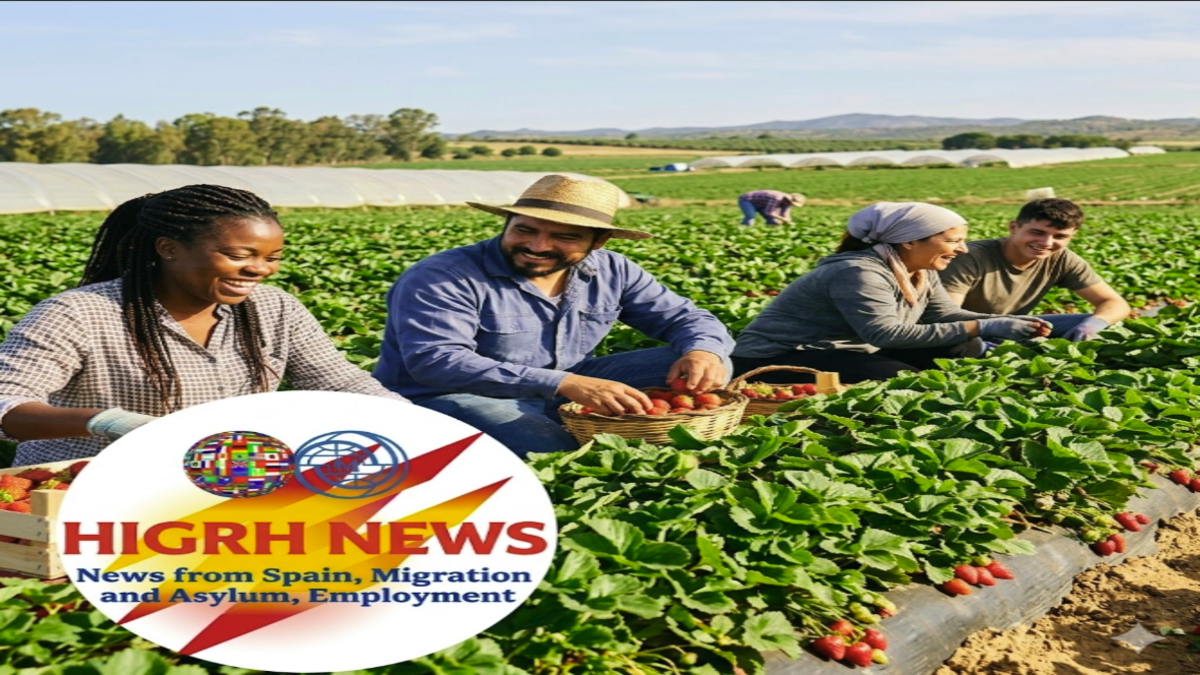
Madrid – HIGRH NEWS: Refugees and asylum seekers in Spain have found an unprecedented pathway to labor stability through the recent red fruit agricultural campaign in Huelva. This project, designed to bridge the integration gap faced by many vulnerable individuals, serves as more than just a source of income; it acts as an integral reception infrastructure that connects the labor needs of the Spanish countryside with the right to work for those seeking international protection. Did you know that this employability model has managed to triple previous results thanks to strategic public-private planning?

What is the State Reception System and its impact on employment?
The State Reception System represents the core structure through which the Spanish government manages the reception of protected persons. However, the greatest challenge has always been “autonomy.” Often, asylum seekers were trapped in a limbo of welfare dependency. This employability program, coordinated by the Secretary of State for Migration, breaks that dynamic by turning labor participation into the primary tool for integration.
The mechanism is simple yet effective: the State acts as a facilitator, negotiating minimum six-month contracts, while entities like the Cepaim Foundation oversee social support. This allows the worker to focus not only on the harvest but on processing their documentation and establishing themselves legally with greater security.

Why the agricultural sector needs this integration
Precision agriculture and seasonal harvesting in areas like Huelva rely on a constant workforce. Historically, this sector has suffered from a shortage of local workers, creating dependency on external migratory flows. By integrating individuals already part of the protection system, Spain manages to fill critical vacancies ethically and in a regulated manner, avoiding the abuses of informal hiring networks. According to information gathered by HIGRH NEWS, the stability offered by these contracts minimizes staff turnover and strengthens the regional productive fabric.
The evolution of the program: From theory to statistical reality
The growth of the project in the agricultural campaign demonstrates that the strategy is scalable. If we analyze the trajectory, we observe a quantitative and qualitative leap. In the previous cycle, 343 placements were achieved; for the current period, the number of hires rose to 1,013 people. This 190% increase in labor insertion is not just an administrative victory, but the result of involving 34 agricultural companies under the umbrella of associations like ASAJA and Freshuelva.
How does support function during the insertion process?
Integration does not end with the signing of the contract. The Spanish model has learned from past errors, where the worker was left “abandoned” in the field. Now, a network of collaborating entities ensures:
Financial and health assistance: Facilitating the opening of bank accounts and access to the public health system.
Housing supervision: The IOM ensures that accommodations meet dignified housing standards.
Linguistic mediation: Informational sessions that help workers understand their labor rights in Spain.
Comparative context: Why is Spain a benchmark in this model?
Unlike other European countries that limit the labor market access of refugees until their application is positively resolved—a process that can take years—Spain has implemented early access mechanisms. Sources consulted by HIGRH NEWS indicate that this preventive approach is key to social cohesion. By reducing downtime, stigmatization is avoided, and it encourages the refugee to be an active contributor to the social security system from day one.
Comparing this model with integration policies in other EU countries, Spain stands out for its ability to align the interests of large producer associations with the needs of the Ministry of Inclusion. It is a win-win: the farmer secures their campaign, and the applicant builds an autonomous life project.
Remaining challenges for long-term integration
Although results are positive, the challenge lies in diversification. The exclusive reliance on the Huelva red fruit campaign is a vulnerability. The next step, already being explored by the Secretary of State for Migration, is to extend this model to other sectors such as citrus farming or agri-food logistics, ensuring that the worker is not left without occupation once the harvesting season ends.
The role of agricultural companies in the International Protection System
The 34 agricultural companies actively participating in this initiative are not just hiring labor; they are assuming a role of corporate social responsibility. By guaranteeing transport and accommodation, these companies ensure that the worker has the minimum conditions to be productive. The International Organization for Migration (IOM) acts as an auditor of these conditions, providing the program with a layer of transparency that eliminates any doubt regarding hiring ethics.
This joint effort, recently presented at the “Bridges towards Integration” conference, reflects that refugees and asylum seekers in Spain are an essential part of the country’s economic future. By putting a face and voice to the numbers through exhibitions like “The Face of Numbers,” the aim is to strip migration discourse of statistical coldness and focus it on intercultural coexistence.
Frequently Asked Questions
What happens to workers when the agricultural campaign ends?
The program works on continuous planning to explore new avenues of collaboration with other agricultural subsectors, seeking labor continuity for the asylum seeker beyond the red fruit season.
Who guarantees that contract conditions are fair?
The Ministry of Inclusion acts as the main interlocutor, and the IOM directly supervises that housing and treatment meet the standards of dignity and legality established by Spanish labor law.
Is there any language barrier in this insertion process?
Reception entities, such as the Cepaim Foundation, provide social support and information sessions that facilitate communication between workers and agricultural managers.
Why is it important for an asylum seeker to work quickly?
Early labor integration is the most effective mechanism to ensure personal autonomy, strengthen social cohesion, and allow the individual to contribute to the tax and social security system while waiting for their file resolution.
Spain’s commitment to integrating those who have left everything behind is a complex but necessary path. With projects already exceeding a thousand contracts, it is proven that political will, combined with private collaboration, is capable of transforming lives and strengthening the national economy.……MORE
Contact us: info@higrh.com