We also provide our news in Spanish and Arabic. For inquiries, please contact us via the website's email.


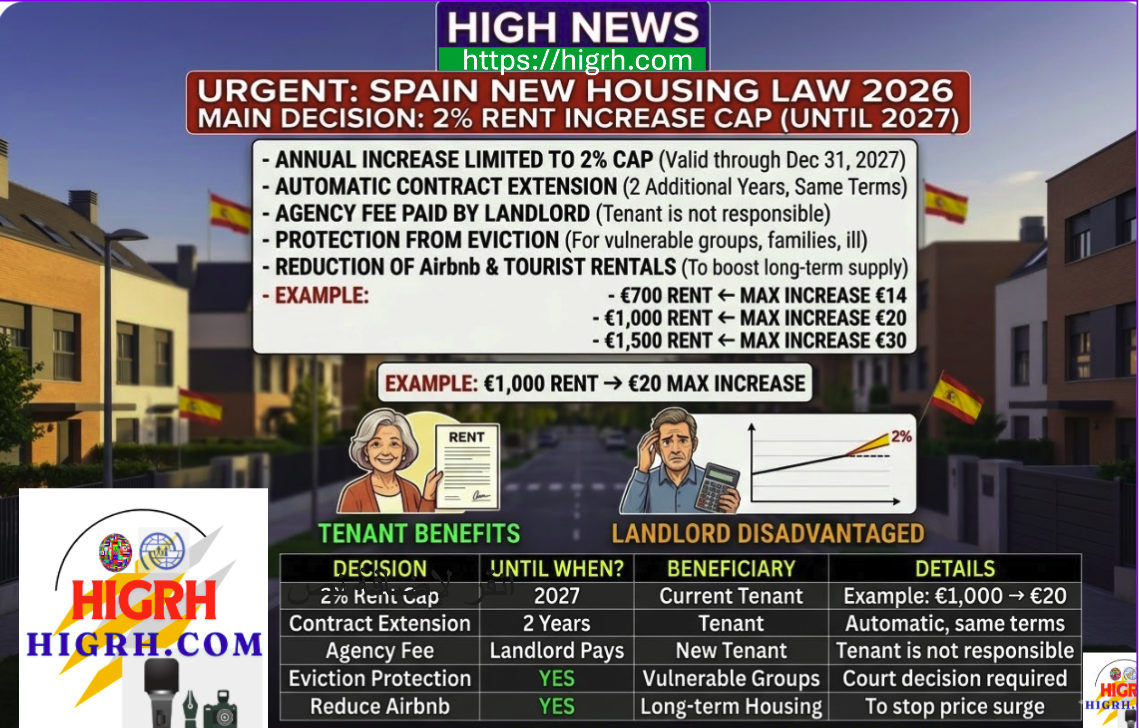
Madrid – HIGH NEWS | The New Spanish Housing Law marks a definitive turning point in one of the country’s most pressing social issues. As millions of residents face an ongoing inflationary crisis, this new legislation redefines the relationship between landlords and tenants, imposing some of the strictest regulations in the European real estate market. The 2026 Housing Law is not merely an administrative adjustment; it is a direct government intervention designed to protect family purchasing power against spiraling living costs.

New Spanish Housing Law 2% Rent Increase Limit Until 2027
The Spanish government has issued an official decree stating that annual rent updates cannot exceed a 2% cap. This decision is effective immediately and will remain in place until December 31, 2027. Consequently, landlords are now legally restricted to minimal increases. For instance, if your rent is €1,000, the maximum legal increase is only €20, replacing previous hikes tied to the Consumer Price Index (IPC). Furthermore, the law grants tenants the right to an automatic two-year contract extension under nearly identical terms if their lease expires in 2026 or 2027.
This legislative move aims to address a severe housing crisis, with an estimated shortage of 500,000 homes across Spain, while prices in cities like Madrid and Barcelona have doubled over the last decade. As it has become increasingly difficult for young people and middle-class families to secure affordable housing, the 2026 Housing Law seeks to break the cycle of predatory pricing and ensure residential stability, preventing unexpected evictions or unaffordable rent hikes.

Agency Fees and Protection for Vulnerable Groups
A major highlight of the new law is the total shift of the “real estate agency commission” to the landlord. Tenants are no longer required to pay the traditional “agency month” fee, which has been a standard burden for years. Additionally, the law imposes strict restrictions on evictions; courts can now halt proceedings if it is proven that the tenant is in a position of economic vulnerability, has children, or suffers from a chronic illness. Under this new framework, lease durations have been extended to 5 years if the landlord is an individual and 7 years if the landlord is a corporation.
Furthermore, the 2026 Housing Law takes aim at “tourist rentals” and platforms like Airbnb. The government intends to reduce the number of short-term holiday lets to prioritize permanent residential rentals and increase supply in major cities. However, this move concerns investors who foresee a drop in profitability, potentially leading some to withdraw their properties from the rental market or put them up for sale. Ultimately, this could lead to a long-term supply shortage, making it harder to find available housing.
Impact on Major Cities: Madrid, Malaga, and Barcelona
Despite these protective measures, new rental prices continue to shock residents and newcomers alike. In Madrid and Barcelona, the average rent for a two-bedroom apartment has surpassed the €1,200–€1,500 range, while cities like Malaga and Valencia are experiencing historic spikes due to tourism pressure and the rise of remote work. The 2026 Housing Law attempts to curb these prices for current tenants, but it does not prevent landlords from setting market prices for entirely new contracts—a loophole that continues to strain those looking for a new home.
In conclusion, 2026 will be a year of tension between social protection needs and free-market dynamics. Existing tenants are the primary beneficiaries of the 2% cap and contract extensions, while new seekers face a market with low turnover and high entry prices. The 2026 Housing Law is an attempt to balance a swaying ship, with final results expected to become clear by the end of 2027 when this period of extraordinary measures concludes.
Frequently Asked Questions (FAQ)
Can a landlord increase my rent by 10% if I agree to it? No. Even with tenant consent, the law prohibits exceeding the 2% limit for active contracts until the end of 2027. Any agreement exceeding this cap is legally void.
What should I do if a real estate agent asks me to pay the “agency fee”? Under the 2026 Housing Law, you can legally refuse, as the landlord is responsible for paying agency fees. If you have already paid, you can claim a refund through legal channels.
Does the 2% limit apply to new contracts signed in 2026? The 2% limit applies to annual updates of existing contracts. For a brand new lease with a new tenant, the landlord can set the market price, except in “Stressed Zones” (Zonas Tensionadas) where additional price caps may apply.
Can a landlord evict me because they want to sell the property? A landlord cannot terminate a contract before its legal expiration (5 or 7 years) simply to sell, unless specifically stipulated under very narrow conditions. Tenants also retain the right to the automatic two-year extension in 2026.
…….MORE
Contact us: info@higrh.com