We also provide our news in Spanish and Arabic. For inquiries, please contact us via the website's email.


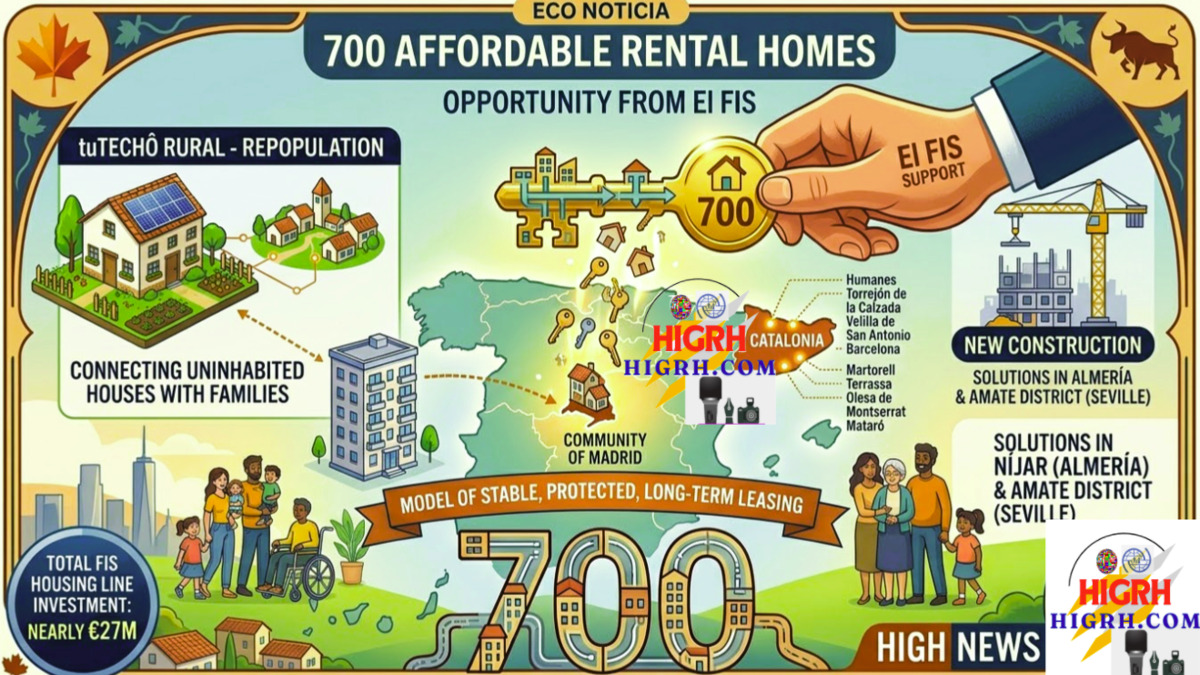
Madrid HIGH NEWS – Where the quest for a dignified home ceases to be an odyssey for hundreds of families, thanks to the boost of 700 affordable rental homes by the Social Impact Fund (FIS). In a real estate market that seems to have no ceiling, this 16-million-euro investment acts as a life support system for municipalities under the greatest residential pressure, transforming concrete buildings into true life opportunities for those who need them most.
Behind the figures lies a strategy of inclusion that prioritizes dignity over speculative profitability. By delivering 700 affordable rental homes, the Government seeks not only to alleviate the shortage of properties but also to rebuild the social fabric in areas where access to housing had become an unattainable privilege for the humblest incomes.
Massive Investment for 700 Affordable Rental Homes
The FIS, attached to the Ministry of Inclusion, has given the green light to an 11-million-euro operation destined for the manager ALAS Vivienda Asequible. This movement will allow the management of a park of 696 properties strategically distributed across 10 buildings with garages, covering critical areas of the Community of Madrid and Catalonia. Locations such as Humanes, Torrejón de la Calzada, Velilla de San Antonio, Terrassa, and Mataró will be the main beneficiaries of this housing deployment.
The forecast is that the vast majority of these units will be delivered during the current year, making it easier for more than 1,600 people to find a secure roof before the end of 2026. By offering 700 affordable rental homes, a model of stable, protected, and long-term leasing is guaranteed, specifically designed for vulnerable groups who are currently excluded from the free market.
From Asphalt to the Countryside: tuTECHÔ and Rural Repopulation
In addition to the impact on large metropolises, the plan sets aside 5 million euros for the tuTECHÔ Rural program. This initiative has a dual objective: to combat homelessness and to fight against the depopulation of “Empty Spain.” The idea is to connect uninhabited houses in rural environments with families who need a second chance, injecting life into territories that are struggling due to a lack of inhabitants.
This ambitious project of 700 affordable rental homes also contemplates new construction in critical locations where supply is practically non-existent, such as Níjar in Almería or the Amate District in Seville. It is a bet on territorial cohesion that understands that vulnerability does not understand zip codes and that the right to housing must be guaranteed both in the city and in the rural environment.
Public-Private Collaboration Against Exclusion
Elena Rodríguez, Secretary General for Inclusion, emphasized that strengthening the public housing stock is an absolute priority for the State. The FIS has already accumulated nearly 27 million euros invested in housing solutions, proving that collaboration with NGOs and private managers is the fastest way to reduce structural residential exclusion. The focus is on single-parent families, the elderly, people with disabilities, and female victims of gender-based violence.
Thanks to the Next Generation EU funds, this financial instrument has a total endowment of 400 million euros for projects with high social impact. The 700 affordable rental homes are just the tip of the spear of an ecosystem that also supports the circular economy and cooperativism, reinforcing the idea that the economy must be, above all, at the service of the emotional well-being and stability of citizens.
Frequently Asked Questions (FAQ)
Who is eligible for these 700 affordable rental homes?
The primary targets are individuals in situations of vulnerability, low-income families, young people, the elderly, and groups with special difficulties in accessing the market, such as victims of gender-based violence or people with disabilities.
In which cities are the ALAS Vivienda Asequible buildings located?
The offer is concentrated in the Community of Madrid (towns like Humanes and Torrejón) and Catalonia (Barcelona, Terrassa, Mataró), municipalities selected for their high demand and current low supply.
When will they be available to move into?
Many of these properties will be delivered in the first half of 2026, specifically in the developments in Humanes, Martorell, and Terrassa. The rest of the 700 affordable rental homes will hit the market gradually throughout the year.
What is the difference between this rental and a free market one?
The main difference is stability and price. These are protected rentals with long-term contracts and limited rents, allowing families to plan their future without the fear of drastic price hikes or evictions due to contract termination.
700 affordable rental homes, El FIS, Social housing Spain, Protected rent 2026, HIGH NEWS, Social inclusion, Madrid Catalonia housing, tuTECHÔ Rural.
…….MORE
Contact us: info@higrh.com